A GEO implementation guide for marketing teams that need measurable evidence
How to turn AI for SEO from scattered prompt checks into a repeatable evidence, content, and measurement practice.
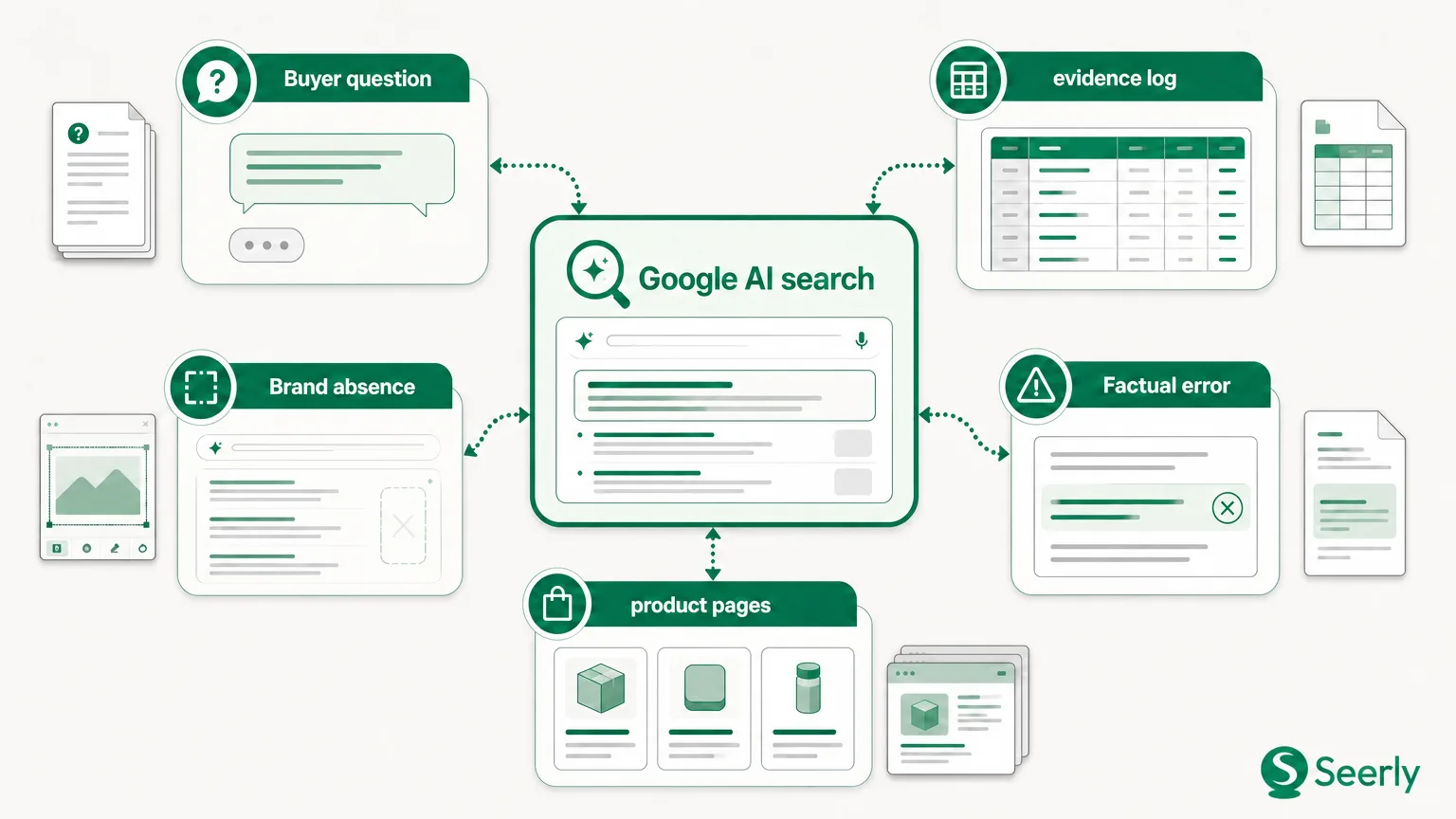
A familiar scene: someone on the team asks an AI assistant for “the best [your category] platform,” sees three competitors named, and forwards a screenshot to the content team. The urgency is understandable. The screenshot is not a strategy.
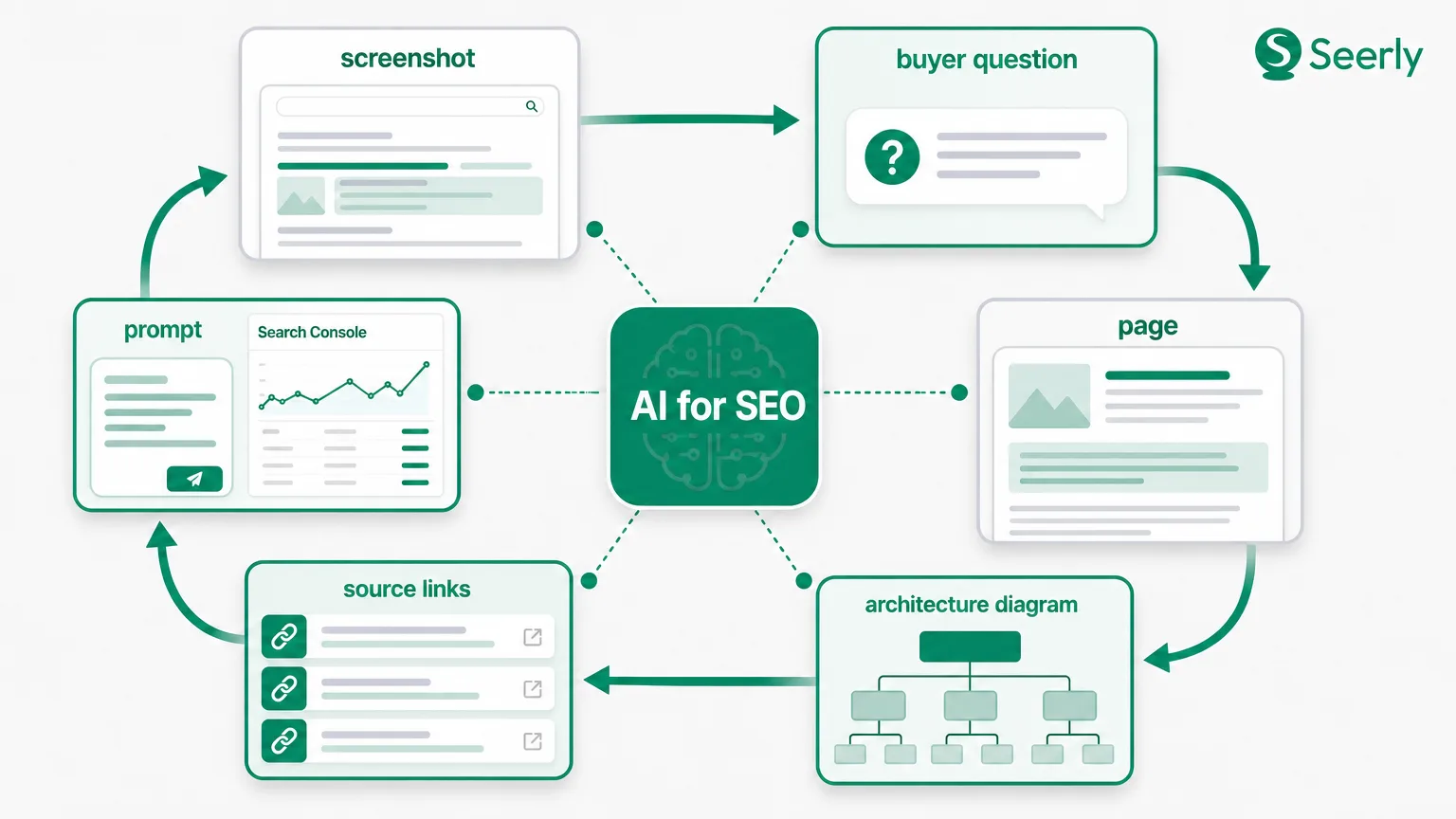
AI for SEO works when a team treats that moment as a research signal, then traces it back to the buyer question, the page AI systems might use, the evidence on that page, and the result after a change. Otherwise, work quickly turns into prompt theatre: a few encouraging outputs, a few disappointing ones, and no reliable way to tell what improved.
The traffic stakes are real, even if the measurement is still immature. Pew Research Center found that users were less likely to click traditional search-result links when an AI summary appeared. At the same time, Adobe reported that generative AI referrals to US retail sites rose 1,200% year over year. Neither figure proves that every brand needs a separate AI-search program. They do make passive observation a poor plan.
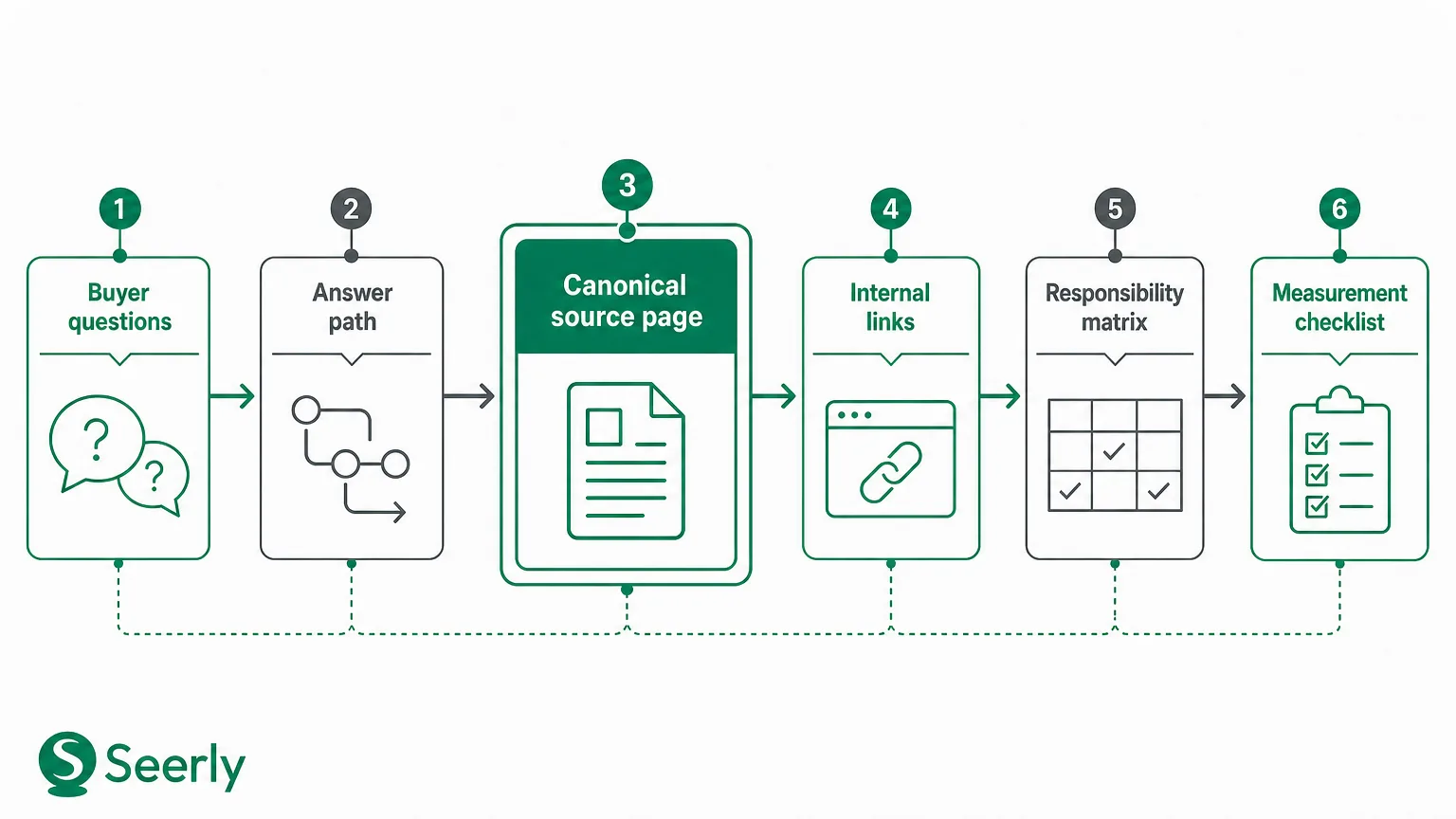
The work is less mysterious than the hype suggests. Pick commercially meaningful questions. Improve the pages that should answer them. Make claims easy to check. Test repeatedly, then record what changed. That’s the operating rhythm.
What problem should AI for SEO solve for a marketing team?
Publishing AI-generated copy and improving a website for AI discovery are different jobs. The first asks, “How can we write more?” The second asks, “Can a system find, verify, and accurately repeat what we already know?” One creates volume. The other builds a body of evidence.
Generative engine optimisation (GEO) is the practice of improving the clarity, evidence, and structure of web content so generative search experiences can retrieve and accurately describe a brand when answering buyer questions.
Google’s own guidance makes the distinction plain: there are no special technical requirements for appearing in AI features. Pages still need to be indexed, eligible for Search, and genuinely useful. A clever prompt does not fix a vague product page, a buried pricing explanation, or an unsupported claim.
I’ve found that teams get better results when they define the program’s problem narrowly. A good starting problem might be: “Prospects researching payroll software in the UK can find competitor recommendations, but our product’s compliance evidence rarely appears.” That statement gives the work boundaries. It also stops a team from editing random pages because an AI response felt unflattering on a Tuesday.
There’s another reality check. AI answers vary with location, query wording, user context, model updates, and the sources available at the moment of retrieval. Treat a single answer as an observation, not a verdict. Prompt performance tracking needs repeated tests and a dated record, much like any other volatile channel.
The practical unit of work
A useful GEO work item has four parts:
- A buyer question that reflects a real decision or concern, such as “Which HR platforms support UK payroll compliance?”
- A page to improve, chosen because it should credibly answer that question.
- An evidence standard, spelling out what proof the page needs before it makes a claim.
- A validation plan, including prompts, markets, review dates, and measures to inspect after publication.
That unit is small enough to assign and large enough to measure. More importantly, it turns AI for SEO into a content quality practice, rather than a hunt for a ranking guarantee nobody can honestly make.
Which buyer questions belong in the first GEO test set?
Start with 15 to 25 questions, not 200. A small set forces useful arguments about what buyers actually need and lets the team inspect each result properly. If every question feels important, the set is too big.
Look for questions where commercial relevance and information gaps overlap. A pricing question may be close to conversion, while a category-definition question might shape a buyer’s shortlist weeks earlier. Both can matter. But a question with no meaningful audience, no brand gap, and no clear supporting page belongs in a backlog.
Use a simple scoring sheet. Give each question one to five points for commercial relevance, recurring demand, competitor presence, reputational risk, and current brand absence. The arithmetic is not sacred. The discussion behind each score is where the useful work happens.
Here are five good sources for candidate questions:
- Sales calls and demo notes often contain the phrasing buyers use before they trust marketing language. Pull recurring objections, comparisons, and “can you do X?” questions.
- Search Console queries and site-search data reveal language visitors already associate with your category. Look for clusters, not isolated long-tail terms.
- Competitor mentions in AI answers indicate questions where the market already has a visible set of alternatives. Record who appears and how they are described.
- Review sites and support tickets surface trust problems that glossy category pages often avoid. These questions can carry reputational risk.
- High-intent product pages expose gaps between what the page says and what a buyer wants confirmed before moving forward.
For every selected question, document the exact wording, target market, date tested, and expected evidence. “Best project management tool” is a sloppy record. “What project management software is best for 50-person UK agencies with client approvals?” is a usable test because it captures the decision context.
The way I see it, specificity protects teams from false wins. If a brand appears for a broad US query but never appears for the UK agency question its sales team cares about, the first result should not close the project. Different question. Different evidence burden.
Turn a buyer question into a source-backed page improvement
Suppose a B2B analytics platform keeps missing from answers to: “Which analytics tools support warehouse-native reporting for mid-market companies?” The marketing team has a feature page, a case study, and a handful of help-centre articles. Yet the feature page says only “powerful reporting,” which is the sort of claim that means almost nothing.
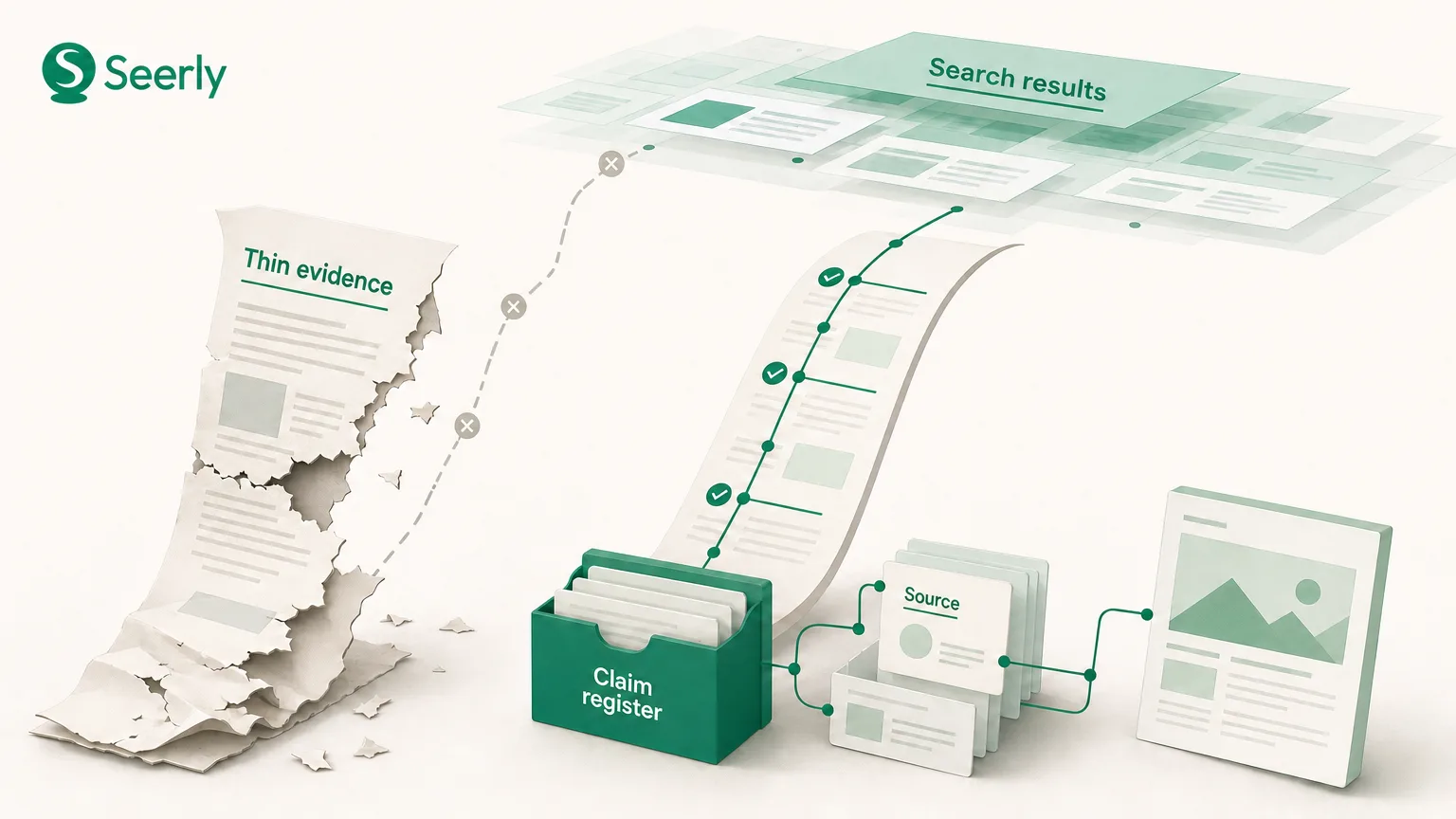
The page needs a claim-to-source map before anyone rewrites it. Writing first often produces a polished version of the same vagueness. Proof first is slower for an afternoon and faster for the next six months.
| Map field | Working example |
|---|---|
| Buyer question | Which analytics tools support warehouse-native reporting for mid-market companies? |
| Relevant page | Warehouse-native analytics feature page |
| Claim to support | Customers can query approved warehouse data without copying it into a separate reporting store |
| Primary evidence | Product documentation, architecture diagram, named customer implementation |
| Missing proof | Supported warehouses, refresh behaviour, access-control details |
| Responsible owner | Product marketing owns copy; solutions engineering validates technical wording |
| Validation method | Repeat prompt set, check source links and description accuracy after publishing |
Notice what the map refuses to do: it does not let marketing imply a feature based on a sales deck alone. If technical details are unclear, the missing proof becomes work for product or engineering. That can feel annoying. It is also the point.
Write claims at the level evidence can bear
A claim such as “works with every modern data stack” creates trouble because “every” invites scrutiny and “modern” says nothing. A more defensible sentence may name supported warehouses, explain the setup boundary, and link to current documentation. Specificity gives both people and retrieval systems something solid to work with.
Google warns that using generative AI to create many pages without adding value can violate its spam policies, while appropriate AI assistance can support useful content. That framing should influence review. AI can help turn approved source material into a draft. It cannot invent customer proof, settle technical ambiguity, or take responsibility for claims.
For pages that lost traction after a content expansion, start with evidence rather than publishing another wave of edits. Seerly’s guidance on recovering from scaled-content losses with stronger SEO evidence has a useful premise: improve what readers can verify before expanding the topic set.
What makes a page easier to verify and describe accurately?
A page does not need to read like documentation to be checkable. It does need to stop making the reader guess. Clear language is often a design choice: put the direct answer near the question, state boundaries, and route interested readers to supporting detail.
Start with definitions. If your company uses a category term differently from the rest of the market, say so. A page about “AI analytics” should define whether that means natural-language querying, forecasting, automated reporting, or something else. Otherwise the brand may appear in contexts it does not actually serve. Awkward.
Next, attach ownership to knowledge. Anonymous content can work for basic topics, but pages carrying product, medical, financial, or compliance claims need a visible accountable author or reviewer. Include a current date when facts can change. Then link to the documents, case studies, methodology, or product details that back the main claims.
A practical implementation check looks like this:
- Answer the page’s central question early. Do not make a buyer scroll past a generic company introduction to learn whether a feature exists.
- Use concrete claims with boundaries. Name supported regions, integrations, eligibility rules, or limits where they affect a purchasing decision.
- Keep company facts consistent. Product names, pricing logic, founding details, and service areas should not conflict across the site.
- Link outward with intent. A feature page can point to setup guidance or a case study, but the next click should deepen the proof rather than send readers on a scavenger hunt.
- Review the page after product changes. Stale evidence is worse than a modest claim because it creates avoidable mistrust.
Direct answers do not require bland copy. The strongest pages often carry a clear point of view, useful examples, and sharp language. They simply make the factual layer easy to locate. For a closer look at that balance, read Seerly’s piece on writing pages answer engines can quote without flattening brand voice.
How should teams validate AI for SEO changes?
One screenshot proves that one system produced one answer at one moment. Nothing more. Test results become useful when the team repeats a controlled set of prompts, records the output, and compares patterns before and after an update.
Create a prompt ledger for each buyer-question cluster. Keep the wording fixed during a review cycle. Record the platform, market or locale, test date, answer summary, brand mention, competitor mentions, linked sources, and whether the description was accurate. If a tester changes five words every time, the team cannot tell whether the page change or the prompt change caused the difference.
Run the same set on a schedule that matches your publishing pace. A monthly cycle works for many teams; a fortnightly check can make sense during a product launch. Changes in AI results can be noisy, so avoid declaring victory after the first positive answer. I personally prefer three or more review points before I label a pattern as promising.
Then pair prompt observations with site data. Watch organic entry pages connected to the question cluster, assisted conversions where available, new referral patterns, and branded search movement. Keep those measures separate from prompt output. Correlation may tell you where to investigate, but it does not prove the mechanism.
Here’s the part many teams skip: document competitor presence even when your brand appears. A mention next to three larger competitors may still be progress, but the wording matters. Are you described accurately? Are competitors backed by source pages you lack? The gap usually points to a content or evidence task, not a reason to rerun the same prompt ten more times.
For reporting discipline, Seerly’s framework for validating AI-assisted SEO gains over time is a sensible companion to prompt testing. Stable work needs a baseline, a dated change log, and enough patience to avoid mistaking a blip for a trend.
How agencies can report GEO work without promising rankings
Clients should never have to reverse-engineer what an agency did from a collage of AI screenshots. A useful monthly report separates completed work from observed outcomes and open questions. It makes uncertainty visible without making the work sound vague.
Start with completed actions. List pages updated, claims rewritten, sources added, technical fixes completed, and owners who approved the changes. Tie each item to a question cluster. “Updated the compliance page” is not enough. “Added UK certification evidence to the payroll compliance page for the ‘UK payroll software’ cluster” tells the client what changed and why.
Follow with evidence quality. Grade each priority page as supported, partly supported, or unsupported. Include a short explanation, such as “integration claim verified in current docs, but no customer example yet.” That section helps clients see why a page may need subject-matter input before more copywriting.
Then report observed representation, carefully. Include repeat-test coverage, instances where the brand appeared, wording accuracy, linked sources, and competitor presence. Avoid percentage claims unless the testing design supports them. Small prompt sets can swing wildly, and pretending otherwise burns trust fast.
End with unresolved gaps and next experiments. Maybe competitors get named because they publish integration matrices while the client has only a logo strip. Maybe inaccurate descriptions point to a category-definition problem. The next experiment should name the page, evidence needed, owner, and review date. Clean, boring, useful.
Frequently asked questions about AI for SEO
Does GEO replace traditional SEO?
No. GEO work depends on much of the same foundation: crawlable pages, useful content, clear site architecture, and credible evidence. Google states that the same SEO basics apply to AI features in Search. GEO adds a question-level way to inspect how brands are retrieved and described in generative answers.
How many prompts should a team test first?
Start with 15 to 25 tightly defined questions across two or three buyer clusters. That is enough to spot recurring evidence gaps without creating a reporting burden nobody maintains. Expand only after the team has a working review routine.
Can an agency promise inclusion in AI answers?
No. AI systems change, answers vary, and external sources affect retrieval. An agency can promise disciplined research, page improvements, documented testing, and transparent reporting. Those are services a client can inspect.
Should we create separate pages for every AI-search prompt?
Usually, no. First check whether an existing page can answer the question with clearer language and better proof. Create a new page when the question reflects a distinct buyer need that deserves its own evidence, examples, and internal links.
Start with one question cluster, then keep the record
Pick one buyer-question cluster this week. Build a claim-to-source map for the most relevant page, identify the proof you do not yet have, and assign an owner before drafting new copy. Then monitor the same questions over later review cycles, including citations, competitors, and post-change visibility.
That process may feel less glamorous than collecting screenshots. Good. It produces a record your team can learn from, defend, and improve. Learn more at Seerly.