How to recover from scaled content losses with stronger AI search evidence
A drop in organic performance after rapid content production is easy to misdiagnose. Teams often assume the problem is the number of pages published, then respond by rewriting everything, deleting entire folders, or banning AI-assisted workflows. Those actions can consume months of effort without addressing the actual weakness: pages that repeat broadly available information but contribute little evidence, experience, or decision-making value.
A stronger AI SEO recovery process starts with a different question: what can this page prove that competing pages cannot? This matters as search journeys become more fragmented. Google states that its AI search features do not require special technical markup or a separate optimisation strategy; the same foundations - helpful content, crawlability, and clear page experience - still apply to content appearing in AI experiences. At the same time, users are less likely to click traditional search results when an AI summary appears, increasing the value of content that earns visibility, citations, and trust before a visitor reaches the site.
Diagnose weak evidence before blaming page volume
Scaled production becomes risky when it creates many pages that answer similar questions using the same public sources, structure, and conclusions. The problem is not that a page was drafted with AI. The problem is that the finished page is interchangeable with dozens of alternatives and gives readers no reason to trust it over them.
Use these diagnostic questions when reviewing an affected cluster:
-
Could a competitor reproduce this page without access to our people, customers, product, or data? If yes, its differentiation is probably weak.
-
Does the page make claims that readers can inspect? Unsupported superlatives and unqualified “best” recommendations indicate low evidentiary value.
-
Does it resolve a real decision? A useful commercial page should help a visitor compare options, understand fit, or take a next step.
-
Does it have a clear source of authority? Every page should have an identifiable owner: a product team, subject-matter expert, research lead, or accountable editor.
-
Does its search intent overlap heavily with another URL? Similar pages split signals and often repeat the same thin evidence.
Prioritise pages with the highest business and evidence risk
Create a simple score from 1 to 5 for each factor below, then prioritise URLs with the highest total. This creates an auditable backlog rather than a subjective rewrite queue.
| Review factor | What to assess | Why it matters |
|---|---|---|
| Business value | Pipeline influence, product relevance, contract value, or strategic category importance | Protects pages closest to revenue and positioning |
| Organic decline | Change in clicks, impressions, rankings, and landing-page engagement | Identifies pages with observable performance risk |
| Conversion role | Whether the page supports demos, trials, product education, or high-intent comparisons | Connects recovery work to commercial outcomes |
| Duplicate intent | Similarity to other pages targeting the same question or keyword set | Reveals consolidation opportunities |
| Factual risk | Unverified claims, pricing, legal guidance, health or financial assertions, and outdated product details | Reduces trust and compliance exposure |
| Ownership clarity | Availability of an expert or team who can validate the content | Determines whether evidence can realistically be improved |
Add evidence that makes AI-assisted content useful
AI SEO optimization should improve the quality and consistency of research, drafting, and maintenance. It should not reduce the evidence threshold. Before approving a revised page, assess it against an evidence checklist that reflects the user’s decision and the page’s risk level.
Evidence checklist for priority pages
A strong page does not need every item below, but it should contain enough evidence to make its claims useful and inspectable.
-
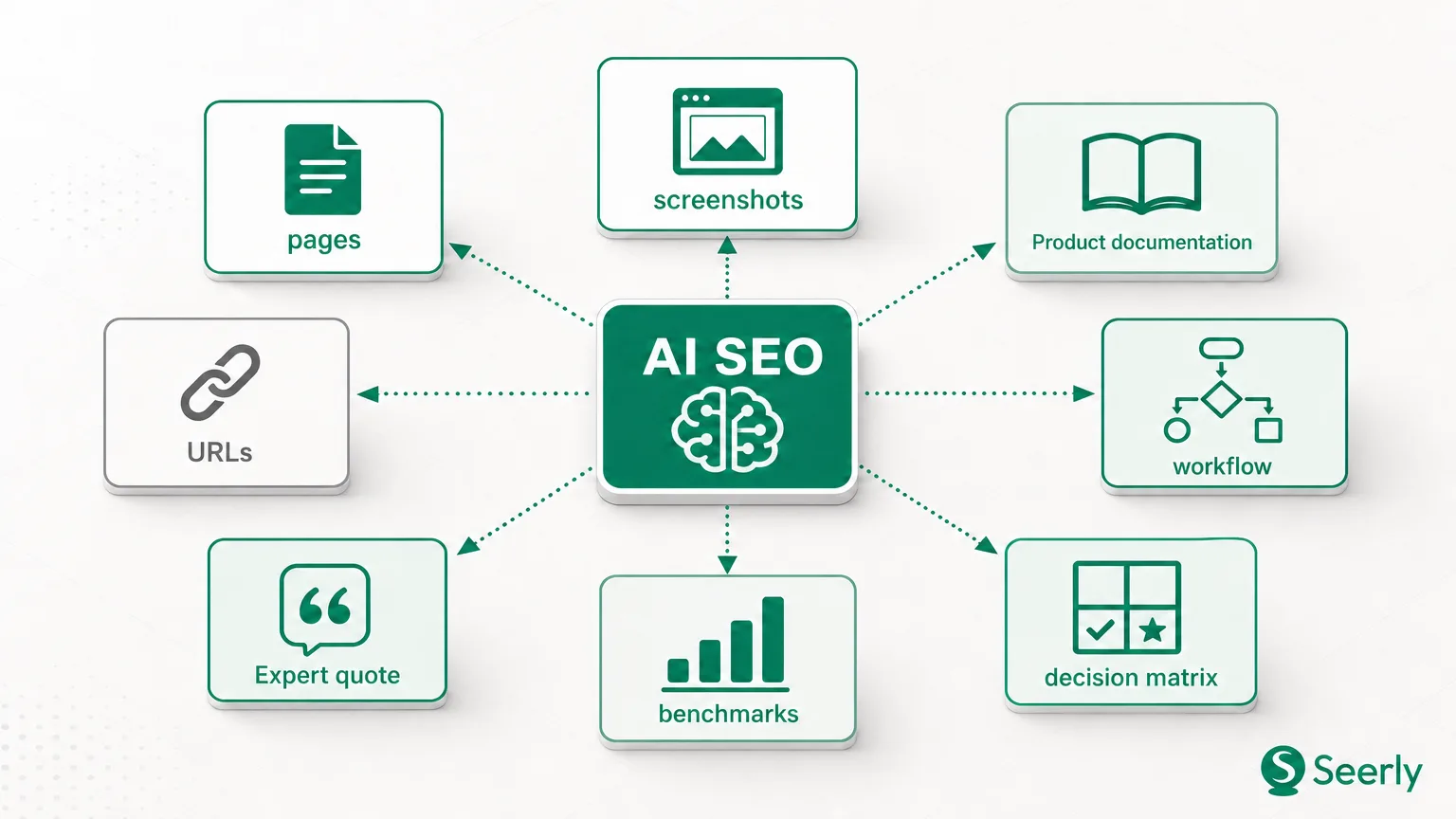
First-party data: Include anonymised benchmarks, survey findings, usage patterns, support trends, test results, or internal analysis where relevant. Explain the sample, time period, and meaningful limitations.
-
Named methodology: Explain how comparisons, rankings, or recommendations were developed. For example, state which features were tested, which criteria were weighted, and when the assessment occurred.
-
Product documentation: Support feature claims with current product details, screenshots, implementation steps, or links to owned documentation where appropriate.
-
Expert contribution: Add a named reviewer, specialist quote, or editorial perspective that clarifies practical trade-offs. Generic “expert reviewed” labels without visible contribution do not add much trust.
-
Concrete examples: Show what the advice looks like in practice. A workflow example, sample decision matrix, or before-and-after page structure is more useful than a broad assertion.
-
Limitations and fit: Explain who should not use the approach, where results may vary, and what the page does not cover. Transparent constraints make recommendations more credible.
-
Date-specific updates: State when volatile information was last checked, particularly for pricing, product capabilities, regulations, and search-platform behaviour.
Use AI SEO in a workflow that prevents repetition
The most reliable AI SEO software supports a controlled process, not an unsupervised publishing pipeline. Separate tasks that AI can accelerate from decisions that require verification, first-hand knowledge, and accountability.
A five-stage production workflow
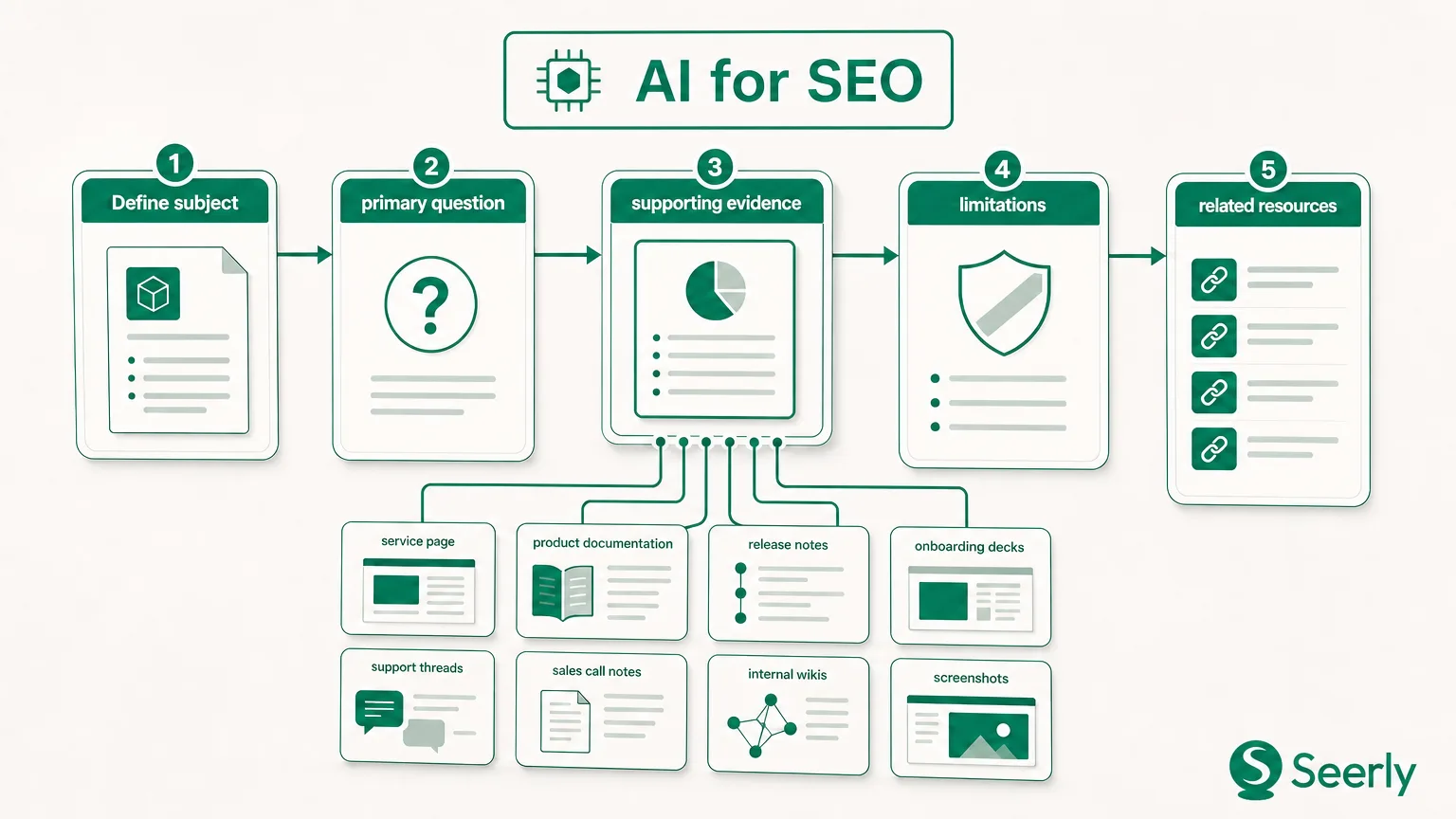
1. Define the decision and evidence gap. Begin with the page’s user intent, conversion role, target audience, and existing weaknesses. Write an evidence brief before generating an outline: what claims must be proven, what source material exists, and which expert needs to approve it.
2. Use AI for research synthesis. AI SEO tools can cluster recurring questions, summarise supplied research, identify missing subtopics, and propose a structure. Treat this output as a working hypothesis, not a source. It can speed up preparation, but it cannot confirm whether a fact is current, complete, or appropriate for your audience.
3. Verify sources and claims. Check every material assertion against source documentation, first-party records, or a qualified reviewer. Maintain a claim ledger for high-value pages: claim, evidence source, date checked, owner, and refresh date. This is especially useful for agencies that need a transparent review trail across multiple clients.
4. Draft with distinct inputs. Give the writer approved evidence, customer questions, product context, and a clear point of view. Ask AI to help improve clarity, create alternative explanations, or identify gaps - but avoid prompts that produce broad “complete guides” from generic web knowledge alone.
5. Apply expert and editorial approval. The final reviewer should confirm factual accuracy, commercial positioning, limitations, and originality. Only then should the team publish, update internal links, and monitor outcomes.
Choose whether to consolidate, rewrite, remove, or retain
Not every weak page should receive the same treatment. Making the wrong choice can destroy useful equity or preserve unnecessary duplication. Evaluate each URL by its unique evidence, intent overlap, current performance, and realistic improvement potential.
| Page scenario | Recommended action | Worked example |
|---|---|---|
| Several overlapping articles | Consolidate | Merge three “AI SEO tools” articles into one comparison with a stated methodology, then redirect retired URLs to the surviving page |
| Outdated explainer with no unique value | Remove or redirect | Retire a legacy article about discontinued search features and redirect it to a current AI search guide |
| Thin commercial page with strong business value | Rewrite | Rebuild a solution page using customer use cases, product proof, implementation details, and current FAQs |
| Unique evidence presented poorly | Retain and improve | Keep a proprietary research page, but add methodology, clear charts, expert interpretation, and an updated date |
| Low-value page with a distinct niche need | Retain selectively | Preserve a narrow support page if it answers a genuine customer question and can be maintained accurately |
Measure recovery across search, conversion, and AI representation
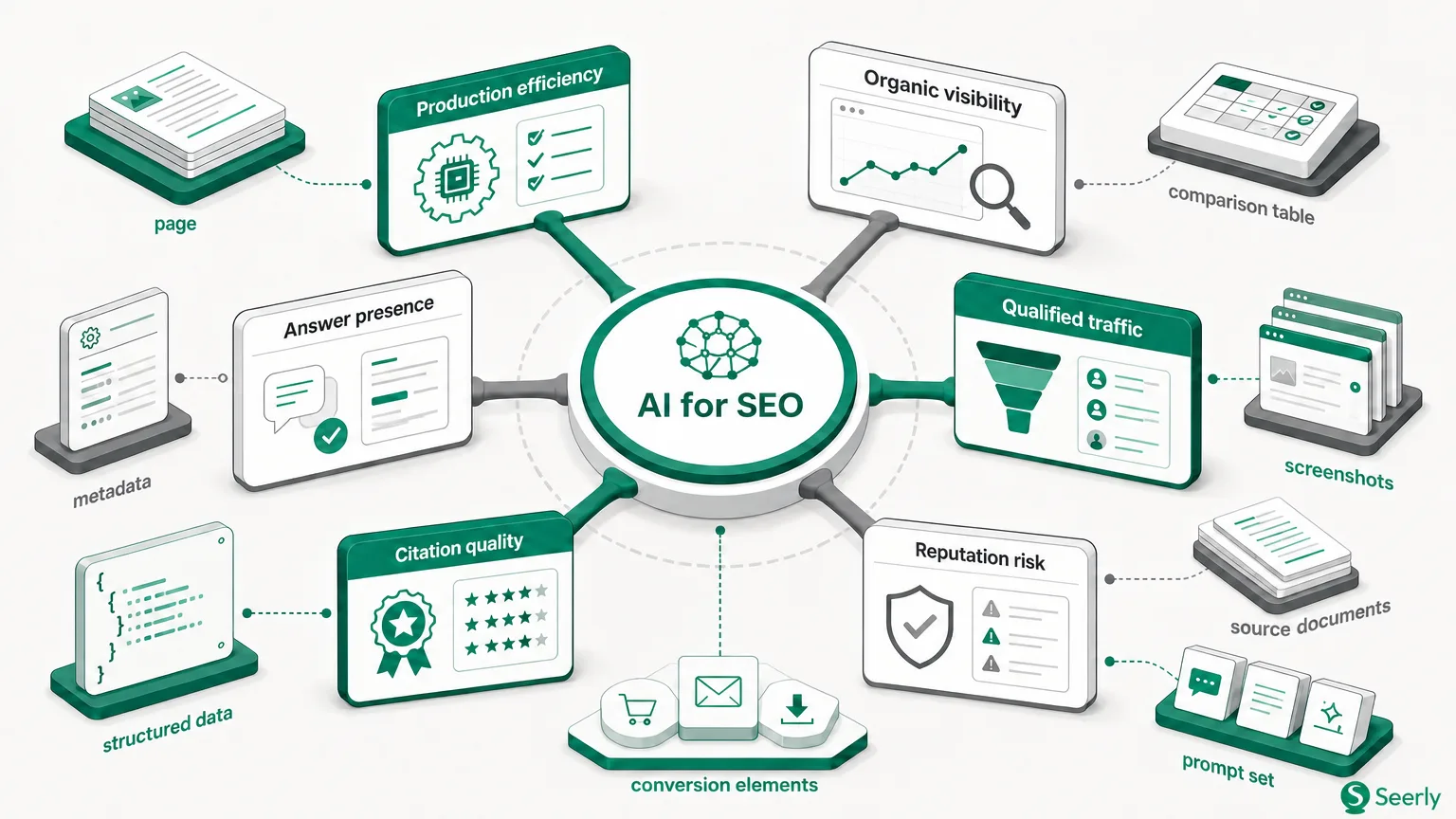
Your measurement checklist should include:
-
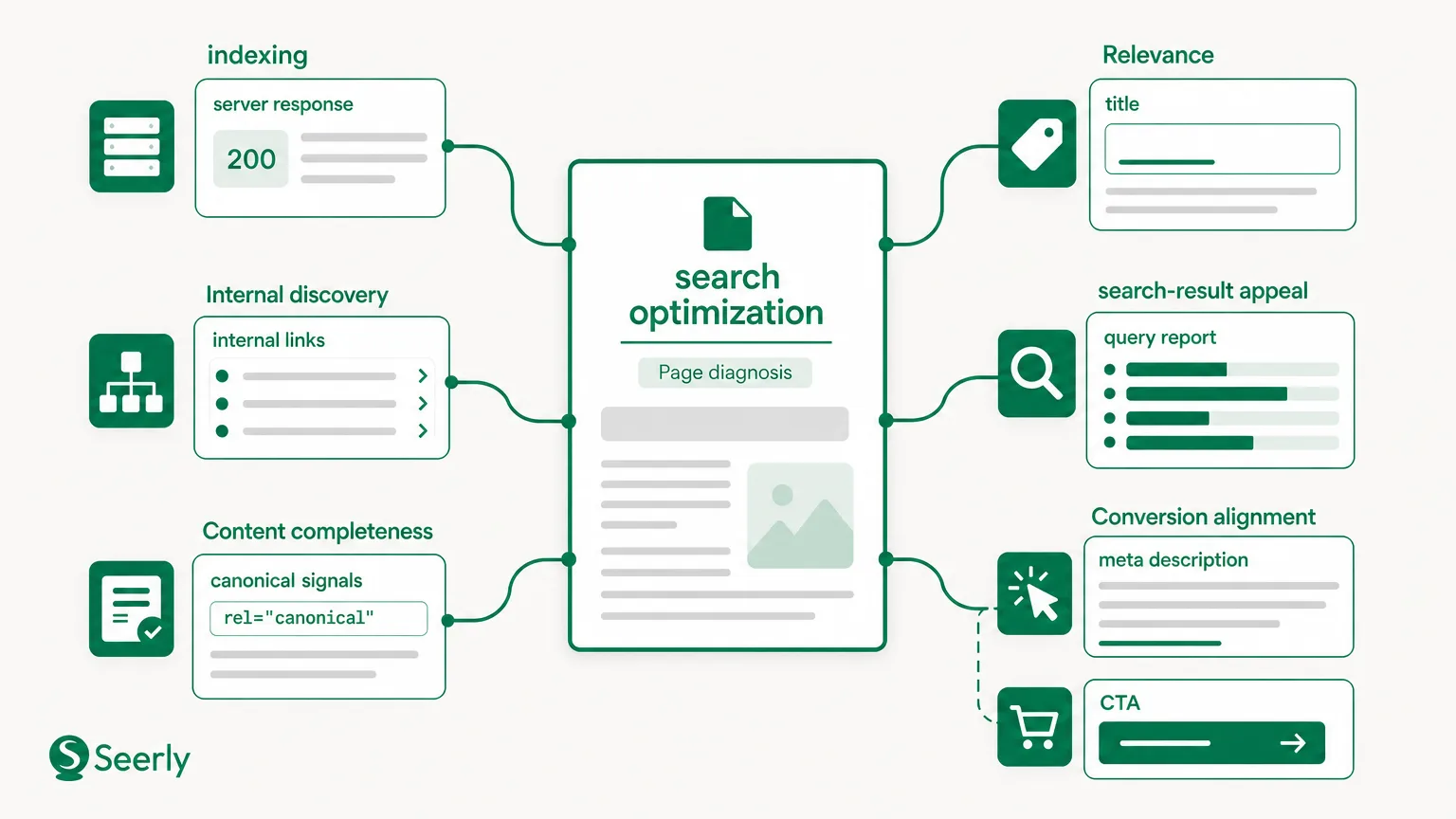
Indexed and eligible pages: Confirm that retained and consolidated URLs are indexed as intended, while removed pages redirect correctly.
-
Search visibility: Track impressions, clicks, queries, and landing-page trends in Search Console. Google recommends linking Search Console and Analytics to understand how search traffic behaves after visitors arrive.
-
Conversion outcomes: Measure demo requests, trial starts, assisted conversions, qualified leads, and engagement on the revised page set.
-
Citation appearances: Track whether your research, product evidence, or expert perspective is being referenced in relevant AI search responses.
-
Brand representation: Test a consistent set of commercial prompts and record whether the brand appears, what claims are repeated, which competitors are included, and whether the representation is accurate.
-
Evidence maintenance: Monitor claim owners and refresh dates so pages do not return to an unsupported state.
FAQ
Can AI SEO tools replace expert review?
No. Use them to cluster questions, summarise supplied research, and identify gaps, then have an accountable reviewer verify claims, sources, and limitations.
What does AI SEO optimization require?
It requires stronger evidence, clear intent alignment, and a review process that keeps important claims current. AI SEO software can support that process, but it should not publish unsupervised.
Build recovery around proof, not production volume
The central lesson of AI SEO recovery is simple: do not rewrite everything, and do not abandon useful automation. Focus on the commercial content cluster where better evidence can create the greatest impact. Consolidate duplicated intent, rebuild thin high-value pages, and preserve pages that contain unique information worth presenting more clearly.
Choose one cluster this quarter, document its current evidence quality, assign accountable reviewers, and measure its visibility before changes begin. Then use Seerly to track how your brand’s representation changes across relevant AI search prompts after the remediation cycle.