The citation absorption experiment: proving whether your evidence influences AI answers
A brand appearing as a cited source in an AI-generated answer can look like a clear visibility win. But a citation only shows that a page was selected as supporting material; it does not prove that the answer adopted the page’s most important claim. For marketing teams investing in AI search visibility, that difference matters: a cited page may still leave the brand’s definition, method, comparison, or proof point out of the response entirely. The practical objective is not simply more citations, but stronger AI citation influence - evidence that a specific, decision-relevant claim is accurately reflected in answers.
This worked experiment provides a controlled way to test that distinction. It is designed for teams that need to determine whether a content revision improves the representation of one claim, rather than assuming citation acquisition equals message adoption.
Why is a citation not the same as influence?
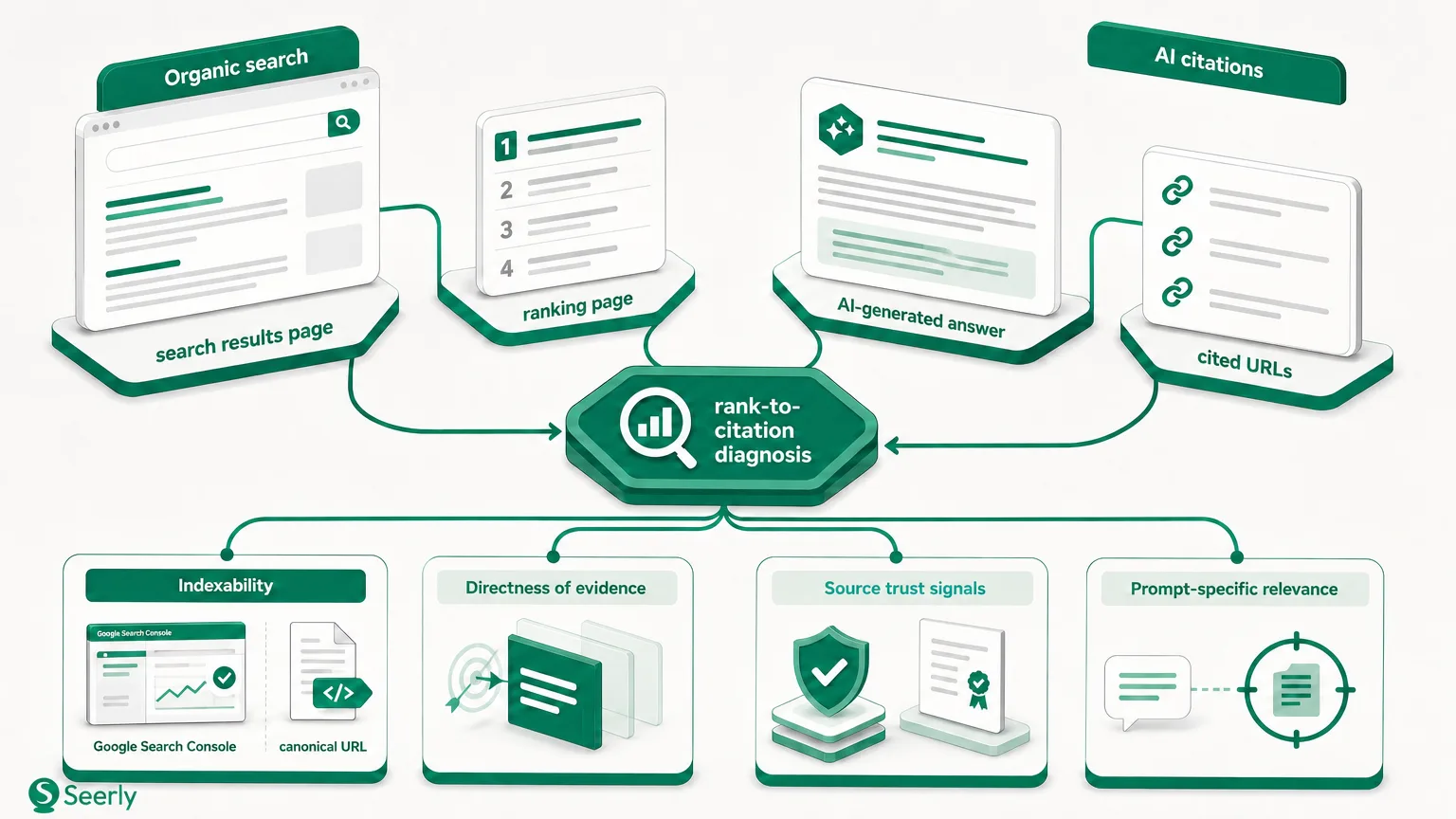
A citation is a source-level event: the AI answer links to, names, or otherwise attributes information to a page. Influence is an answer-level outcome: the answer includes the page’s actual definition, fact, comparison, or process in a way that preserves its intended meaning. These outcomes can overlap, but they should not be treated as interchangeable.
For example, an answer may cite a software provider’s implementation guide while describing the category using a competitor’s framework. Conversely, it may accurately repeat a brand’s distinctive process without visibly citing the original page in every interface. The useful question is therefore not only, “Did our page receive a citation?” It is, “Did the answer present the claim we need buyers to understand?”
This distinction has empirical support. A preprint analysing 602 controlled prompts and 21,143 valid search-layer citations across ChatGPT, Google AI Overview/Gemini, and Perplexity found that citation breadth and answer-level citation influence diverged by platform. That makes raw citation counts an incomplete success metric, particularly when teams compare engines with different retrieval, attribution, and answer-generation patterns.
The stakes are growing because answers can reduce the need for a follow-up click. Pew Research Center found that Google users were less likely to click traditional search-result links when an AI summary appeared. When an answer becomes the primary point of interpretation, accurate representation matters as much as discoverability.
Which claim should a team test first?
Start with a claim that can affect a buyer’s evaluation and can be assessed consistently in an answer. Good candidates explain a capability, a documented methodology, a concrete implementation step, or a measurable outcome that has credible supporting evidence. The claim should be narrow enough that two reviewers can agree whether it appeared and whether it remained accurate.
Use this prioritisation checklist:
- Decision relevance: Would accurate inclusion change how a prospect evaluates the product, service, or category?
- Evidence availability: Can the page support the claim with documentation, attributable research, first-party methodology, or verifiable product detail?
- Prompt relevance: Does the claim answer a recurring question in your monitored prompt set?
- Distinctiveness: Is it meaningfully more specific than generic category language?
- Scorability: Can reviewers classify the answer as accurate, partial, absent, or inaccurate?
Avoid testing statements such as “the leading platform” or “built for modern teams.” These may be useful positioning language, but they lack a stable pass/fail condition. A better test claim is: “The platform separates citation frequency from answer-level claim representation so teams can identify whether their messaging was actually adopted.” That statement identifies a capability, an audience, and a measurable interpretation.
What should the original and revised pages keep constant?
A controlled claim-level test should preserve the conditions that make results comparable. Keep the topic, search intent, URL, core evidence set, target audience, and fixed measurement prompts unchanged. Change one meaningful content variable at a time, then allow time for relevant systems to recrawl, retrieve, and re-evaluate the page.
Consider an illustrative software page intended to answer: “How should brands measure AI search visibility?” Its original claim reads: “Our platform helps brands understand AI visibility.” This is broad, difficult to verify, and weakly connected to a decision process.
| Element | Original page | Revised page |
|---|---|---|
| Core claim | “Understand AI visibility” | “Measure citation presence, claim inclusion, and answer accuracy for fixed prompts” |
| Evidence | General product description | Defined measurement fields and documented workflow |
| Structure | Feature-led narrative | Definition, comparison table, and explicit process |
| Test variable | None | Clarity and evidence structure |
| Measurement | Citation count | Citation and claim-absorption score |
The revised page might define its method plainly: first record the prompt and engine; then capture the answer and citations; next assess whether the target claim is included accurately; finally compare the brand’s representation with alternatives named in the same answer. This does not guarantee an influence gain. It does create a clear, testable semantic unit that an answer can represent.
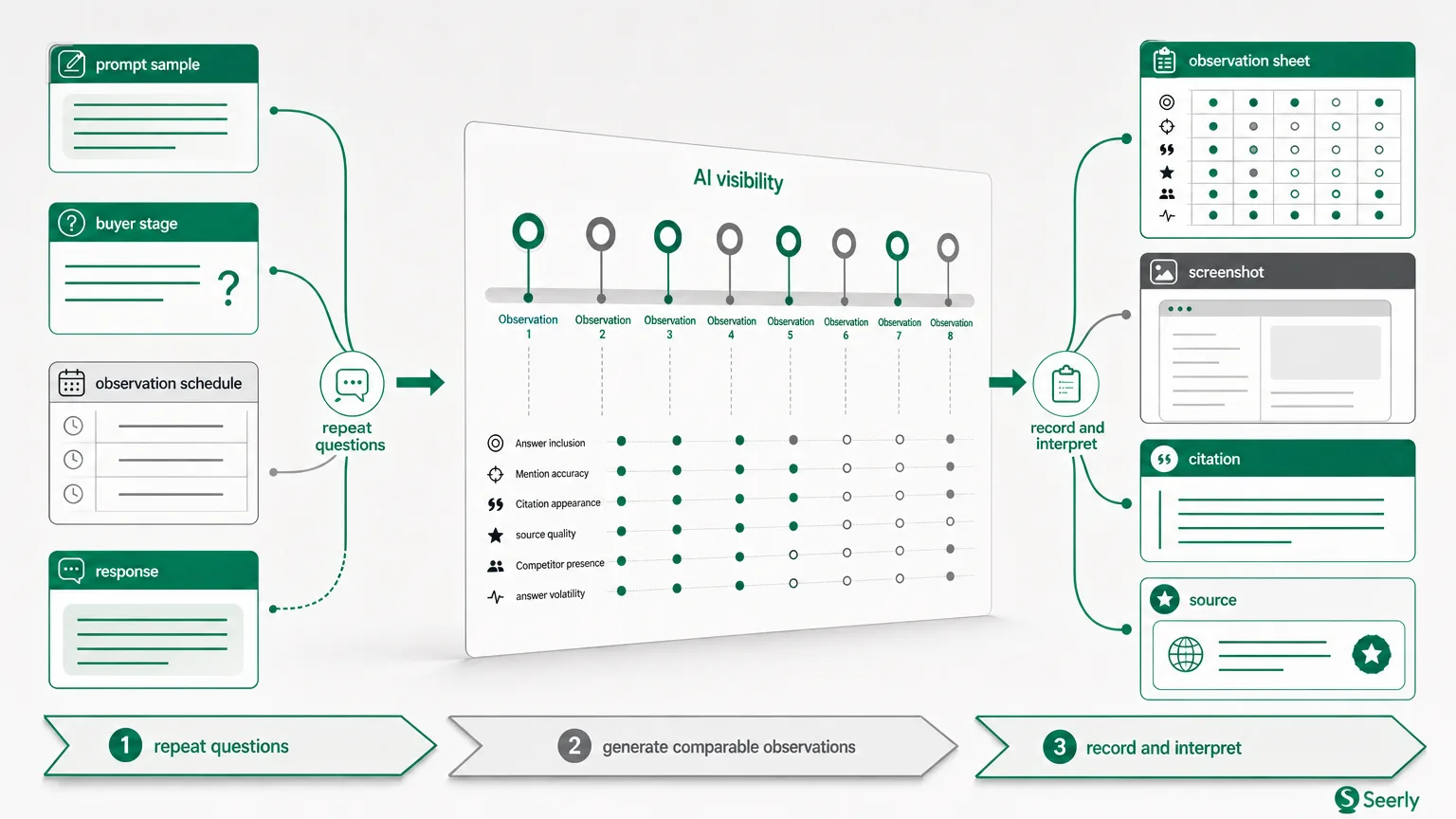
Run the experiment in stages. Capture a baseline across a fixed prompt set before publishing. Make the revision, record the exact change and publication time, then compare repeated observations after recrawl cycles rather than reacting to one answer run. Seerly’s guidance on distinguishing meaningful trends from ordinary variation is especially relevant here: an isolated change is evidence to investigate, not proof of causation.
Which page changes are worth testing?
Prioritise changes that improve evidence density and semantic precision, not cosmetic rewrites. A clearer definition can help an answer identify what a term means. A quantified fact can make a claim more extractable, provided the figure has a credible source and appropriate context. Attributable evidence, procedural steps, and decision tables can also turn vague sales language into information that can be accurately summarised.
Terminology alignment matters, too. If the monitored prompt asks how to “measure AI citation influence,” a page should explain that concept using compatible language rather than burying it beneath unrelated labels. This is not keyword repetition; it is making the relationship between the user’s question, the claim, and the supporting evidence explicit.
Do not assume a Q&A block alone solves the problem. The same cross-platform citation-influence study found lower mean influence for Q&A-formatted pages than non-Q&A pages, concluding that question-and-answer packaging is insufficient without semantic fit and evidence density. Test a Q&A treatment if it serves users, but pair it with definitions, proof, and a complete explanation.
How do you score whether the answer actually absorbed the claim?
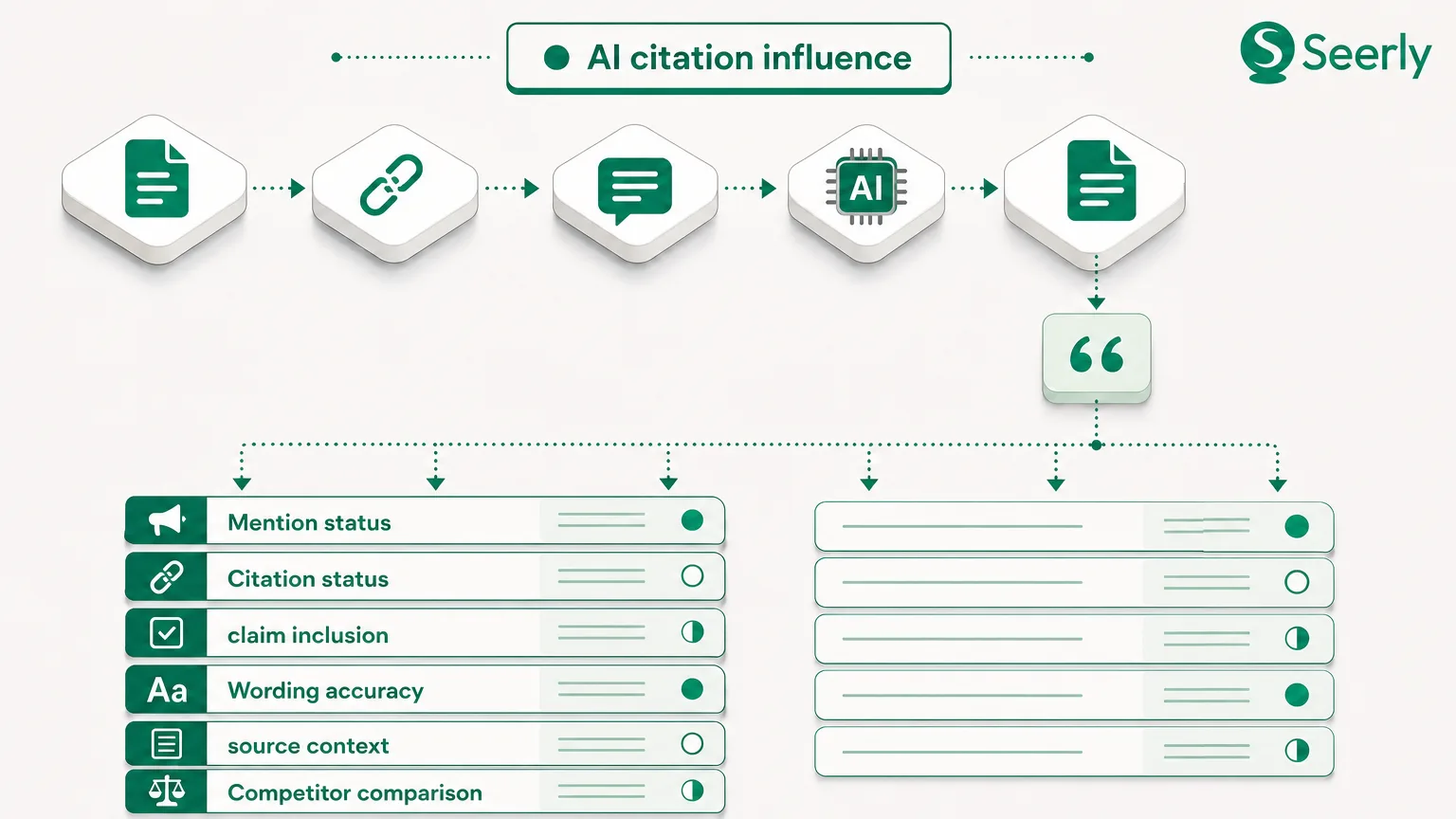
Use a row-based measurement template for every prompt, engine, and observation date. This makes answer influence auditable and prevents a favourable citation from masking inaccurate representation.
| Field | What to record |
|---|---|
| Mention status | Is the brand named or clearly described? |
| Citation status | Is the tested page cited, linked, or attributed? |
| Claim inclusion | Is the target claim absent, partial, or complete? |
| Wording accuracy | Is the claim represented accurately, ambiguously, or incorrectly? |
| Supporting-source context | Which other sources frame or qualify the answer? |
| Competitor comparison | Which competitors appear, and what claims are assigned to them? |
| Change over time | What changed from the baseline across repeated runs? |
A citation without accurate claim inclusion is not a complete success. Likewise, a correctly represented claim may need further investigation if the answer omits attribution, contradicts the page elsewhere, or consistently credits a competitor with the stronger framing. Teams can use citation-level details and recurring source patterns to connect answer observations with broader monitoring data.
When should a team keep testing, revise the evidence, or stop?
Keep testing when results are inconclusive, such as when the revised claim appears in only one engine or one observation window. Review whether the prompt is stable, whether the page has been recrawled, and whether a competing source dominates the answer’s evidence. Do not declare a winner from a temporary citation increase.
Revise the evidence when the answer includes the claim inaccurately or strips away necessary conditions. That often signals that the page needs a tighter definition, clearer qualification, stronger attribution, or a more explicit process - not simply more copy. If a claim cannot be supported cleanly, remove or narrow it rather than trying to optimise an unsupported assertion.
Stop the test when repeated observations show stable, accurate inclusion across the defined prompt set and recrawl cycles, or when multiple well-controlled revisions do not produce a meaningful answer-level change. Both outcomes are useful. The former identifies a repeatable content pattern; the latter prevents teams from scaling an ineffective tactic.
Choose one high-value claim, document its current representation in a fixed prompt set, and run one controlled revision before expanding to additional pages. That discipline turns AI citation influence from a surface-level visibility metric into a measurable test of whether your evidence changes the answers people receive.