Why AI citations depend on answerable passages, not content chunks
A page can rank well for a broad topic and still fail to appear when someone asks an AI assistant a narrow buying question. That gap frustrates content teams because the page may look “well structured” on the surface: short sections, plenty of H2s, tidy bullets, and a sprinkling of keywords. Yet none of that proves a section contains a complete, trustworthy answer.
AI search optimization has encouraged a new formatting superstition: split every page into smaller pieces, and retrieval will take care of itself. It’s an appealing idea because it feels mechanical. Add more headings. Cut paragraphs in half. Turn every statement into a standalone “chunk.” Done.
But content isn’t a box of Lego bricks. A passage earns selection when it states something useful, explains what it means, sets boundaries around the claim, and gives a reader a way to check it. The page around that passage also matters. Context tells a system who is making the claim, what the page is about, and whether the answer belongs in a wider body of work.
Content leads and SEO managers should treat this as an editorial problem before treating it as a formatting problem. The task is to create pages where a buyer can land on one section and understand the answer without having to reconstruct it from five vague paragraphs above and below.
What passage-level relevance means for AI search optimization
Google describes passage ranking as an AI system that can identify individual sections or passages of a web page to better understand how relevant the page is to a search. The useful interpretation is simple: a broad page can contain a narrow answer. A reader searching for a detailed question may need only one section, even when the full page covers a wider subject.
Passage-level relevance: the degree to which a self-contained section directly answers a specific question within the context of the full page.
Picture a page called “How to evaluate AI search visibility software.” Its introduction defines the category. A later section answers a buyer’s narrower question: “What should a brand track after testing a prompt?” That section explains prompt wording, answer inclusion, cited sources, competitor mentions, and changes over time. The rest of the page establishes why those measures belong together and how the company approaches measurement.
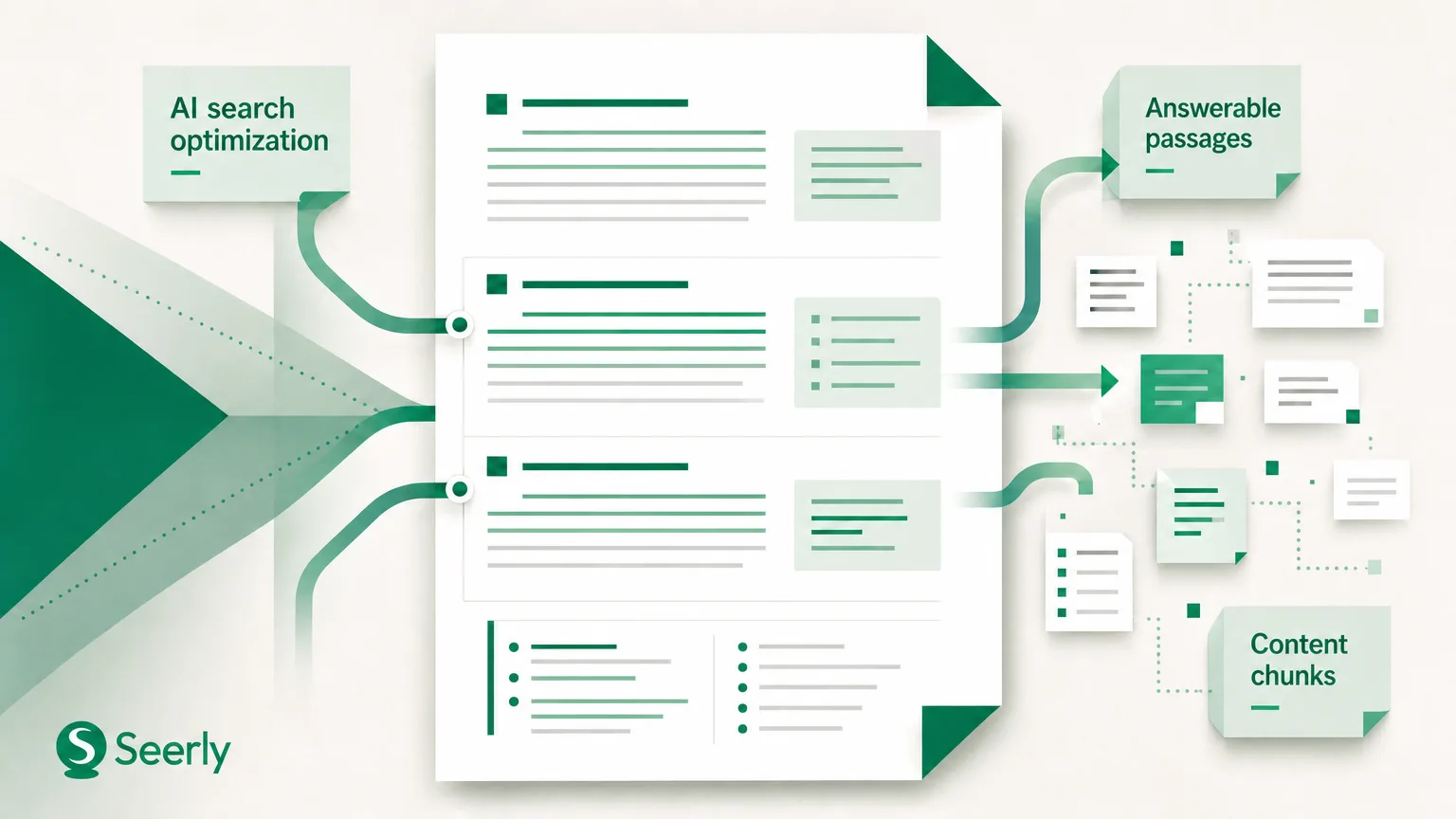
Here is the annotated version:
-
Page title and introduction: establish the broader subject, intended reader, and decision context. They signal that the page concerns measurement, not merely content writing.
-
Section heading: asks “What should teams monitor after testing a prompt?” The heading narrows the job of the next few paragraphs.
-
Answer passage: starts with a direct response, defines each measurement, and explains why a single answer snapshot can mislead.
-
Supporting links and methodology: help a reader check the basis of the explanation and find deeper detail.
The section matters because it meets the narrow need. The surrounding page matters because it makes the section credible and correctly framed. Strip away either piece and the answer gets thinner.
That distinction has practical consequences. A heading like “Monitoring” may sound neat in a content outline, but it leaves too much work for the reader. “How to track changes in AI answers for the same buyer prompt” tells the system and the human what the section is trying to answer. Small difference on the page. Big difference in meaning.
Content chunks are useful for reading, not a retrieval trick
The content-chunking myth survives because scannability is genuinely helpful. Nobody enjoys meeting a 900-word paragraph with no heading and no escape route. Shorter sections can make a complex page easier to read, edit, and maintain.
That benefit stops short of a retrieval tactic. Google’s guidance says site owners can ignore tactics such as chunking content and should focus on effective SEO practices instead, as stated in its guidance for AI features in Search. The wording matters. Chunking alone does not manufacture authority, proof, or relevance.
| Myth | Fact |
|---|---|
| More headings make a page more likely to appear in AI answers. | Headings help people scan, but the passage under each heading still needs to answer something fully. |
| Every paragraph should stand alone. | A passage needs enough local context to make sense, while the page needs a coherent argument. |
| Shorter copy is easier to retrieve. | Brevity helps only when it removes clutter. Cutting definitions or evidence often damages the answer. |
| Repeating the buyer question makes the page sourceable. | A direct answer works better than a question repeated with vague promotional language. |
Honestly, I think “chunking” became a stand-in for editorial discipline. Teams knew pages were hard to scan, poorly ordered, or padded with generic claims. Breaking the copy apart looked like a fix. Sometimes it was. But it was a fix for readability, not a shortcut to being selected as evidence.
A section can be 80 words or 280 words. Length isn’t the issue. The test is harder: if someone copied only that section into a briefing note, would it still answer the question accurately? If the answer is no, more headings won’t save it.
What makes a passage answerable and sourceable?
Here’s the standard I’d use: a strong passage should leave a reader with a claim they can understand and a trail they can inspect. That’s more demanding than a polished sentence, but it prevents the familiar “we help brands win in AI search” fog.
Use this checklist during editing:
-
Start with the answer. Lead with the conclusion, then explain it. A buyer asking how prompt monitoring works shouldn’t need three paragraphs of category history before reaching the method.
-
Define the terms that carry the claim. If a page refers to “visibility,” say whether that means answer mentions, linked sources, share of responses, or something else. Loose terms cause loose interpretation.
-
Set a concrete scope. Name the prompt type, user situation, geography, product category, or comparison boundary where it applies. Claims without scope tend to overreach.
-
Use original evidence where possible. Link to a methodology page, documented process, primary research, or source material. A statement becomes more useful when a reader can inspect the basis for it.
-
Qualify claims honestly. Say “in the prompts we monitor” rather than implying every AI response behaves the same way. Limits build trust; inflated certainty does the opposite.
-
Link to supporting resources. One well-placed link beats a pile of “learn more” buttons. Readers should know what they’ll find on the next page.
Here’s a common before-and-after rewrite.
Before: “Our platform helps businesses improve their presence in AI search through detailed insights and tracking.”
After: “Teams can test a defined set of buyer prompts, record whether their brand appears in each response, and review the sources named alongside competing brands. Tracking the same prompts over time helps separate a one-off mention from a repeatable pattern. See Seerly’s approach to AI search optimization tracking for the measurement questions that belong in that review.”
The second version has limits. Good. It names the work, explains why repeat testing matters, and points to related detail. It doesn’t promise an outcome it can’t support.
A ranking page with no AI-answer presence needs diagnosis, not panic
A conventional ranking is evidence that a page may be relevant to a query. It is not proof that its individual passages suit a generative answer. Search results and AI-generated responses can draw on different query wording, source sets, and answer formats.
The first mistake is rewriting the full page before knowing which buyer question it fails to answer. That turns a focused editorial issue into an expensive guessing game. I’ve seen teams do it, and the result is often more copy with less clarity. Not ideal.
Run a small diagnostic instead:
-
Choose one real buyer prompt. Use wording a prospect would plausibly type, including conditions such as industry, use case, and comparison criteria. “Best AI visibility platform” is too broad; “How can a SaaS team monitor brand citations across recurring prompts?” is more useful.
-
Locate the intended answer section. If the page has no obvious section for that question, you have found a content gap. Don’t hide the answer in an introduction written for everyone.
-
Read the section in isolation. Does it give a direct response, explain terms, and show the basis for its claims? If it relies on nearby copy to make sense, repair the passage before adding more material.
-
Compare cited alternatives. Look at the pages surfaced in the response. What evidence do they name? Do they define the same terms more clearly, include a method, or answer a narrower version of the prompt?
-
Log the change and monitor again. Record the original prompt, model or search experience, date, page section, revision, and later result. A simple log turns impressions into evidence.
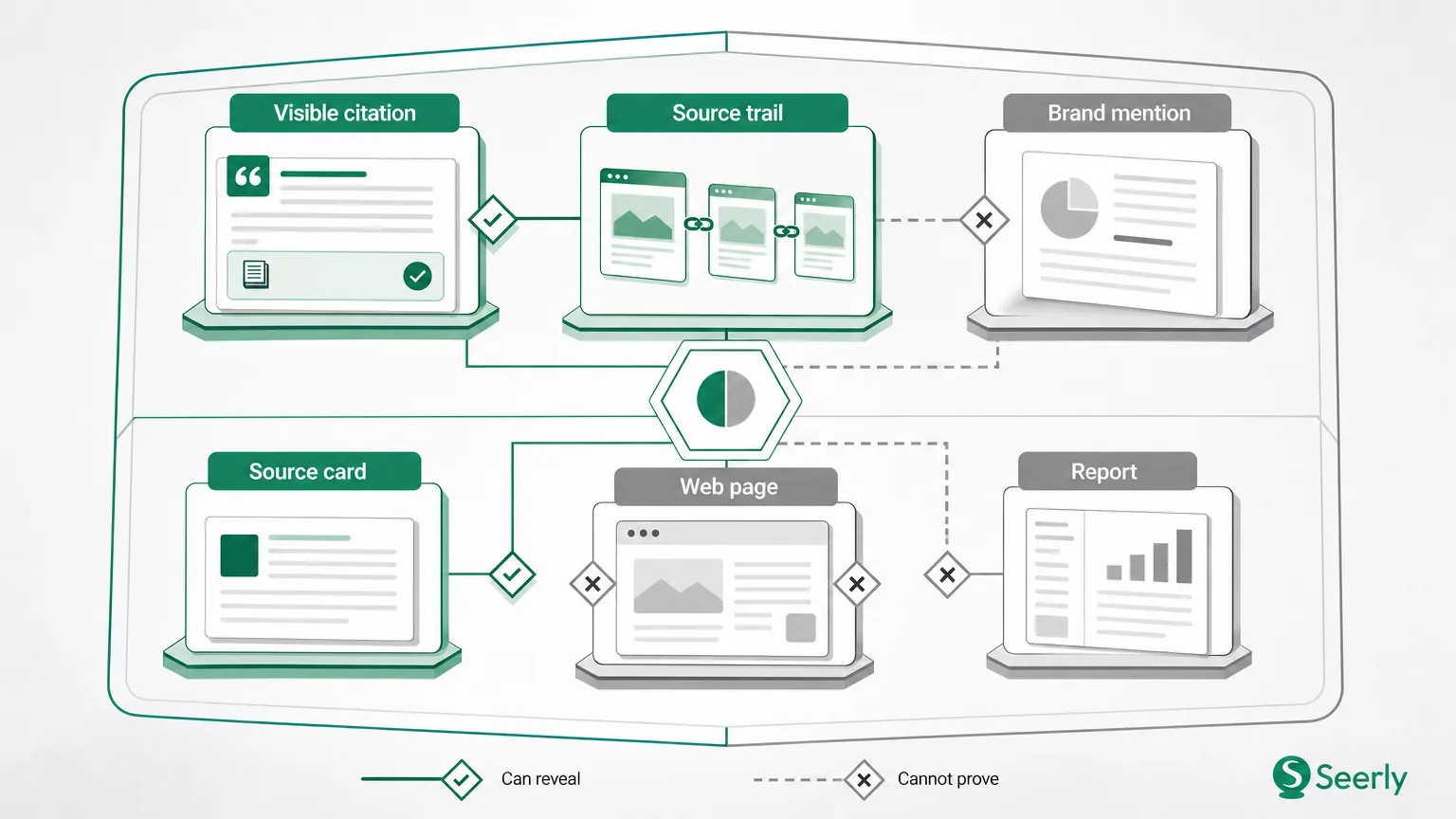
Brand citation monitoring becomes useful here because it lets teams watch representation, not merely page traffic. Seerly’s guide to what visible citations reveal and hide makes the point well: appearing as a source and being described accurately are related, but they are not identical.
Start where inaccurate answers create the most risk
Not every page deserves the same editing effort. Prioritize pages where a buyer needs a precise answer before they can progress, or where a loose description could distort what your company does.
| Page type | Buyer intent | Representation risk | Priority |
|---|---|---|---|
| Solution pages | A buyer wants to know whether a product solves a specific problem. | High, because vague claims can misstate fit. | Start here |
| Product pages | A buyer checks features, limits, integrations, or pricing logic. | High, because factual errors create bad expectations. | Start here |
| Explanatory guides | A reader wants to understand a category or process. | Medium, but these pages can establish useful context. | Next |
| Methodology pages | A prospect wants to assess how measurements or scores are produced. | High, especially where trust depends on transparency. | Next |
| Comparison content | A buyer needs differences and trade-offs. | High, because omission can make the comparison misleading. | Review carefully |
A product page often has the shortest path from question to commercial consequence. If the page says a platform tracks “AI visibility” but never explains what gets measured, a buyer may infer features that don’t exist. Methodology pages deserve similar care because they carry the burden of proof.
For ecommerce teams, the same principle applies to product facts. A section that states material, compatibility, dimensions, or return conditions needs to be exact and easy to verify. Seerly’s article on improving product-page discovery in AI search explores that more specific workflow.
Frequently asked questions
Is breaking a page into more sections enough?
No. More sections can improve reading, but they don’t add evidence or make a vague claim precise. Edit section boundaries when they help a reader find an answer, then spend more time on the answer itself.
How long should an answerable passage be?
Long enough to answer the question without forcing the reader to hunt for missing definitions or proof. A simple factual response may take a short paragraph; a comparison or method may need several. Word count is a poor proxy for usefulness.
Should every passage include a link?
No. Link where a reader needs supporting material, such as a methodology, documentation page, or original research. Random internal links make a passage feel like a hallway full of doors.
Can prompt monitoring tell us why a page was not cited?
It can show patterns, not a secret scoring formula. Repeated testing helps teams see where their pages appear, how the brand is described, and which competing sources recur. That is enough to form better editorial hypotheses and test revisions.
Choose three buyer prompts that matter to your business. Find the precise passages that should answer them. Then revise those passages until a reader can understand the claim, its boundaries, and its evidence without filling in the blanks.
Keep monitoring the prompts after publication. If updated pages begin appearing more often and with more accurate representation, you have learned something real. If they don’t, inspect the evidence again rather than cutting the page into even smaller pieces. Learn more through Seerly’s AI search resources.