From keywords to prompt portfolios: a prioritization framework for AI visibility
An AI visibility keyword strategy for choosing buyer prompts when dependable volume data is missing.
A marketing team exports its keyword list, turns each phrase into a question, and uploads the questions into an AI visibility tracker. The dashboard fills up. At the next budget meeting, someone asks which missing brand mentions deserve attention, and the team discovers that its measurement plan has become a very large sorting problem.
More prompts haven’t made the decision easier. Hundreds of questions may repeat the same buying concern, while a single question about security or migration could affect a purchase decision. Without a broadly accepted equivalent of reliable prompt-level search volume, an AI visibility keyword strategy needs a different basis for prioritization.
The temptation is to manufacture certainty: borrow keyword volumes, attach them to conversational questions, and rank the spreadsheet. I’d resist that shortcut. Search demand can help identify relevant topics, but it cannot tell you how often buyers ask a particular question inside an AI product.
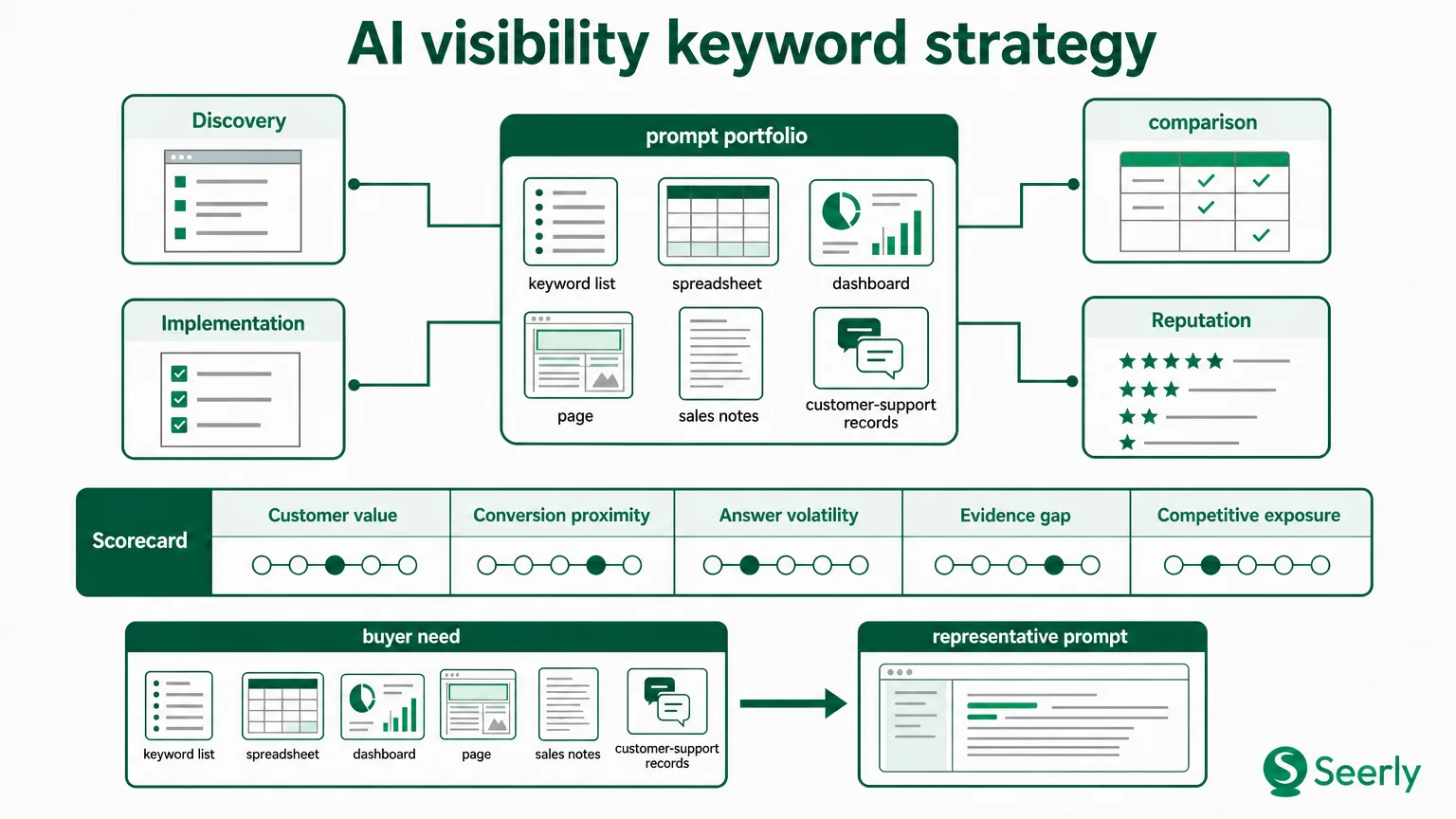
For marketing leaders and agencies, the useful unit is a governed prompt portfolio: a limited set of buyer questions with explicit selection criteria and someone responsible for the response. Every monitored cluster should connect to a business decision and a page or evidence source the team can improve. Otherwise, monitoring becomes an expensive way to collect screenshots.
A prompt portfolio is a deliberately selected set of buyer-intent clusters, represented by repeatable test questions. Each cluster has a documented purpose, a priority score, and an assigned owner.
The practical payoff is focus. Instead of defending why a dashboard contains a thousand prompts, you can explain why ten buyer questions deserve funding, what evidence those questions require, and which observations would justify further work.
Why conventional keyword lists break down in answer engines
A keyword such as “customer support software” is a useful starting point. It doesn’t distinguish a buyer discovering the category from one evaluating migration costs. Turn that keyword into twenty conversational variations, and you may still be measuring one broad concern twenty times.
Prompt-cluster planning starts with the decision behind the wording. Questions belong together when they express the same buyer need and require substantially the same evidence. Separate them when a constraint changes the answer: a regulated industry, for example, may introduce procurement requirements that a general comparison page cannot address.
Google says website owners don’t need to capture every long-tail keyword variation for visibility in its AI search features. Its guidance also describes query fan-out, where AI features may issue related searches across subtopics. The planning implication is to cover the underlying need well, rather than create a separate target for every plausible phrasing.
There’s also a reason to distinguish answer visibility from website traffic. In a study of U.S. browsing behavior in March 2025, Pew Research Center found that users clicked a traditional search result on 8% of visits with an AI summary, compared with 15% without one. Those observations don’t establish causation or predict your conversion rate. They do caution against treating a brand mention as interchangeable with a visit, much less a sale.
Define the four prompt roles in a buyer journey
“Which support platform fits a small ecommerce team?” and “Can we migrate our ticket history without losing attachments?” belong to the same category, but they ask for different proof. One seeks a shortlist. The other tests whether a shortlisted product can survive contact with the buyer’s actual workflow.
Use four prompt roles to distinguish those needs:
- Discovery: Questions about the problem, available approaches, or suitable product categories. A prompt such as “What tools help a small ecommerce team manage support?” tests whether the brand enters the initial consideration set.
- Comparison: Questions that weigh alternatives against explicit criteria. “Which support tools include audit logs and regional data hosting?” calls for documented capabilities, not an unsupported “best software” claim.
- Implementation: Questions about setup, integration, or switching effort. A buyer asking about ticket-history migration needs documentation about supported formats and known limitations, potentially alongside a migration service description.
- Reputation: Questions about trust, reliability, or the credibility of a claim. “What should we verify before trusting this vendor with customer data?” warrants factual answers and traceable evidence, not defensive copy.
Don’t turn the roles into four sealed boxes. A comparison prompt may contain a reputation concern, and an implementation question may appear before a formal shortlist exists. Assign a primary role, then record any secondary concern that changes the evidence requirement.
The thing is, a new adjective doesn’t necessarily justify a new cluster. Ask whether the buyer would need a different page or materially different proof. If not, keep the wording as a controlled variation within the existing cluster.
How to score an AI visibility keyword strategy without volume data
A scoring model should make judgment visible, not disguise it as demand measurement. Use a simple one-to-five scale, with written anchors and a short explanation beside every score. The numbers below are a proposed planning rubric, not an industry benchmark or a forecast.
| Criterion | Score 1 | Score 3 | Score 5 |
|---|---|---|---|
| Customer value | Peripheral audience | Relevant segment | Priority customer segment |
| Conversion proximity | General learning | Active evaluation | Purchase or renewal decision |
| Answer volatility | Stable observations | Occasional material changes | Repeated changes in recommendations or accuracy |
| Evidence gap | Clear, current proof exists | Proof is incomplete or scattered | Missing or outdated proof blocks a useful answer |
| Competitive exposure | Little observed displacement | Mixed competitor presence | Competitors repeatedly occupy a relevant shortlist |
Apply the rubric through a repeatable process:
- Validate the buyer need. Find the concern in sales notes or customer-support records. Keep the record reference so the portfolio doesn’t drift toward questions that only marketers ask.
- Create the cluster and representative prompt. Record the audience and decision constraint. Preserve meaningful variations, but don’t count paraphrases as separate strategic opportunities.
- Score business importance first. Add customer value and conversion proximity to create an importance subtotal. A commercially peripheral question shouldn’t outrank a purchase-blocking concern simply because its answers fluctuate.
- Score the observed problem separately. Add volatility, evidence gaps, and competitive exposure to create an intervention subtotal. Mark unknown criteria as “unassessed” until baseline observations exist; don’t quietly substitute a low score.
- Select within importance bands. Review the highest-importance clusters first, then use intervention need and available capacity to choose work. Record any exception, including legal or reputational risk that warrants immediate attention.
Why not collapse everything into one impressive score? Because the criteria answer different questions. Business importance determines whether the concern deserves attention; the intervention subtotal helps diagnose where work may be needed.
I prefer that separation because it keeps a volatile curiosity from outranking a stable buying requirement. Review the anchors quarterly with sales and product colleagues, and attach a confidence label to each assessment. A score supported by repeated buyer conversations deserves more trust than one based on a workshop guess.
Turn a prompt cluster into a page-and-evidence plan
Take a hypothetical software vendor monitoring this comparison prompt: “Which customer support platforms support EU data residency and audit logs?” No actual vendor result is implied here. The example shows how a team could turn a monitoring question into an editorial and evidence assignment.
Before commissioning a new article, inspect the relevant existing pages. The product page may mention “enterprise security” without stating which data types remain in which regions. A separate help document may describe audit logs but omit plan availability or retention limits.
The resulting work plan should be specific:
| Planning field | Illustrative assignment |
|---|---|
| Prompt cluster | Support software for buyers with data-location and audit requirements |
| Best page | Existing security and data-residency page, supported by audit-log documentation |
| Proof required | Verified hosting scope, applicable plans, audit events, retention limits, and exceptions |
| Page owner | Product marketing |
| Evidence owner | Security lead, with product confirmation of capability details |
| Expected observation | Check for accurate eligibility descriptions; record whether the brand appears and which sources the answer cites |
The expected observation is a test, not a promised outcome. Publishing clearer evidence doesn’t guarantee inclusion, and absence alone doesn’t prove the page caused the problem. The engine may use other sources, interpret the constraint differently, or produce an answer without a vendor shortlist.
Seerly’s explanation of turning visibility gaps into a content roadmap addresses the connection between prompt-level absence and the next content assignment. Keep that connection explicit in your own workflow. “Improve visibility” is too vague for an owner to complete; “publish verified audit-log retention limits on the existing documentation page” is a task someone can review.
And if the product doesn’t meet the requirement? Say so. No amount of copy should turn an unsupported capability into a recommendation.
Set a repeatable monitoring cadence
One missing mention is a sample, not a trend. For a starting protocol, run each representative prompt three times per selected engine during the baseline week, using fresh sessions where possible. Repeat the same protocol weekly for priority clusters, then review the portfolio monthly; those intervals are working choices, not statistically validated thresholds.
Keep the conditions explicit. A consumer interface with personalization and an API-based test may not produce comparable observations. If an engine doesn’t expose its model version or location controls, record the limitation instead of implying that your test controlled them.
Use a log with these fields:
| Field | What to record |
|---|---|
| Cluster ID and version | Stable identifier, buyer role, and revision history |
| Exact prompt | Full wording, including constraints and follow-up context |
| Engine and interface | Product, search mode, model version if exposed, and session state |
| Date and run | Timestamp, time zone, and repetition identifier |
| Location assumptions | Requested geography, language, and actual test location where known |
| Answer outcome | Brand presence, recommendation context, accuracy, and competitor inclusion |
| Citations | Linked sources, specific cited pages, or an explicit “none” |
| Next action | Finding, page assignment, owner, and review date |
Seerly’s standardized prompt sets for monitoring and experimentation fit this need for consistent testing. Regardless of the tool, preserve the exact prompt and retain the answer alongside its citations. If wording changes, version it rather than silently replacing the original test.
For reporting, distinguish mention rate, the proportion of valid runs naming the brand, from citation rate, the proportion linking to a brand-owned source. Show the denominator and keep results separate by engine. A ten-prompt portfolio measures performance on those selected questions; it doesn’t estimate market-wide exposure.
Honestly, the bookkeeping can feel tedious. But without it, a changed location setting can masquerade as a marketing win. Look for repeated changes under comparable conditions, and avoid attributing an improvement to a page edit without stronger supporting evidence.
Avoid prompt-portfolio failure modes
A spreadsheet containing “best support software,” “top support software,” and “leading support software” can look productive while testing almost the same concern. Add a few flattering branded questions, and the dashboard may become even greener. Neither development makes the portfolio more useful for allocating work.
Before adding a cluster, check four common failure modes:
- Duplicate prompts: Merge questions when intent and evidence needs match. Keep a variation separate only when it tests a meaningful condition, such as a different buyer segment.
- Vanity questions: Don’t make “Why is our brand the best?” a core discovery test. Branded prompts can assess accuracy, but their results should remain separate from unbranded recommendation monitoring.
- Unsupported claims: Require approval from the evidence owner before publishing capability or performance statements. A missing citation is no excuse to invent a statistic or imply a certification the company doesn’t hold.
- No action owner: Assign responsibility before routine monitoring begins. Some responses require documentation changes; others require a product decision or a reputation review.
What happens when none of those teams can act? Put the cluster on a watchlist with a reason and review date, rather than leaving it in the active work queue. The way I see it, a healthy portfolio has a removal rule as well as an admission rule.
Frequently asked questions
Can SEO search volume still help select prompts?
Yes, as directional evidence about topic interest, not a count of AI conversations. Combine it with documented buyer concerns and commercial relevance. Don’t transfer a keyword’s volume onto a conversational prompt as though the two measures were equivalent.
How many prompt variations should a cluster contain?
Start with one representative prompt and add variations only for meaningful buyer constraints. A wording change that demands the same evidence rarely needs its own cluster. Keep exploratory tests separate from the fixed monitoring set so experimentation doesn’t muddy trend reporting.
What should happen when the brand is absent?
Check whether the answer actually calls for a vendor recommendation, then inspect its claims and sources. Compare the required evidence with what the brand has published. Assign a specific correction or research task instead of automatically commissioning another article.
Start with ten decisions worth measuring
Choose ten buyer-critical prompts and group them by the decision each supports. Score their commercial importance separately from intervention need, then assign every cluster to a page owner and an evidence owner. Record a repeatable baseline before expanding coverage.
Keep the portfolio small until the team can explain what each observation changes. More coverage can wait; clear responsibility shouldn’t. Put the ten-prompt framework to work with Seerly.