Not every AI citation is a trust signal: a source-quality scorecard
An AI answer links to your brand, but the source describes a retired product. Another answer cites several pages, yet none supports its recommendation. Your citation count rises while the quality of your brand’s representation remains uncertain.
AI citation monitoring needs to measure more than appearances. In Pew Research Center’s browsing study, users clicked traditional search results in 8% of visits with an AI summary, compared with 15% without one. That finding does not measure citation quality, but it reinforces the importance of examining what an answer presents before readers investigate further. The scorecard below helps teams distinguish useful evidence from sources that warrant investigation.
Why citation count is not enough
Being cited, being accurately represented, and being supported by trustworthy evidence are different outcomes. A citation establishes that an answer attached a source; it does not establish that the source supports the adjoining statement. Research evaluating generative search explicitly distinguishes citation precision from citation recall: whether citations support associated statements, and whether statements receive supporting citations.
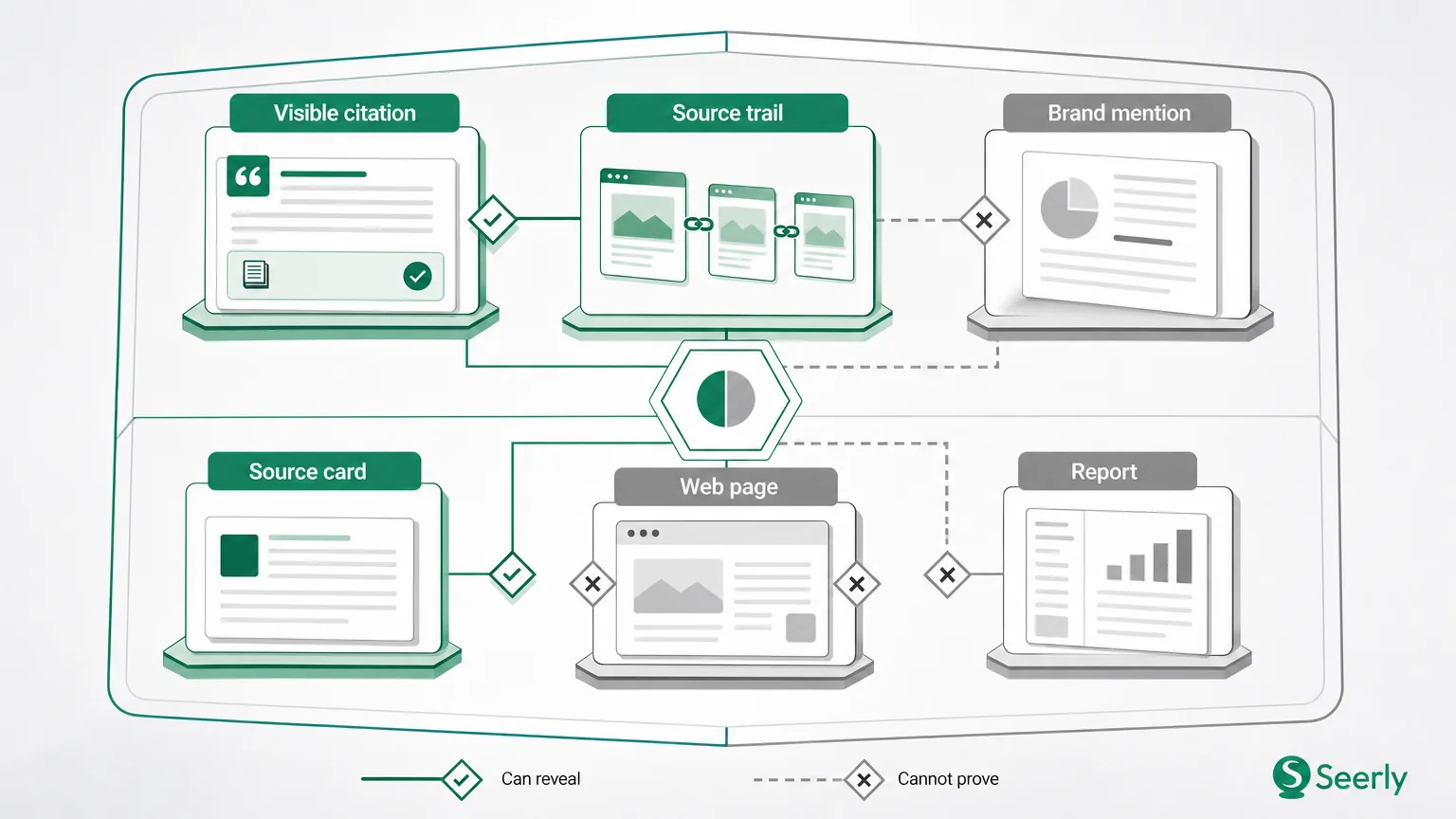
A large citation count can therefore conceal repeated weaknesses. Stale facts may describe discontinued capabilities, while weak topical relevance can make a general category article look like product-specific evidence. Entity confusion can attach another company’s attributes to your brand. Self-referential sources can also repeat an owned claim without adding independent verification.
The practical unit of review is the claim-source pair, not simply the domain. One page may support a product specification but not a market-leadership claim. Review the exact statement, the cited passage, and the relationship between them.
The five dimensions of citation quality
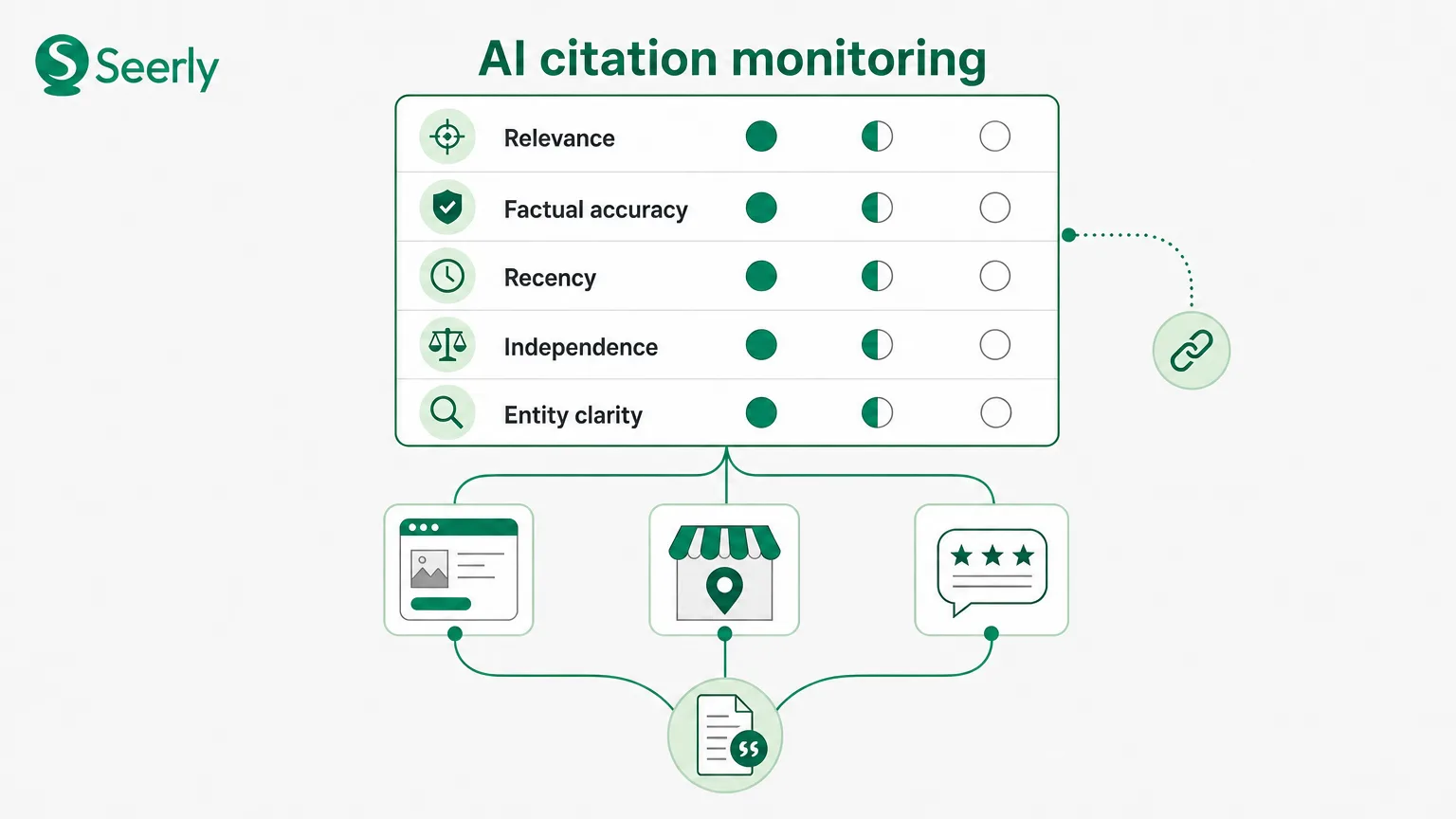
Use this proposed rubric to score each claim-source pair from zero to two across five dimensions. Record a short justification alongside every score so another reviewer can reproduce the assessment. If evidence is inaccessible or verification remains incomplete, mark the dimension “unverified” rather than assuming it passes.
| Dimension | 0 points | 1 point | 2 points |
|---|---|---|---|
| Relevance | Does not support the claim | Supports only part of it | Directly supports the specific claim |
| Factual accuracy | Material facts contradicted by verified evidence | Partially checked or mixed accuracy | Material facts checked and consistent |
| Recency | Superseded for this claim | Currency uncertain or partly dated | Current enough for this claim |
| Independence | Owned, sponsored, or circular evidence | Relationship or method unclear | Independent evidence with transparent methods |
| Entity clarity | Wrong brand or product | Ambiguous identity | Correct brand, product, and market |
For fully scored pairs, use 8-10 as lower investigation priority, 5-7 as targeted review, and 0-4 as priority investigation. These are workflow bands, not validated trust thresholds or predictions of AI-answer outcomes. Any material factual error, unsupported claim, or wrong entity overrides the total.
Independence also depends on the claim. An owned page can be authoritative about available features without independently proving superiority over competitors. Likewise, recency means fitness for the statement - not simply a recent publication date.
Three hypothetical citation situations
The examples below are hypothetical worked assessments, not customer results. Their scores demonstrate the rubric rather than measured platform performance. Each situation assumes reviewers have inspected both the answer and its cited source.
| Hypothetical situation | Relevance | Accuracy | Recency | Independence | Entity clarity | Total |
|---|---|---|---|---|---|---|
| Current independent review supporting a tested feature claim | 2 | 2 | 2 | 2 | 2 | 10 |
| Outdated directory supporting a current pricing claim | 1 | 0 | 0 | 1 | 2 | 4 |
| Current owned product page supporting feature availability | 2 | 2 | 2 | 0 | 2 | 8 |
A current independent review
The review identifies the correct product, explains its testing method, and supports the answer’s narrow feature claim. Reviewers verify the relevant facts against current documentation and find no disclosed commercial relationship. The action is to retain it as useful evidence and monitor changes - not assume it supports every recommendation elsewhere in the answer.
An outdated directory profile
The directory identifies the right company but lists a retired plan as currently available. Its historical details may remain useful, yet they cannot substantiate today’s pricing. Request a correction with supporting documentation, and separately flag the answer’s current-price statement as inaccurate.
A highly relevant owned product page
The product page clearly documents an available integration, making it suitable evidence for that capability. Its lack of independence does not invalidate a first-party specification. However, if the answer turns that specification into “the best integration available,” investigate the unsupported comparison rather than treating the eight-point total as approval.
Turn low scores into an action plan
Begin by preserving the answer, observation date, engine, cited URL, relevant passage, and score rationale. Separate a source defect from an answer defect: the source may be correct while the answer overstates it. Assign an owner and review date before selecting the appropriate response.
- Improve owned information. Correct outdated specifications, clarify product names, and distinguish current offerings from archived material. Make important qualifications visible beside the claims they limit.
- Request third-party corrections. Send the publisher the specific error, proposed correction, and supporting evidence. Track acknowledgement separately from publication and subsequent answer checks.
- Escalate sensitive claims. Route potentially defamatory statements, trademark confusion, security allegations, or regulated claims through legal or communications review. Preserve evidence before requesting changes.
- Monitor when intervention is unwarranted. An accurate negative review or clearly labelled historical page may require no correction. Record the rationale and revisit it if context changes.
Prioritize impact as well as score. A pricing error affecting a purchasing decision deserves faster attention than a harmless omission in background material. Correcting a page completes an editorial action; it does not demonstrate that subsequent AI answers have changed.
Report citation quality alongside citation quantity
Use a monthly table that separates coverage, reviewed quality, and unresolved exposure. Define citation occurrences separately from unique URLs, since repeated citations are not independent evidence. Keep the monitored questions and review rules consistent, and disclose changes in coverage.
| Monthly measure | What to report |
|---|---|
| Citation count | Total occurrences and unique cited URLs |
| Review coverage | Claim-source pairs reviewed; unverified pairs |
| Quality distribution | Counts and shares in each score band; override flags |
| Recurring source types | Reviews, directories, owned pages, forums, publications |
| Inaccuracies found | New and recurring errors, grouped by severity |
| Actions completed | Owned updates, published corrections, completed escalations |
| Unresolved risks | Outstanding issue, owner, next step, review date |
Compare like-for-like reviewed samples rather than interpreting a rising average as proof of improvement. Use citation-level details and source patterns to organize the evidence, with a separate action log where needed. Report whether errors disappeared from rechecked answers, not merely whether correction requests were sent.
Start with your highest-impact citations. Use Monitoring > Citations > Who's Citing You and Monitoring > Citations > Browse Citations to identify sources, then document scores and follow-up actions. Valuable citations are relevant, accurate, current, appropriately independent, and consistent with the claims they support - not merely numerous.