How to update expert content when AI citation patterns shift
A source pattern shifts, and the first reaction inside many content teams is predictable: open every affected page, add more copy, sprinkle in a few “expert” phrases, and hope the answer changes next week. It feels productive. It also produces a lot of bloated pages that say more while proving less.
The better response starts with a slower question: what did the changed answer actually reveal about the buyer’s information need? AI for SEO works best when teams treat answer monitoring as research, not a red alert. A changed citation can point to a missing detail, an out-of-date claim, or a question your page never answered clearly. It cannot, on its own, prove a universal rule about what ranks or gets referenced.
That distinction matters because AI-generated summaries are changing how people use search results. Pew Research Center found that users clicked traditional search links less often when an AI summary appeared. Fewer exploratory clicks raise the stakes for pages that sit behind serious buying questions. Your content has to earn attention before the click and repay it after the click.
Here’s a practical editorial process for doing that. It helps SEO leads, content strategists, and subject-matter experts decide what to update, how to add proof without sanding off the author’s voice, and how to learn from each revision.
What does a changed citation pattern actually tell a content team?
Start with an observation, not a conclusion. A citation pattern is the mix of sources appearing across answers for a prompt set over time: vendor documentation, independent research, editorial guides, forums, analyst material, and so on. It records what appeared in an answer on a particular date. It does not reveal a secret ranking formula.
Definition: A citation-pattern shift is a repeatable change in the types or individual sources referenced in answers to the same buyer question. It is a signal for editorial investigation, not proof that a page has failed.
Picture a SaaS company with a page called “How long does implementation take?” In April, answers to several prompts reference its implementation guide alongside vendor documentation. In June, the company no longer appears. Instead, answers reference integration documentation and detailed customer case studies from competitors.
That one before-and-after view can mean three very different things.
A lost citation may be page-specific
The company may have lost a reference because its guide uses vague phrases such as “fast setup” and “minimal effort,” while competitors explain the setup sequence, system dependencies, training time, and exceptions. That is a content gap worth checking. Yet it may also be temporary answer variation, a change in the prompt wording, or a shift in which pages the system retrieved.
Run the same prompt several times, with a documented date and location where possible. Test close variants too. One isolated result is thin evidence. A repeated pattern across related prompts gives you a better reason to inspect the page.
A source-type shift points to a different evidence need
Suppose responses used to cite blog posts and now pull from product documentation. The lesson is not “blogs no longer work.” The buyer question may have moved closer to implementation, where technical detail carries more weight than broad advice.
Google’s own guidance says people should focus on helpful, reliable, people-first content, not write material primarily to attract search traffic. That principle travels well here. If the prompt asks how a feature connects to an existing system, a glossy thought-leadership article will struggle to answer it.
A changed buyer question may sit behind the shift
Sometimes the language changes before the sources do. “Best customer data platform” can become “Which customer data platform supports consent deletion across regions?” Those are not interchangeable questions. The first invites a broad comparison. The second asks for scope, legal constraints, and technical process.
Look, a page can remain accurate and still be the wrong page for the newer question. Don’t treat every missing appearance as an instruction to patch the old URL. You may need a new decision page, a documentation update, or a sharper internal link between the two.
Which pages should AI for SEO teams review first?
A sensible backlog starts with impact, not irritation. The loudest source change is rarely the best use of an expert’s time. One obscure informational prompt can fluctuate for weeks without touching pipeline, while a quiet gap on a pricing-adjacent question may affect serious evaluation.
Use a simple score from 1 to 5 across five fields. You do not need mathematical theater here. The point is to make trade-offs visible when the editorial queue gets crowded.
| Review factor | What to check | Why it matters |
|---|---|---|
| Commercial relevance | Does the question appear before a demo, trial, renewal, or purchase decision? | High-intent questions deserve senior review sooner. |
| Repeated prompt exposure | Does the pattern recur across prompt variants and reporting periods? | Repetition separates a pattern from a one-off oddity. |
| Factual risk | Could an unclear claim mislead someone about security, pricing, eligibility, or implementation? | Errors near a decision cost trust fast. |
| Affected source type | Are answers now using documentation, research, reviews, or case material? | The source category hints at the evidence missing from your page. |
| Currency | Has the page changed since the product, policy, or market changed? | Old claims become liabilities, even when the prose still reads well. |
A product comparison page scoring 5 for commercial relevance, 4 for repeated exposure, and 5 for factual risk should rise above a general educational article with a single missing mention. Make the decision in the open. Otherwise the most insistent internal request wins, which is an odd way to run editorial work.
I’d also separate pages into two queues. Put pages with potentially inaccurate product or policy claims in a rapid-review queue. Place pages with an evidence gap but no apparent factual issue in the normal editorial queue, where a writer can collect material before changing copy.
Teams watching AI search performance alongside conventional reporting can borrow a useful discipline from evaluating an AI visibility dashboard alongside SEO reporting: compare trends, but don’t collapse them into one score. A rise in answer presence and a drop in qualified visits might tell a very different story than either measure alone.
How can an expert improve a page without generic AI-written copy?
Generic copy arrives when a writer starts with language instead of evidence. It tends to sound polished, broad, and strangely unhelpful. “Our platform supports flexible workflows” is grammatically fine, but a buyer cannot test, budget, or challenge that claim.
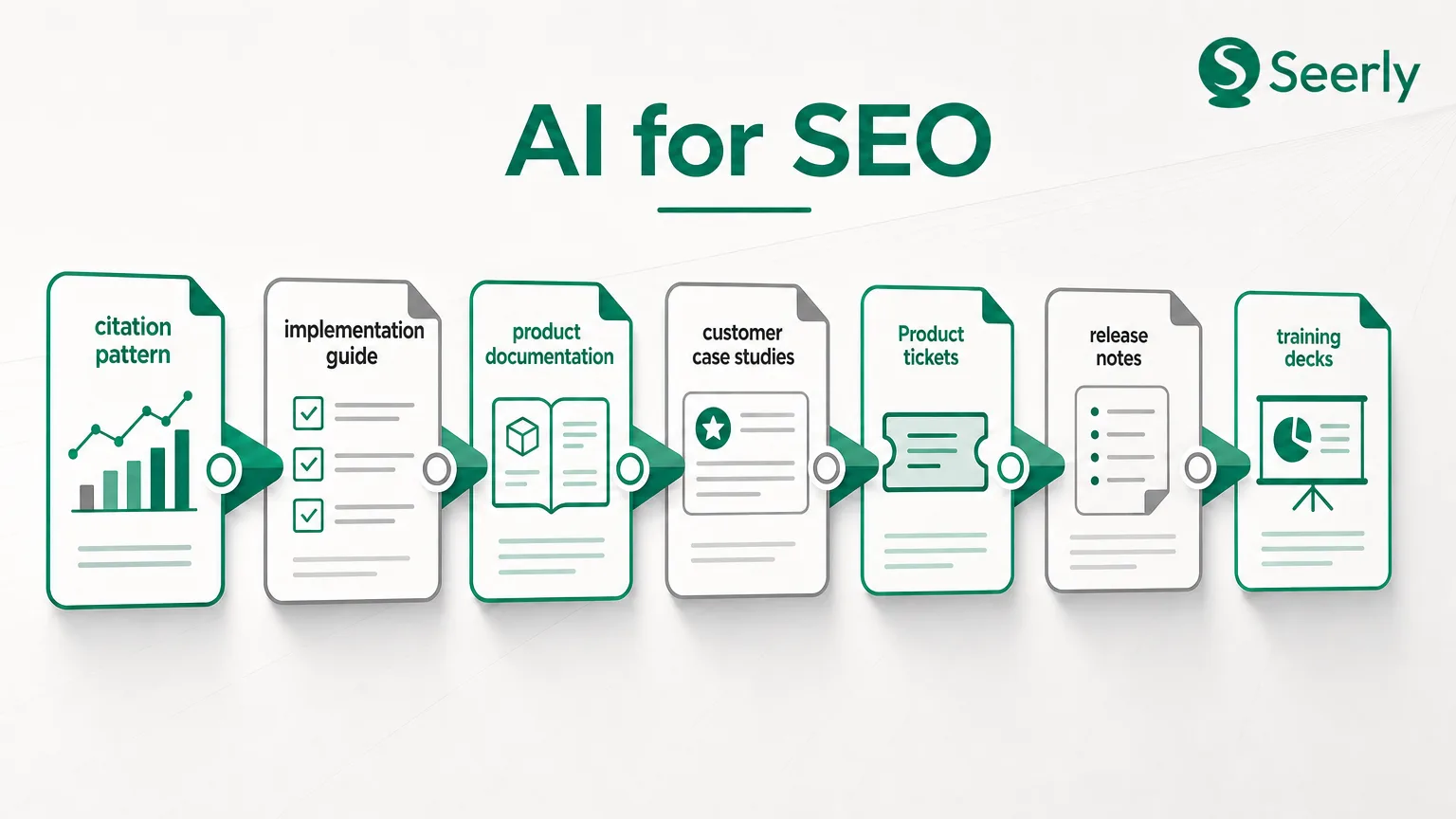
Start with the raw material an expert uses to do the job. Product tickets, implementation notes, support-call themes, release notes, customer questions, and training decks contain the useful friction that marketing copy often removes. The friction is often the point.
Use this update sequence:
-
Collect product and customer evidence. Ask the product owner for the actual configuration path, dependencies, known exceptions, and time expectations. Ask the customer-facing team which question prospects repeat after reading the page. Keep source material in the change record, not in someone’s memory.
-
Mark claims that lack support. Read the existing page sentence by sentence and label claims as documented, observed, opinion, or unsupported. “Cuts onboarding in half” needs a defensible basis. “Most teams start with one workflow” needs a clear source and scope.
-
Write the concrete explanation. Replace “quick setup” with the work involved: data mapping, user permissions, test environment, training, and handoff. You needn’t publish every technical detail. You do need to state enough that a buyer can judge fit.
-
State boundaries without hiding them. A credible page names when a feature does not apply, which plans include it, what requires professional services, or where a workaround still exists. The legal team may need a look. So might support.
-
Get a named expert approval. Ask one subject-matter owner to confirm factual accuracy and one editor to check that the language answers the reader’s question. Those are different jobs. Treating them as one review usually creates either errors or leaden prose.
Google’s guidance on generative AI content makes a similar point: publishers remain responsible for accuracy, relevance, and quality, even when they use AI in the workflow. Read Google’s guidance on using generative AI content as a prompt to keep human accountability attached to the page.
Where does AI belong? Use it to cluster recurring questions, compare draft coverage against a checklist, or flag claims that need an owner. Don’t let it manufacture customer experience or product behavior. That’s how pages become a beige fog of “efficiency” and “flexibility.” Nobody wants to buy beige fog.
What evidence helps a buyer evaluate options?
Evidence should match the question. A buyer comparing tools needs different material from a buyer checking compliance requirements. One dense proof section can be more useful than 800 extra words of positioning.
| Evidence type | Use it when the buyer asks | What good content looks like |
|---|---|---|
| Implementation detail | “How long will this take?” | Steps, prerequisites, roles, handoff points, and likely delays |
| Constraints and limits | “Will this work in our situation?” | Plan limits, exclusions, supported environments, and exceptions |
| Methodology | “How did you calculate that claim?” | Inputs, time period, assumptions, and what the result does not measure |
| Product documentation | “Can the product do X?” | Specific feature behavior, configuration notes, and version context |
| Real examples | “What happens in practice?” | A bounded scenario with the starting state, decision, and outcome |
| Named ownership | “Who is accountable?” | A product, legal, or technical owner responsible for review |
| Dated updates | “Is this still current?” | A visible update date and a note on what changed |
Product documentation works well for capability questions because it can be direct and testable. A case example works better when a buyer wants to understand adoption, trade-offs, or organizational change. Don’t force one into the job of the other.
Methodology deserves more attention than it gets. If you publish a performance claim, readers should know whether the result came from one customer, a sample of accounts, a controlled test, or an internal estimate. The Google AI search guidance advises site owners to maintain useful content and technical accessibility for Search, rather than creating separate content solely for AI features. Plainly stated methodology helps on both counts.
I personally prefer putting constraints near the relevant claim instead of burying them in a footer. “Available on Enterprise plans” belongs beside the feature description. “Results require CRM data from the prior 90 days” belongs beside the benchmark. Buyers notice when caveats arrive late.
How should teams record the reason for each content change?
Without a change log, teams end up telling themselves a comforting story after every result. A page gains references and someone claims the new heading did it. A page loses appearances and someone blames the last edit. Both stories may be wrong.
Keep one row for every documented update cycle. A shared spreadsheet is enough at first. What matters is the discipline of preserving the original observation, the evidence used, and the expected lesson before results arrive.
| Field | What to record |
|---|---|
| Page and date | URL, publication date, and date of the revision |
| Observed answer pattern | Prompt set, answer dates, cited source types, and changes noticed |
| Buyer question | The exact decision question the page should help answer |
| Evidence gap | Missing implementation detail, unclear methodology, stale documentation, or another specific gap |
| Source evidence | Links or internal records used to support the revised claim |
| Update owner | Writer, subject-matter reviewer, and final publisher |
| Review date | The date you will check prompts, analytics, and expert feedback |
| Expected learning | A testable statement, such as “adding plan limits may improve coverage for eligibility prompts” |
The expected-learning field changes the tone of the work. “Improve AI visibility” is too foggy to evaluate. “Check whether answers now reference our implementation guide for setup-time prompts” gives the team a real test.
At Seerly, we see the strongest editorial conversations happen when people can point to the original answer, the page revision, and the owner who approved the facts. No one has to reconstruct a decision from Slack fragments three months later. That alone saves a surprising amount of grief.
How can teams tell whether the update was worth repeating elsewhere?
Give the page enough time to be discovered and assessed, but avoid declaring victory from one favorable answer. Check the same documented prompt set at regular intervals. Keep query wording stable for the first review cycle, or you’ll test your wording changes and your page changes at the same time.
Use this measurement checklist:
-
Answer presence: Does the page or brand appear more often for the original buyer question and close variants?
-
Citation source change: Did the source mix move toward the evidence type you added, such as documentation or a methodological explanation?
-
Factual consistency: Do answers describe the feature, process, or limit correctly after the update?
-
Qualified visits: Are visitors reaching the page and taking meaningful next steps, such as viewing pricing, requesting a demo, or reading implementation material?
-
Expert-review feedback: Did the subject-matter owner find the new wording accurate, complete enough, and easy to maintain?
Avoid treating an appearance increase as a standalone win. A page may be mentioned more while visitors get a less clear answer, or while the answer misstates a limitation. Not ideal. Accuracy has to stay in the scorecard.
Qualified traffic also deserves a less simplistic read. Google has said that its AI search experiences are producing higher-quality clicks for some queries, while independent research shows less clicking when AI summaries appear. Your own analytics, segmented by page purpose and visitor behavior, will tell you more than either broad claim.
If one update improves answer presence, factual consistency, and relevant visitor behavior, look for comparable evidence gaps elsewhere. Don’t clone sentences across the site. Clone the research method: inspect the question, collect proof, clarify limits, get expert review, and measure the result.
Frequently asked questions
Should we rewrite every page after an AI citation shift?
No. Start with pages tied to important buyer questions, repeated prompt exposure, or factual risk. A single changed reference may reflect answer variation rather than a page problem, so confirm the pattern before committing editorial time.
How often should we check citation patterns?
Match the cadence to the page’s business importance and rate of change. Product, pricing, policy, and implementation pages may need monthly checks or checks after releases. Stable educational pages can work on a slower schedule.
Can AI draft the update?
AI can help organize notes and surface coverage gaps. A subject-matter owner should still verify product claims, customer examples, and limitations before publication. Draft speed is useful. Unsupported certainty is not.
What is the best first metric to watch?
Start with accurate answer presence for a defined buyer question, then pair it with qualified visits and expert-review feedback. One metric alone will tempt you into a flimsy conclusion.
Choose one high-value page with an obvious evidence gap this week. Run one documented update cycle, resist the urge to repaint every page, and let the result refine your wider AI for SEO editorial process.
Learn more about AI visibility workflows.