How to format answer blocks so rich snippets and AI systems can extract the same proof
A well-researched page can still be difficult to surface if its answer is buried inside long paragraphs, surrounded by broad marketing language, or separated from its supporting evidence. Effective formatting for rich snippets enhances visibility and improves AI extraction. A search system looking for a concise result and an AI system assembling a grounded response face a similar practical task: identify the claim, understand its scope, and determine whether the page provides enough proof to support it.
Think of a product page that says, “Our platform delivers powerful visibility for modern teams.” A person may infer the intended meaning from the surrounding page. A system has less room for interpretation. Compare that with: “Seerly monitors how a brand appears in AI-generated answers, helping teams identify citation gaps and visibility changes.” The second version states a specific capability in language that can be quoted, summarized, or paired with supporting detail.
Formatting alone does not earn rich snippets, rich results, AI citations, or rankings. Google explicitly notes that structured data can make a page eligible for enhanced search appearances, but it does not guarantee that Google will display one. Still, pages with concise claims, visible evidence, and scannable answer blocks give search features and AI systems clearer material to interpret and verify.
What extractable proof looks like
Extractable proof is a page element that connects a direct answer to the evidence that qualifies or supports it. It should make the subject, claim, conditions, and source clear without requiring a reader - or a system - to reconstruct the argument from multiple sections.
Consider this example from a hypothetical software comparison page.
Weak page section
Our analytics platform gives teams the insights they need to make smarter decisions. With intuitive reporting and advanced capabilities, businesses can improve performance across every stage of the customer journey.
This copy is polished but hard to use. “Insights,” “smarter decisions,” and “advanced capabilities” are undefined. There is no clear answer to a buyer’s question, no scope for the claim, and no evidence to corroborate it.
Improved page section
Summary: The platform combines campaign, conversion, and channel reporting in one dashboard so marketing teams can identify performance changes without reconciling separate exports.
Supporting detail: Users can filter reports by date range, channel, campaign, and conversion event, then export the selected view for stakeholder review.
Source attribution: Feature availability and report fields are documented in the product’s reporting guide, last reviewed in March 2025.
Direct answer: Yes. Teams can compare channel-level conversion performance from a single reporting view, provided the relevant campaign and conversion data are connected.
The improved version makes the key answer visible first, then gives context, limitation, and corroboration. That structure helps a human skim the page, helps an editor verify the copy, and gives search systems a coherent block to assess. It also avoids turning an unqualified feature claim into a vague promise.
Page formatting patterns that improve extractability
Use these patterns to improve the parts of a page that answer high-intent questions. The goal is not to make every section look identical. It is to make each important claim easy to locate, understand, and validate.
Concise definitions
When to use it: Use a definition near the start of educational pages, glossaries, feature explainers, and category pages where visitors may not share your terminology. Define the term in one or two plain-language sentences, then expand on implications below it.
Mistake to avoid: Do not define a term with circular language, such as “AI visibility is visibility in AI.” Also avoid packing the definition with every possible qualifier; that creates a sentence that is technically complete but difficult to quote.
Search intent served: This format addresses “what is” and “how does it work” queries. For example: “Rich results are enhanced Google Search displays, such as product, review, recipe, or FAQ-style appearances, that may be generated when a page qualifies under Google’s requirements.” The Search Gallery lists the supported rich result types, which makes it a useful reference when choosing the right page format and markup.
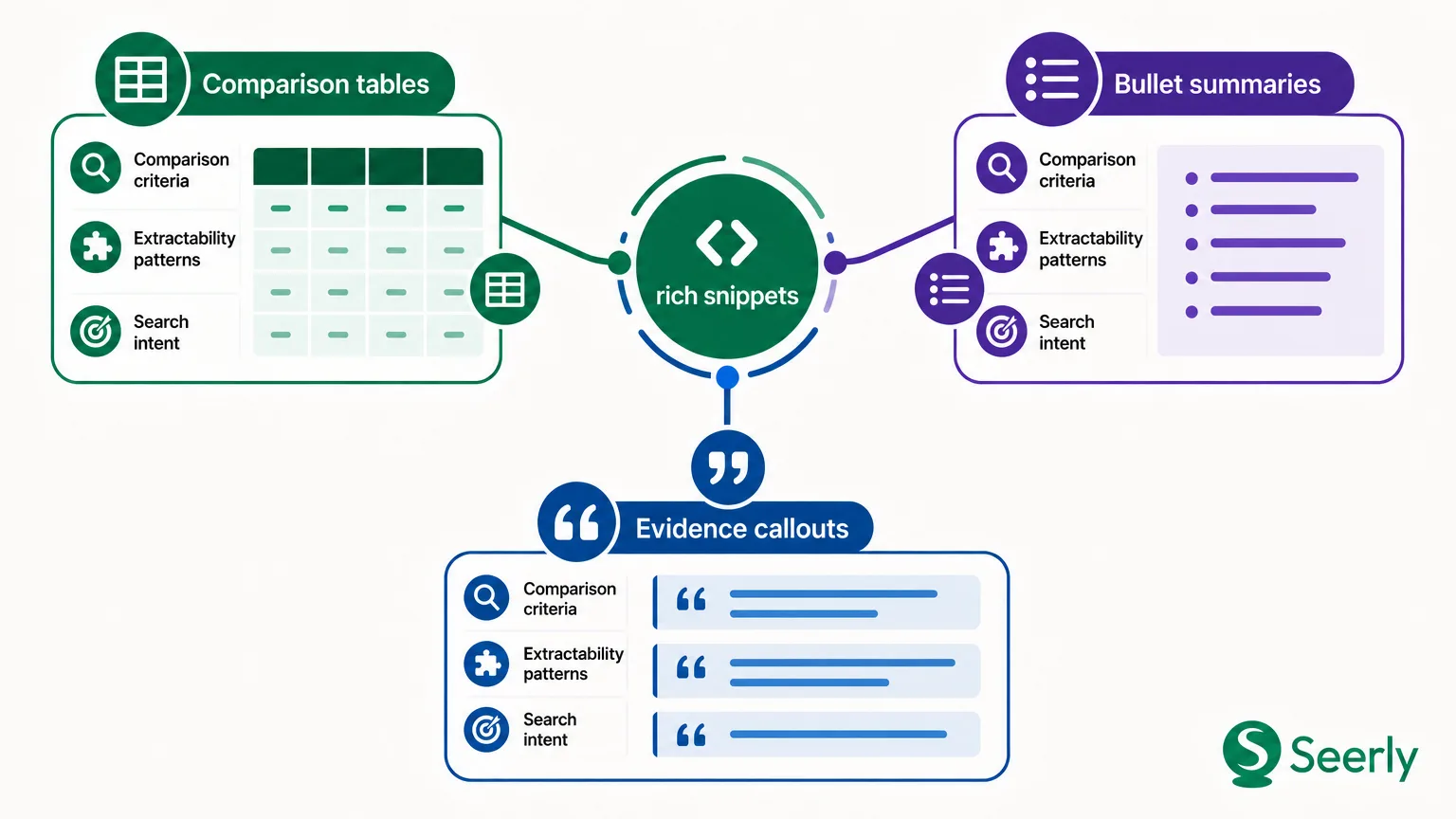
Comparison tables
When to use it: Use a table when readers need to evaluate two or more options against the same criteria: plans, methodologies, product capabilities, eligibility rules, or implementation approaches. A table reduces ambiguity because every comparison point appears in the same visual structure.
| Criterion | Weak comparison | Extractable comparison |
|---|---|---|
| Capability | “More powerful reporting” | “Exports channel and campaign data to CSV” |
| Limitation | Not stated | “Available on Business and Enterprise plans” |
| Evidence | “Trusted by teams” | “Linked to documentation or dated methodology” |
Mistake to avoid: Do not use tables to imply equivalence where criteria differ. A feature labelled “yes” may have usage limits, configuration requirements, or plan restrictions. Put those qualifications in the relevant cell rather than hiding them in a footnote.
Search intent served: Comparison tables support “X vs. Y,” “best option for,” and “does this include” queries. They also create a reliable review surface for content teams before claims are published.
Bullet summaries
When to use it: Use bullet summaries directly after an introductory answer when a user needs the essentials quickly: requirements, steps, included features, exclusions, or decision criteria. Keep each bullet parallel in structure and specific enough to stand alone.
Mistake to avoid: Avoid bullets that repeat a headline in slightly different words. A list of “better results,” “more insight,” and “greater control” adds visual structure without adding information.
Search intent served: Bullets fit task-based queries such as “how to qualify,” “what to include,” and “what are the requirements.” Use them to make the page’s answer available before the longer explanation, not as a substitute for it.
Evidence callouts
When to use it: Use an evidence callout after a claim that could affect a buyer’s decision: a performance statement, product limitation, compliance assertion, research finding, or pricing condition. Include the evidence type, the date, and a link or clear path to the underlying source.
Mistake to avoid: Do not treat a customer logo strip or an unqualified testimonial as proof of a universal outcome. If a result came from a case study, identify the organization, measurement period, and relevant context.
Search intent served: Evidence callouts serve evaluative searches where readers are asking, “Can I trust this?” They also align with a broader principle behind AI-ready websites: a claim is more useful when its basis is clear. Google’s own structured data guidance emphasizes that markup helps search engines understand page content, rather than replacing the content itself, in its introduction to structured data.
FAQ framing
When to use it: Use FAQs for recurring, narrowly answerable questions that your page has already addressed but readers need to find quickly. Start each answer with a direct response, then explain conditions or exceptions in the following sentences.
Mistake to avoid: Do not create an FAQ by restating every target keyword as a question. Questions should reflect genuine audience uncertainty and the answers must be visible, accurate, and consistent with the rest of the page.
Search intent served: FAQs work for “is,” “can,” “do I need,” and “how long” queries. If you add FAQ structured data, follow the eligibility and policy guidance rather than assuming markup produces an enhanced display.
Quote-ready sentences
When to use it: Use quote-ready sentences at the beginning of important sections, after a table, or immediately before detailed evidence. A quote-ready sentence names the subject, gives the answer, and states a meaningful condition.
Mistake to avoid: Do not write a sentence so absolute that it becomes inaccurate when extracted from context. “Schema guarantees rich snippets” is short but false. “Valid structured data can make an eligible page easier for Google to interpret, but does not guarantee a rich result” is both usable and appropriately qualified.
Search intent served: This pattern supports direct-answer queries and makes internal review faster. It can also improve the raw material available for summarization across search experiences.
Signals that weaken extractability
Before publishing or refreshing a page, check for signals that make its claims harder to interpret:
-
Generic claims: Replace “industry-leading” and “powerful” with a stated capability, process, or measurable scope.
-
Unsupported superlatives: If “fastest,” “best,” or “most accurate” cannot be corroborated, remove it or narrow it to a defensible statement.
-
Broken heading structure: Use headings that describe the question the following section answers. A vague heading such as “Why it matters” forces users to hunt for the actual point.
-
Hidden answers below the fold: Put the direct answer and key qualification early, then provide the detailed explanation. Do not require five paragraphs of brand narrative before answering a basic question.
-
Missing corroboration: Link claims to documentation, methodology, research, or dated evidence. If no source exists, phrase the statement as an opinion or remove it.
For pages that use schema, test implementation after the content update. Google’s Rich Results Test can identify which rich result types a page may be eligible for and flag markup issues. This is a validation step, not a visibility forecast; content quality, query fit, and Google’s own display decisions still matter.
Formatting for AI trust and verification workflows
AI search discovery introduces an additional editorial need: teams should be able to verify the claims an AI answer might summarize before that answer is used in sales, support, or reputation workflows. A well-formatted answer block reduces the chance that a reviewer mistakes a broad promotional statement for a documented fact.
Build verification into the content process. Assign an owner to each evidence-heavy block, record when the cited material was last checked, and ensure qualifying language remains close to the claim it limits. This makes updates more manageable when features, policies, or research findings change.
Technical validation remains important, but it should follow editorial clarity. Use a rich result testing workflow to make pages easier for AI engines to parse after strengthening the visible answer and proof on the page. That sequence supports more reliable trust signals without treating markup as a shortcut to visibility rankings.
FAQ
Do rich snippets guarantee visibility?
No. Rich snippets and rich results are not guaranteed by formatting or structured data. Google can choose whether and how to show an eligible result, based on its systems and the query context. Focus first on specific, useful content that answers a real question and follows applicable requirements.
Is schema required for rich snippets?
For many Google rich result types, structured data is needed for eligibility. However, schema does not replace visible page content, and not every search-result feature relies on the same markup. Match the schema type to the page’s real content and consult Google’s supported-feature documentation before implementation.
How can I update older pages without rewriting everything?
Start with the highest-value pages: those that drive qualified traffic, support sales conversations, or explain important product and educational topics. Rewrite only the answer sections first - add a summary sentence, clarify claims, surface limitations, and place evidence beside the relevant statement. Then test the page, monitor its search performance, and expand the update only where readers still need more context.
Pick three existing high-value pages and rework their answer sections, summaries, and evidence blocks this quarter. Compare how easily each page can be cited, summarized, and surfaced across search experiences - then use those findings to guide a more data-driven AI-ready content program.