Search Engine Positioning: 5 Guardrails for AI-Assisted Copy
AI-assisted rewriting can make a page read more smoothly in minutes. It can shorten sentences, remove repetition, sharpen headings, and produce a more confident tone. But those improvements can come at a cost: the revised page may answer a different question, speak to a less specific buyer, remove the proof behind a claim, or weaken the next step a visitor should take.
That is a search engine positioning problem, not just an editorial one. Search systems aim to surface content that is useful and relevant to a query, while visitors need clear evidence that a page solves their problem. Controlled updates help you preserve both. Instead of treating an AI rewrite as a finished draft, treat it as a proposed change to a page’s audience, intent, evidence, and conversion role.
The five guardrails below give your team a practical way to improve copy without weakening its purpose.
Guardrail 1: define the page’s non-negotiable job
Before you ask AI to rewrite a page, document what the page must continue to achieve. A page may have several supporting goals, but it should have one primary job. For example, a product page might help a comparison-stage buyer understand whether a platform supports a specific workflow. An AI rewrite that turns it into a broad explainer may sound polished while becoming less useful to that buyer.
This matters because Google describes its ranking systems as designed to identify helpful, reliable information created to benefit people. Helpful, people-first content is not just a writing style; it requires a clear match between the reader’s need and the page’s substance.
Create a short page charter before editing. It becomes the reference point for prompts, reviewers, and final approval.
Reusable page charter
-
Intended reader: Who is the page specifically for?
-
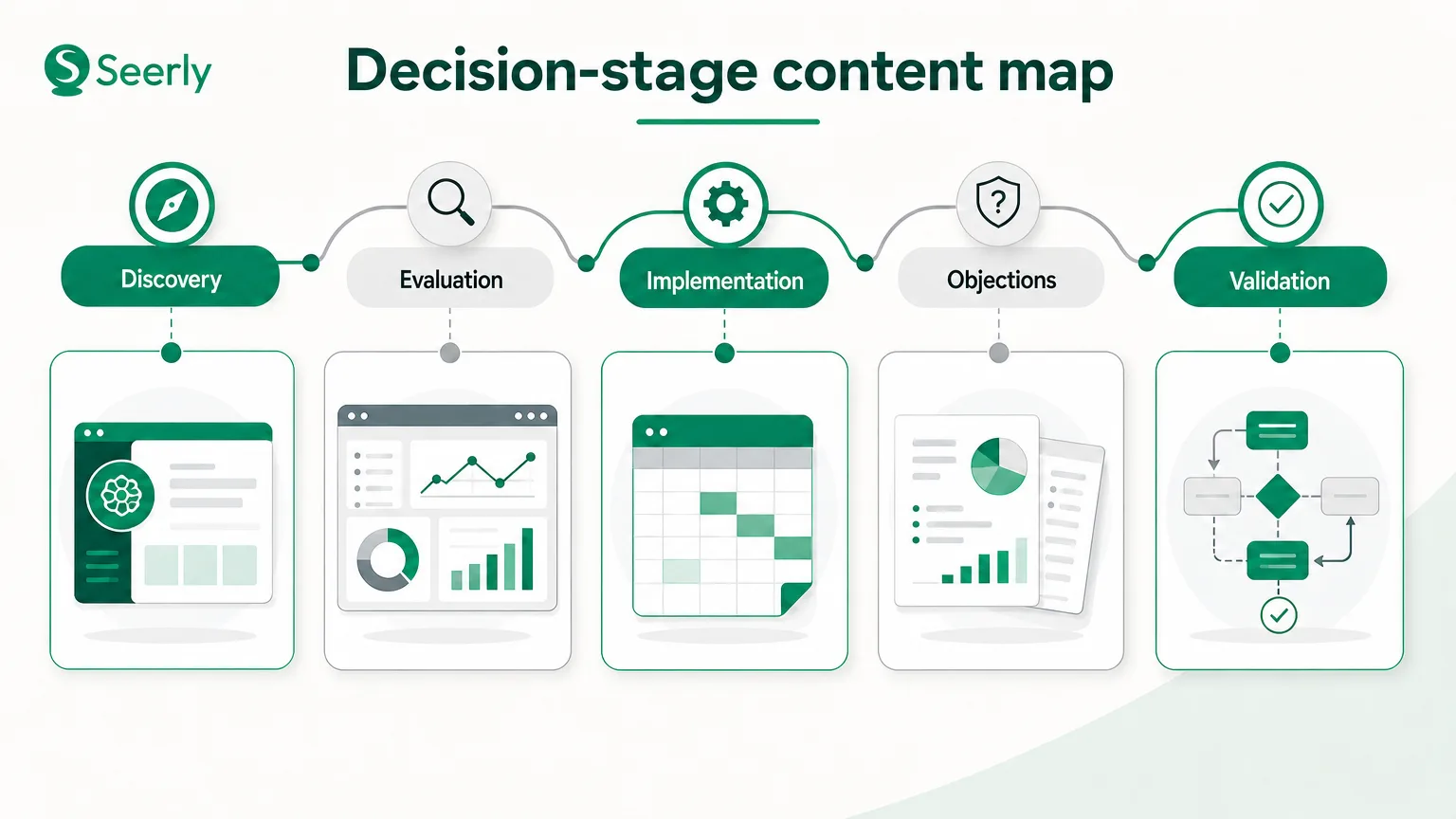
Decision stage: Are they learning, evaluating options, or ready to act?
-
Primary problem: What question or obstacle must the page resolve?
-
Required proof: Which examples, data, product details, reviews, or sources must remain?
-
Desired next action: What should a qualified visitor do after reading?
-
Claims requiring approval: Which statements need product, legal, customer, or executive sign-off?
For example, a page on AI visibility monitoring may be aimed at an SEO manager evaluating reporting tools - not a general reader seeking a definition of AI search. Its charter should require an explanation of what is monitored, how results are reviewed, and what actions the team can take. That clarity prevents an AI-assisted draft from flattening the page into generic “improve your visibility” language.
Guardrail 2: check for intent drift
Intent drift happens when a revised page still covers the same broad subject but no longer fulfils the reason a visitor arrived. It is easy to miss because the new version may be clearer, more concise, and better structured. The issue is not whether the prose improved. The issue is whether the page still answers the right query for the right person.
Consider this worked example for a SaaS product page.
Original copy:
Seerly helps SEO teams monitor how their brand appears in AI-powered search results, identify missing citations, and compare visibility across defined buyer questions.
AI-edited copy:
Modern brands need comprehensive digital marketing strategies to stay ahead of competitors. Our platform provides powerful insights that help you improve online presence, content performance, and market leadership.
The revision is grammatically clean, but it has moved away from the product’s specific use case. It broadens the audience from SEO teams to all brands, shifts the query purpose from evaluating AI search monitoring to general marketing strategy, introduces an unsupported competitive frame, and removes the distinct capabilities that make the page relevant.
Compare versions against four intent controls
Review the original and proposed draft side by side:
-
Audience: Does the rewrite retain the job role, industry, or situation the page serves?
-
Query purpose: Does it still answer the practical question behind the target search theme?
-
Topic boundaries: Has it added adjacent subjects that dilute the page’s focus?
-
Conversion relevance: Does the revised copy still lead naturally to the relevant product action, demo, resource, or next page?
Search engine positioning improvement is not achieved by making every page more general. Search results are shaped by multiple signals, including the meaning and relevance of the content to a user’s query. Specificity gives both search systems and buyers clearer context about what the page is for.
Guardrail 3: review claims before style
A human should verify high-impact claims before anyone spends time improving tone, grammar, or formatting. AI can produce plausible language around product capabilities, customer results, competitor comparisons, and compliance requirements. Plausible is not the same as approved, current, or provable.
Start with factual review because a polished unsupported claim can create more risk than an awkward sentence. This is especially important for pages that influence purchase decisions, describe regulated use cases, or position your product against alternatives. Search systems also evaluate signals connected to content quality and reliability, so accurate claims support both trust and long-term visibility.
Claim-review checklist
Before editorial polish, ask the accountable reviewer to confirm:
-
Product capabilities: Does the feature exist, and does it work as described today?
-
Performance statements: Is the result measurable, scoped, and supported by current evidence?
-
Customer outcomes: Do you have permission and documentation to use this example?
-
Comparisons: Are “best,” “faster,” “more accurate,” or competitor claims substantiated and fairly framed?
-
Legal and regulatory language: Has the appropriate internal owner approved it?
-
Dates and numbers: Are the figures current, and can a reader understand their context?
Separate the workflow into two decisions: factual approval confirms that a statement may be published; editorial approval confirms that it is clearly expressed in the brand voice. A copy editor can improve “We offer weekly monitoring” to “Review AI visibility trends each week,” but cannot decide whether weekly monitoring is available. That distinction is a core content governance control.
Guardrail 4: preserve the evidence
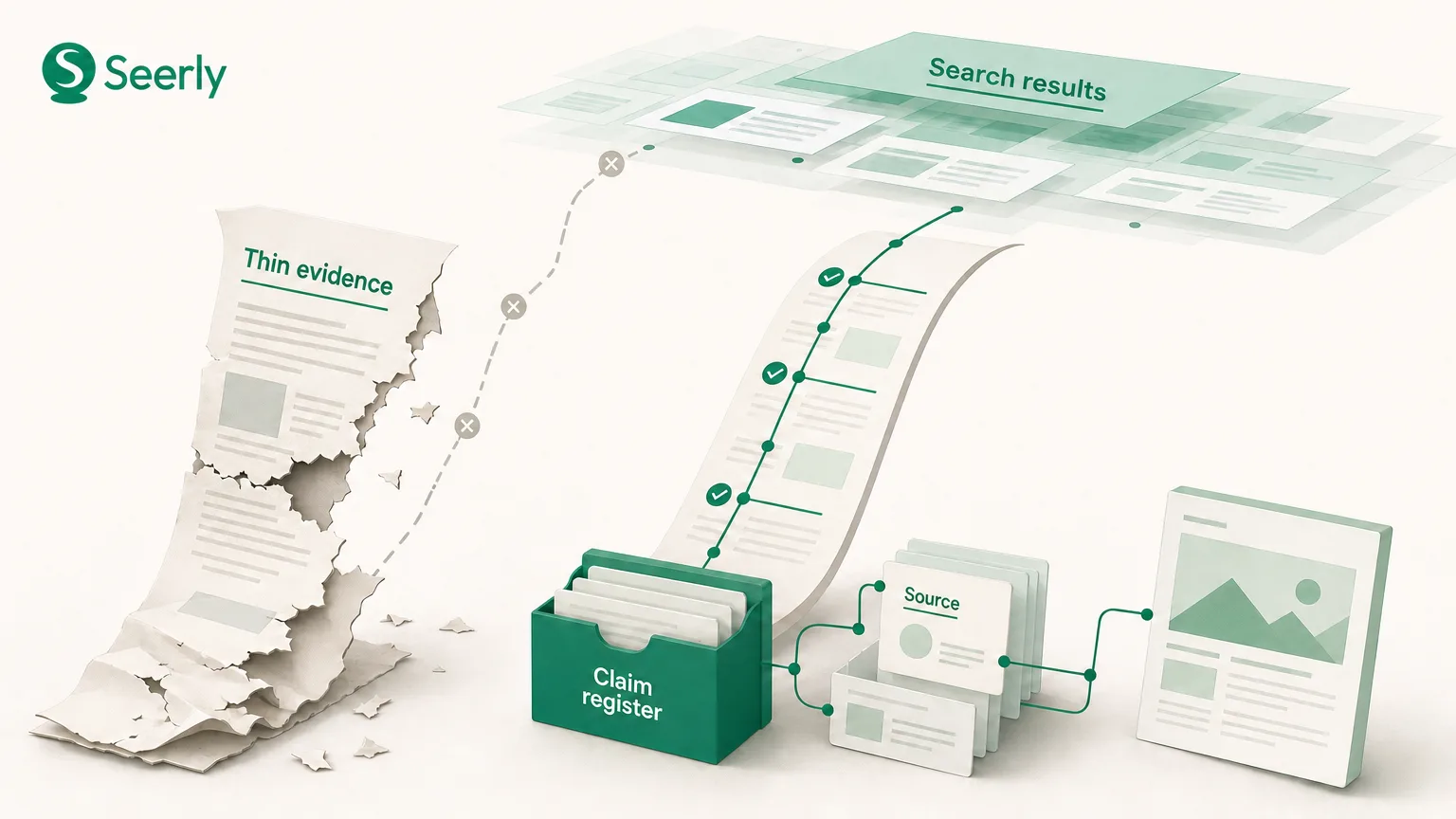
AI often removes the details that make a page credible. In an effort to simplify, it may delete implementation steps, source dates, limitations, named owners, methodology notes, customer context, and links to supporting material. The result may feel easier to scan, but it gives readers fewer reasons to believe the page.
Evidence quality matters because buyers need to assess whether a claim applies to their situation. It also matters for AI representation: source material with clear definitions, attributable claims, and accessible proof is easier to interpret than broad marketing language. If you are refining AI-generated pages, start by identifying whether the rewrite has introduced thin evidence that weakens search positioning.
Evidence-preservation checklist
Confirm that the revised version retains:
-
Product demonstrations or concrete workflow examples
-
Links to first-party documentation, research, or customer proof
-
The scope of a claim, including relevant conditions and limitations
-
The owner of a process, dataset, or result where accountability matters
-
Source context, such as dates, sample definitions, or reporting periods
-
Clear distinctions between product facts, customer opinions, and future plans
Do not preserve every detail by default. Remove outdated, repetitive, or irrelevant material. The goal is to retain the evidence required for the page charter, then present it more clearly. For high-consideration pages, a concise explanation plus a link to supporting documentation is often stronger than an unsupported headline claim.
Google’s guidance on structured data similarly emphasizes that markup must represent page content accurately and not mislead users. The same standard should apply to copy: content and structured information should be truthful and representative of what your business can support.
Guardrail 5: recheck the discovery path
Publication is not the end of the review. A lightweight post-publication check helps you see whether the revised page still matches the way people discover and evaluate it. You do not need to wait for a major ranking change. Look for directional signals that show whether the page remains connected to the right query themes and visitor journey.
Start with search query themes rather than individual keyword positions. Are the queries bringing visitors to the page still related to the reader and problem defined in the charter? Search Console and Analytics can be connected to compare search performance with on-site engagement, helping teams investigate whether visitors who arrive from relevant searches continue into meaningful journeys.
Then review entry-page behaviour. Look at the pages visitors reach next, the internal links they use, and where they leave. A revised feature page that now sends visitors primarily to broad educational content may signal that its conversion path is unclear. Conversely, a guide that attracts research-stage visitors but pushes them immediately to a demo may be too commercially abrupt.
Finally, add recurring buyer questions from sales calls, support tickets, and chat logs to your monitoring routine. If the same questions keep appearing after a rewrite, the page may have lost necessary explanation or proof. This is where search engine positioning software can support a better process: use it to monitor patterns, then have humans interpret whether the page is representing the brand accurately across search and AI discovery environments.
Build the guardrails into your approval workflow
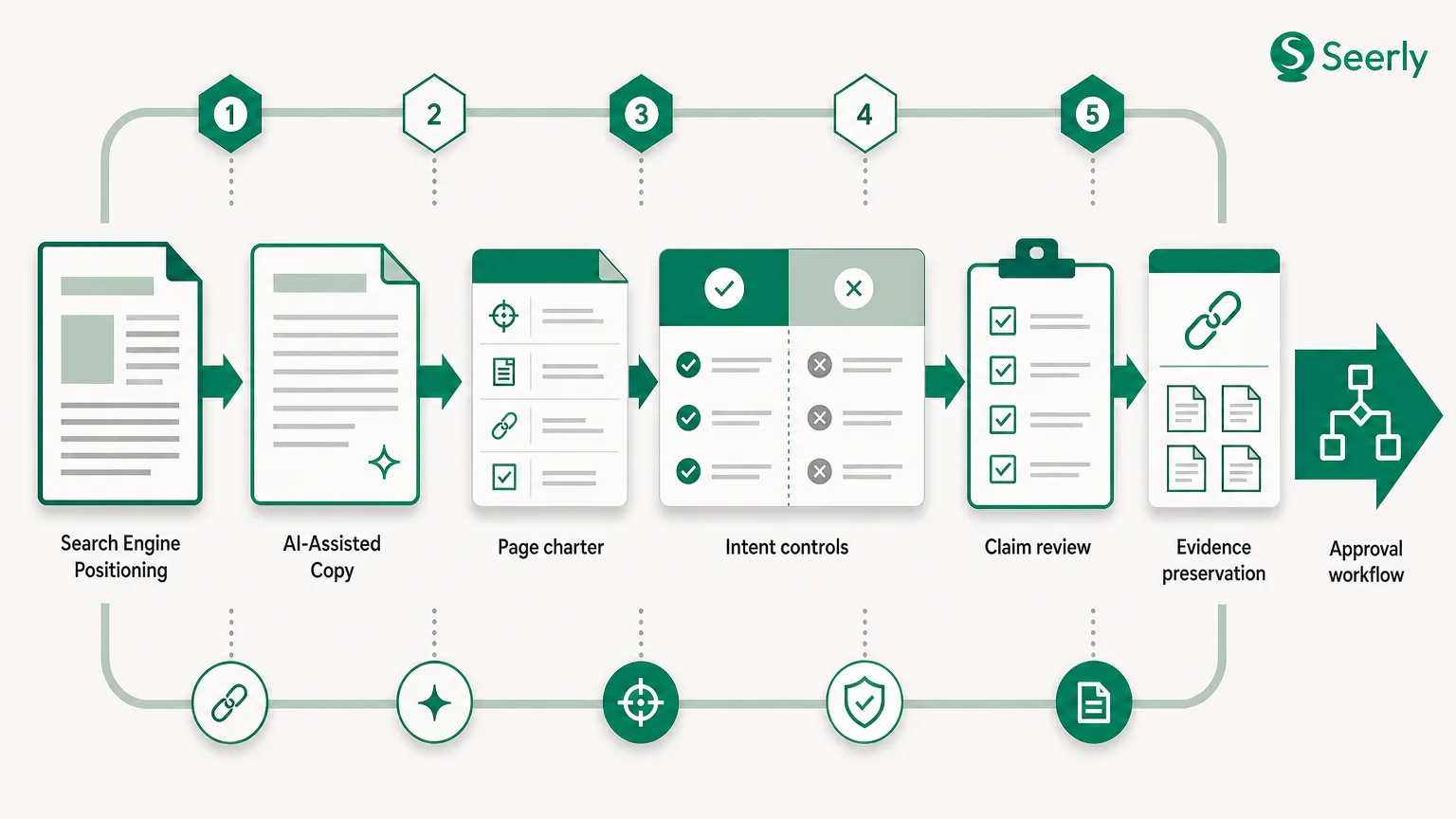
The practical workflow is simple: write the page charter, generate or request the AI-assisted draft, test it for intent drift, approve claims before style, preserve required evidence, and review the discovery path after publication. Assign clear owners: a content lead protects the charter and conversion role, a subject-matter expert approves claims, and an SEO manager checks search intent and discovery signals.
Keep a version log that records what changed, why it changed, which claims were reviewed, and who approved them. Set escalation rules for high-impact pages such as pricing, product capabilities, regulated industries, and competitor comparisons. This creates an audit trail without turning every copy update into a slow committee process.
AI can accelerate revision, but it cannot own your relevance, credibility, or brand representation. Use Seerly’s AI-readiness analysis and visibility monitoring to connect content changes with evidence quality, discovery outcomes, and how your brand appears over time.