A schema markup change-control process to keep marketing facts consistent
A marketing site can publish accurate new copy while still presenting outdated machine-readable facts. A product page may describe a revised plan, a new support policy, or a discontinued feature correctly for visitors, while its schema markup continues to expose the previous version. That gap can create confusing signals for search engines, downstream tools, and AI systems that assess public web evidence.
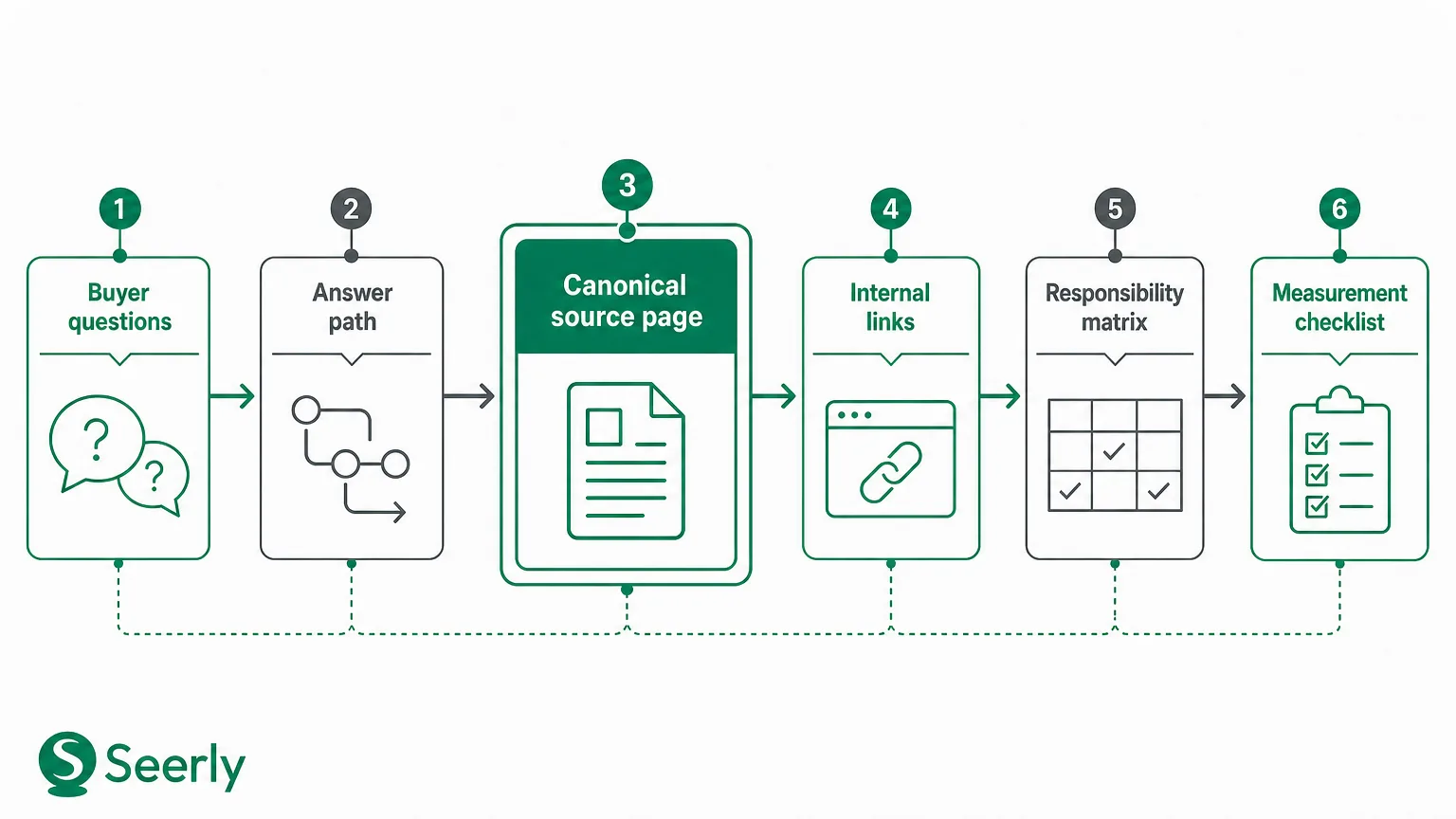
The operational fix is not a one-time schema implementation. It is a change-control process that treats structured data as a maintained evidence layer: every material claim has an owner, a source of truth, a validation step, and a record of the decision. This tutorial shows how marketing, web, and SEO teams can build that process into routine publishing work.
Why accurate page copy can still be undermined by stale schema markup
Schema markup is structured data that gives machines explicit context about entities and page content. The Schema.org data model defines types, properties, and relationships, while search platforms may use selected structured-data formats to understand and present eligible pages. The most common implementation format is JSON-LD, but the schema markup language is less important than whether the values remain accurate and supportable.
Problems usually emerge after ordinary site operations. A redesign can move support content or change canonical URLs. A CMS editor may update the headline and pricing table but not a manually maintained JSON-LD block. A migration may leave markup on old templates, duplicate Organization details across subdomains, or preserve offers that are no longer available.
Google’s policies are direct on the core issue: structured data should represent the main content of the page and not be misleading. In practice, that means a valid snippet of code is not necessarily trustworthy markup. If visible copy says “annual plans only” but an Offer object names a monthly price, the page contains contradictory public evidence even when the JSON syntax is flawless.
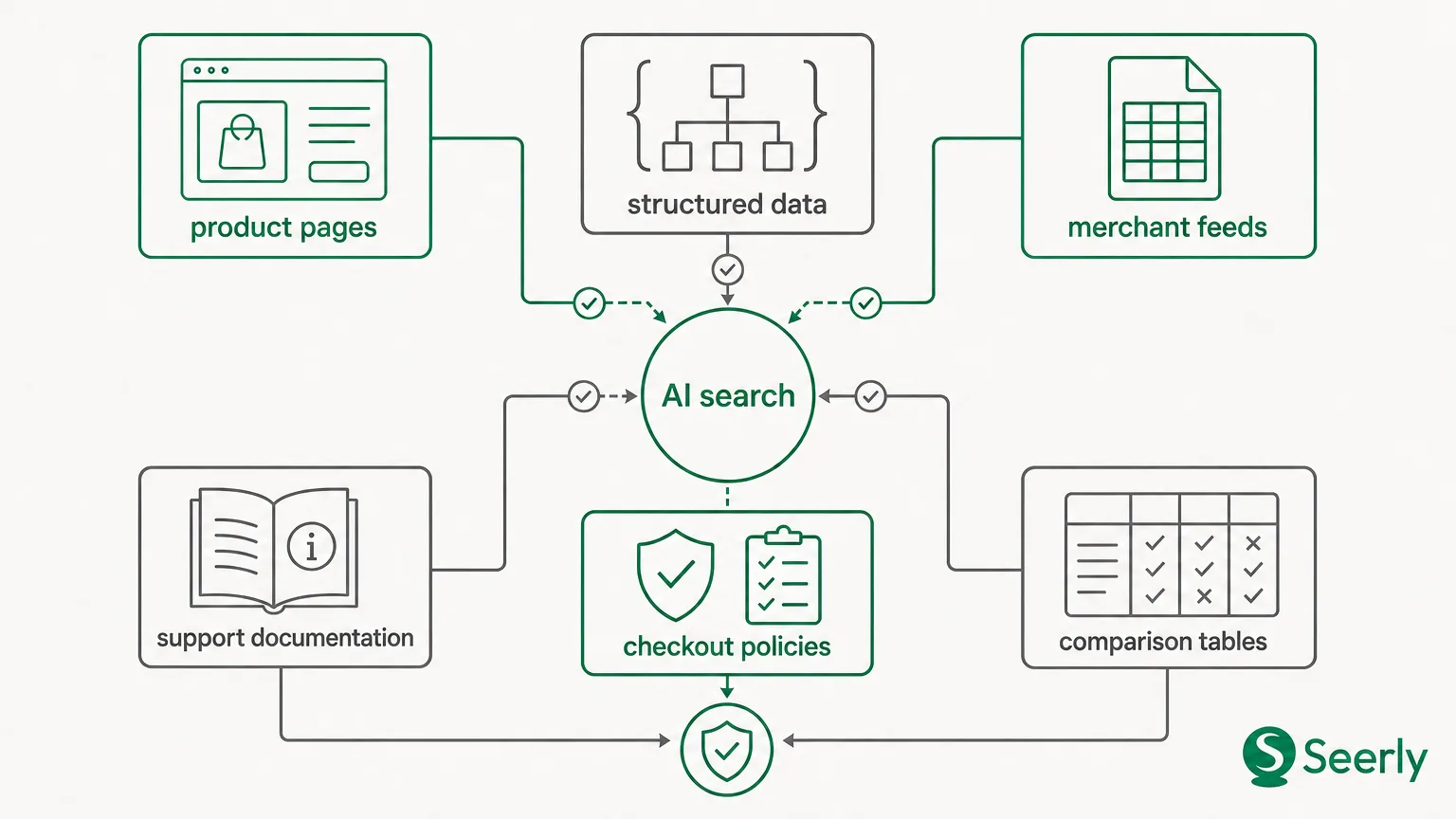
This matters beyond conventional search appearance. Teams working on AI-ready websites need consistent facts across pages, documentation, support resources, and markup because discoverability and credibility depend on verifiable evidence. Schema can clarify facts; it cannot repair conflicting source material. For more context on this distinction, see Seerly’s guide on whether schema markup can help AI citations.
Build an inventory of facts that need control
Begin by identifying claims that are material enough to require named ownership. Do not try to govern every descriptive phrase on the site. Instead, prioritize facts that influence how a company, product, offer, or page is identified and assessed.
Company and website identity
Assign an owner to company name, logo, primary domain, canonical website URL, social profiles, customer-support contact details, and legal entity information. These values commonly appear in Organization, WebSite, and related markup, often across shared templates. A single old logo URL or legacy brand name can therefore persist across hundreds of pages after a rebrand.
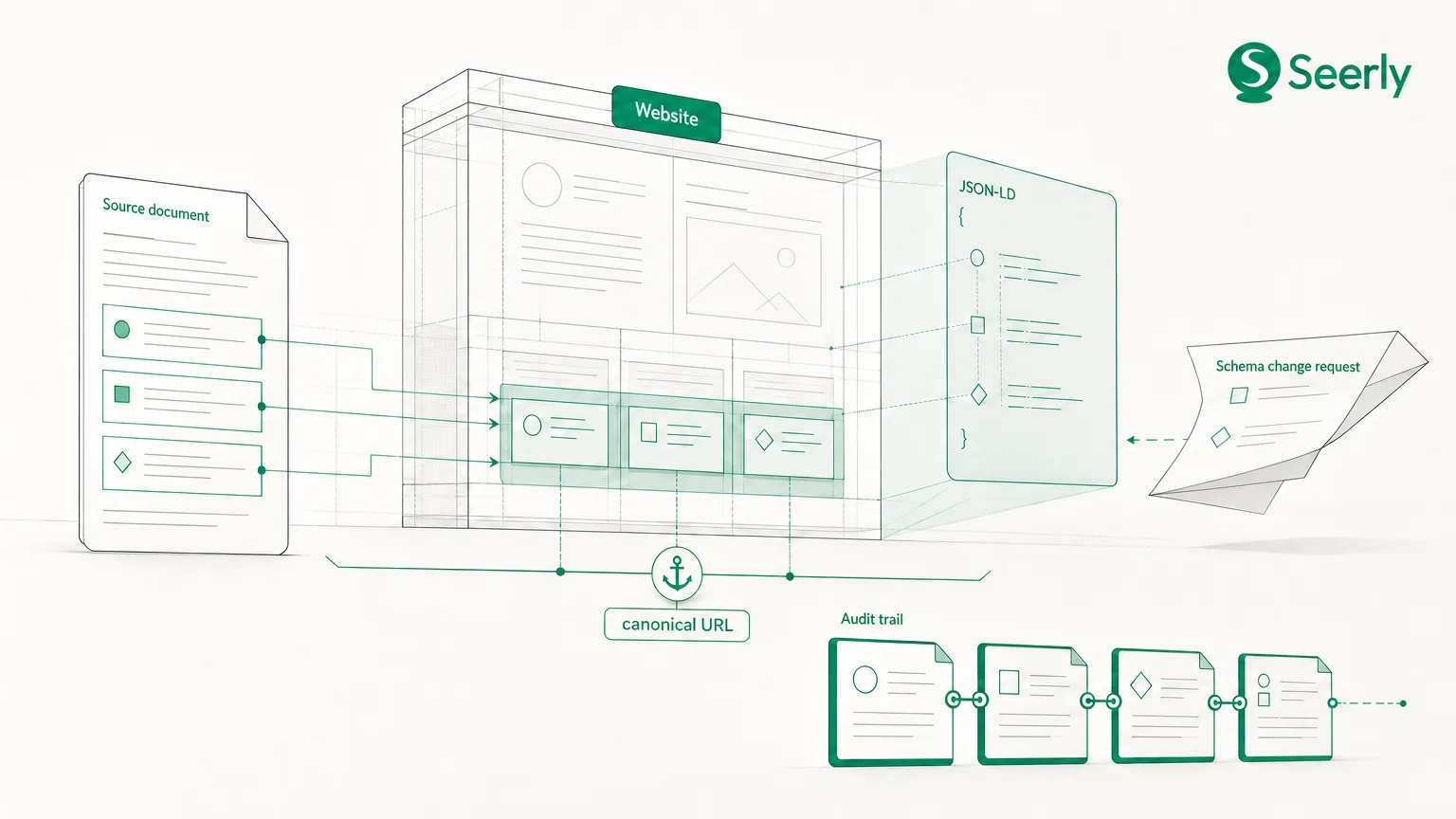
Make one team accountable for approving organization-level facts, usually brand operations, legal, or web governance. Maintain a central source document rather than allowing each page owner to recreate the information. Teams that need a deeper model for this work can review how Organization schema makes company facts easier to verify.
Product, offer, and support facts
For software, ecommerce, and service pages, inventory product names, descriptions, feature claims, price, currency, availability, trial conditions, ratings, and review statements. Product markup is particularly sensitive because Google’s guidance requires product data to reflect the product experience available on the page. If an offer is visible only to a limited segment or is expired, it should not remain as a broad public claim in markup.
Also control support details: documentation URLs, help-center locations, telephone numbers, support hours, and return or cancellation policies. These facts are often changed by customer-success or operations teams without a corresponding web request. Give each category a business owner who can confirm what is currently true, not merely what was true when the template was built.
Page-level claims and navigation
Finally, track claims tied to individual pages: article authorship, publication dates, event dates, FAQ answers, video details, and breadcrumb paths. Breadcrumb markup should mirror the site’s hierarchy; Google’s documentation notes that breadcrumb markup helps categorize a page within a site hierarchy. When a content hub is reorganized, the navigation and the markup need to change together.
Create a schema change request before development begins
A reliable workflow begins before a developer touches a template. Ask marketers, product managers, or content leads to submit a structured request whenever a material public fact changes. This prevents the developer from deciding which internal document is authoritative or inferring whether an update applies to one URL, a template family, or the entire domain.
Use this request template:
| Field | What to provide |
|---|---|
| Changed claim | The exact old and new statement, such as “14-day trial” to “No free trial” |
| Source of truth | Link to the approved pricing record, product documentation, legal policy, or brand record |
| Affected URLs | Individual URLs, a CMS content type, or a shared template |
| Markup type and property | For example, Product.offers, Organization.logo, or BreadcrumbList |
| Business approver | The person authorized to confirm the fact is accurate |
| Publication date | The intended go-live date and any expiry date |
| Implementation owner | The developer, SEO specialist, or agency responsible for the update |
A request should explain scope, not just wording. “Update pricing schema” is ambiguous; “replace the annual-plan price on 18 UK product URLs and remove monthly Offer values” is actionable. The requester should also identify whether the visible page copy, documentation, and support material will be updated in the same release.
Set a service-level expectation based on risk. A logo update may be handled in the next scheduled deployment, while an expired offer or regulated claim may need immediate correction. The key principle is simple: no material schema change is complete until the business owner confirms the fact and the implementation owner confirms the output.
Validate the markup and the page together
Schema markup validation has two separate jobs: checking whether the code can be parsed and checking whether it is an accurate representation of the canonical page. A team that stops at syntax validation can still publish misleading or obsolete information. Treat testing as a comparison between evidence, not as a pass/fail code exercise.
Check syntax and supported features
First, use a schema markup validator to test the rendered page or its JSON-LD. The Schema Markup Validator checks structured data against Schema.org vocabulary, which is useful for identifying invalid types, properties, and nesting. For Google-specific results, use the relevant testing tools and compare the implementation with Google’s structured-data feature guidance.
Warnings are not always defects, and valid code does not guarantee eligibility for a search feature. Google states that structured data does not guarantee a rich result will appear. Record the distinction in your workflow: “valid syntax” is a technical outcome, while “accurate, policy-aligned evidence” is the governance outcome.
Compare values with what visitors can verify
Next, open the rendered canonical page in a browser and compare each material property against visible copy. Check names, descriptions, pricing, availability, URLs, dates, support details, and ratings. If markup asserts a claim that a visitor cannot reasonably verify on the page or through an appropriately linked source, remove it or add the needed supporting content.
Then verify canonical-page alignment. Confirm that the URL being tested is indexable, that its canonical points to the intended page, and that the markup is not inherited from an irrelevant template. Google’s technical requirements include making pages accessible to Google and following the general search essentials, so schema quality should sit within, not replace, broader technical hygiene.
Finally, capture evidence: save validator output, screenshots of the relevant visible copy, the source-of-truth link, and the deployment reference. This makes schema markup validation repeatable when a question arises weeks later.
Resolve conflicting sources before publishing
Consider a SaaS company preparing a feature-page update. Product documentation says, “Exports are available on Enterprise.” Sales copy says, “Advanced export options on Pro and Enterprise.” The existing SoftwareApplication description says, “Exports included with every plan.”
Do not choose the most appealing claim or silently edit schema to match a sales campaign. Pause publication of the disputed markup and identify who owns the capability definition - typically product management, with input from pricing and legal where needed. The approved source should specify the capability, affected plans, relevant conditions, and effective date.
Once approved, update every affected public source in a coordinated release. In this example, the team might define “standard exports” and “advanced exports” separately, revise product documentation and sales copy to use those terms, and update the page markup to make only supported claims. Record the decision: what conflicted, which source prevailed, who approved it, and why. That annotation prevents the same debate from reappearing during the next launch.
Keep an audit trail that supports investigation
A change log turns schema maintenance from tribal knowledge into an operating system. It also gives agencies and internal teams a clean handoff record when ownership changes. Use one shared register or ticketing workflow rather than leaving evidence in release notes, chat threads, and individual spreadsheets.
For every material change, retain:
- URL and canonical URL
- Markup type, property, and previous versus new value
- Change reason, such as pricing update, migration, redesign, or factual correction
- Source-of-truth link and business approver
- Implementation owner and reviewer
- Schema markup validator result and visible-copy comparison result
- Evidence files, deployment date, and next review date
Set review dates based on how fast a fact can change. Pricing, availability, and campaign offers may require a monthly or release-based review. Corporate identity information may be reviewed quarterly, while evergreen articles can be checked during content refreshes. This risk-based approach gives teams coverage without creating an unmanageable manual audit.
Frequently asked questions
Can schema markup alone make a brand more trustworthy in AI search?
No. Markup can make entity and page facts easier for machines to interpret, but it cannot establish trust independently of the website’s visible evidence, documentation quality, reputation, or consistency across public channels. Google also makes clear that structured data is not a guarantee of enhanced search presentation, so it should never be treated as a shortcut to visibility.
A stronger approach is to align structured data with accurate pages, accessible documentation, and repeatable validation. Consistency gives search systems and users fewer reasons to encounter conflicting claims, which is a more realistic foundation for long-term AI search visibility.
How often should schema markup be reviewed?
Review it whenever a material fact changes, not only during an annual SEO audit. Trigger a review for product releases, pricing changes, promotions, migrations, redesigns, rebrands, content-template updates, and changes to policy or support information. Add scheduled checks for high-value pages to catch problems caused by template changes or CMS publishing errors.
Should every page have schema markup?
No. Prioritize pages where structured data accurately describes meaningful, visible content and where your team can maintain it. Google recommends using structured data that follows its quality guidelines and is relevant to the page. Expanding markup coverage without an ownership model usually increases maintenance risk.
Make schema governance part of publishing
The central lesson is that schema markup is maintained evidence, not a set-and-forget technical enhancement. Every material site change should have an accountable owner, an approved source, validation against the rendered page, and a recorded result. That discipline reduces contradictions before they become search, brand, or customer-trust issues.
Start with your ten most commercially important pages. Inventory every claim in their markup, identify the source of truth for each claim, and assign a named review owner for every recurring schema change. When you are ready to make this process part of broader AI search visibility monitoring, explore Seerly.