How software companies can publish verifiable product facts with schema markup
A software company can have an accurate product, a well-written website, and a clear positioning statement - yet still publish conflicting facts across its homepage, product pages, pricing pages, help centre, and legal footer. A product name is shortened in one template, pricing is updated in another, and the company behind the product is never stated consistently. Those discrepancies make it harder for people and search systems to understand what the business actually offers.
Schema markup helps make these facts easier to interpret in a machine-readable form. It does not prove a claim, guarantee rankings, or ensure a rich result. Its most useful role is to express public facts that visitors can already see and verify, using a format that supports clearer entity understanding and more reliable publishing operations.
Start with visible facts, not markup
Schema markup is a shared vocabulary for describing entities and relationships on the web. A company can use it to identify its organisation, product, support channels, pricing offers, and official web pages. It gives search systems structured context alongside the visible page, rather than requiring them to infer every relationship from unstructured copy alone.
For most marketing and web teams, JSON-LD is the practical schema markup language to use. It places structured data in a script block and separates the data model from the page’s presentation layer. The JSON-LD specification defines a JSON-based format for linked data, which makes it well suited to declaring identifiers and relationships such as “this application is published by this organisation.”
However, markup is only an assertion. It cannot demonstrate that a product is the market leader, that an offer is still available, or that a rating was collected legitimately. Google’s structured data policies require markup to represent content that is visible to users, and they prohibit misleading or irrelevant implementations. Treat the rendered page as the evidence and the markup as a precise representation of that evidence.
This is particularly important for AI-ready websites. Search and AI systems may retrieve facts from several pages, third-party references, and technical signals. Consistent public information gives those systems less ambiguity to resolve. For a wider view of this relationship, see how organisation schema can make company facts easier to verify.
Build a fact inventory before adding schema markup
Do not begin by selecting every possible Schema.org property. Begin with an inventory of facts your company can support on the relevant page. This turns markup from a one-off development request into a controlled review of the information that shapes product discovery.
Reconcile organisation facts
Create one canonical record for your company’s legal or public-facing name, logo, primary website URL, social profiles, customer support address, and contact methods. Decide whether the brand name and legal company name are different, then make that distinction explicit in visible copy where it matters. If a product page says “by Northstar,” while the footer says “Northstar Labs Ltd.” and the privacy policy uses another variation, resolve the ambiguity before publishing structured data.
Your organisation record should also identify the pages that substantiate key details. The contact page should show the support route you mark up. The about page should establish the company identity. The logo used in structured data should be the official, stable version - not an experimental campaign asset that may disappear after a quarter.
Reconcile product, support, and pricing facts
For each application, document its exact product name, short description, application category, operating environment where applicable, official product URL, publisher, support destination, and current offer details. A SaaS product does not need a downloadable installer to be described as a SoftwareApplication, but its page should still make the product’s purpose and availability understandable to visitors.
Pricing deserves separate governance. If the visible page says “Plans from $49/month,” do not mark up a $29 price left over from an old launch page. If pricing is quote-based, represent the sales process honestly rather than inventing a numerical offer. Likewise, do not add aggregate ratings, review counts, compatibility claims, awards, or feature claims unless they are genuinely displayed and maintained on the page.
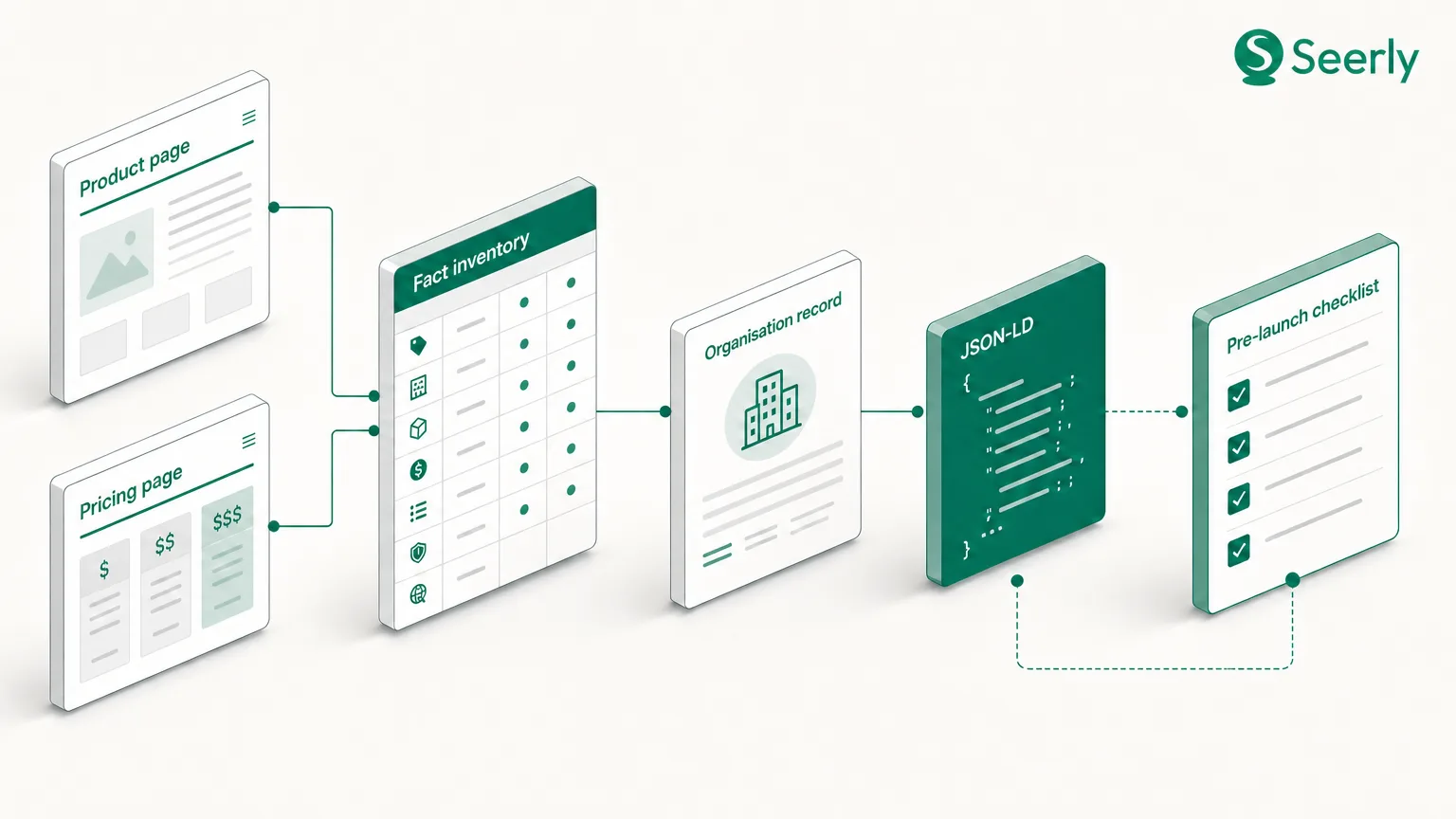
A useful inventory is a simple table with four columns: fact, source URL, content owner, and schema property. It creates a traceable path from the statement a visitor sees to the structured field a crawler receives. That evidence-led approach is more durable than treating markup as a technical checklist.
Map page evidence to organisation and product properties
Schema markup design works best when each page has a clear job. The sitewide organisation entity establishes who the company is. A product page describes the particular software offering. Both can reference stable identifiers so systems can understand that the product and publisher are related rather than unrelated names repeated across pages.
Use stable identifiers and narrow claims
Give the organisation a consistent @id, typically a canonical URL fragment, and reference that same identifier from product markup. On a product page, use SoftwareApplication for the application and connect its publisher to the organisation. Use name, description, url, and applicationCategory only when the corresponding information is visible and current.
The following fictional example shows a restrained implementation. It communicates the relationship between the product and publisher without introducing unsupported performance claims, ratings, or prices.
{
  "@context": "https://schema.org",
  "@type": "SoftwareApplication",
  "@id": "https://www.northstar.example/products/atlas#software",
  "name": "Atlas Workspace",
  "description": "Atlas Workspace helps revenue teams manage account research and planning.",
  "url": "https://www.northstar.example/products/atlas",
  "applicationCategory": "BusinessApplication",
  "publisher": {
    "@type": "Organization",
    "@id": "https://www.northstar.example/#organization",
    "name": "Northstar Software"
  }
}
Schema.org’s getting-started guidance explains how types and properties describe things on the web. The goal is not to fill every optional field. It is to select the smallest accurate model that helps identify the entity, describe it clearly, and connect it to supporting public evidence.
Avoid “aspirational” properties
Marketing language changes quickly, while schema can persist through CMS templates and cached pages. Avoid marking up “best,” “most trusted,” “AI-powered,” or “enterprise-ready” as if those statements were stable factual attributes. If a page has a specific, documented feature - such as SSO availability or an iOS app - describe it visibly first, then decide whether the relevant property is necessary and supportable.
Also distinguish a product from the company that makes it. A product name should not replace the publisher name in Organization markup simply because both appear in the same navigation. This is a common source of entity confusion, especially after acquisitions, rebrands, or product-line expansions.
Worked example: cleaning up a fictional SaaS product page
Consider a fictional analytics platform called “SignalBoard.” Before review, its product page headline says “SignalBoard AI,” the navigation says “Signal Board,” and the footer identifies the company as “Brightpath Inc.” Its JSON-LD calls the product “Brightpath Analytics,” points to a retired pricing URL, and lists a social profile for a former brand.
The site may still be understandable to a human visitor, but the public facts are fragmented. A structured-data cleanup should begin by deciding which facts are canonical. The team confirms that the product is officially “SignalBoard,” that “SignalBoard AI” is a campaign descriptor rather than the product name, and that Brightpath Inc. is the publisher. It also replaces the retired pricing path with the live product page and removes the obsolete social profile.
After the review, the visible headline uses “SignalBoard,” the introductory copy explains what it does, and an “About Brightpath” link establishes the publisher relationship. The markup mirrors those changes with name: SignalBoard, a concise page-supported description, a canonical url, and a publisher reference to Brightpath’s organisation identifier. The resulting schema is not more impressive; it is more defensible.
That distinction matters when teams assess AI search visibility. Schema can contribute useful context, but it is not a reliable shortcut to being cited or surfaced. Read more about whether schema markup helps AI citations before setting success metrics around outcomes markup alone cannot promise.
Validate markup and release it like production content
Schema markup validation should happen before and after deployment because syntax can be correct while the live page is inaccurate. A CMS migration, pricing-module update, localisation rule, or inherited template can silently change the visible content without updating the JSON-LD.
Pre-launch checklist
Before release, confirm the following with the page owner, developer, and reviewer:
- Check the rendered page - not only the CMS preview - and confirm every marked-up name, description, URL, price, support detail, and publisher relationship is visible and current. Review desktop and mobile templates if their content differs.
- Run the code through the Schema Markup Validator, which checks Schema.org structured data. Fix parsing errors first, then investigate warnings in the context of the page rather than adding data merely to remove a warning.
- Test any Google-specific implementation against Google’s structured data documentation and feature requirements. Eligibility requirements vary by feature, and valid Schema.org vocabulary alone does not make a page eligible for a Google enhancement.
- Inspect template inheritance. A product component added globally can accidentally apply one product’s description or offer to dozens of pages.
Post-release monitoring
After launch, compare the live HTML source and rendered DOM with the approved record. Check canonical URLs, language variants, staging exclusions, and pages generated from the same template. Log what changed, why it changed, who approved it, and the date of the next review.
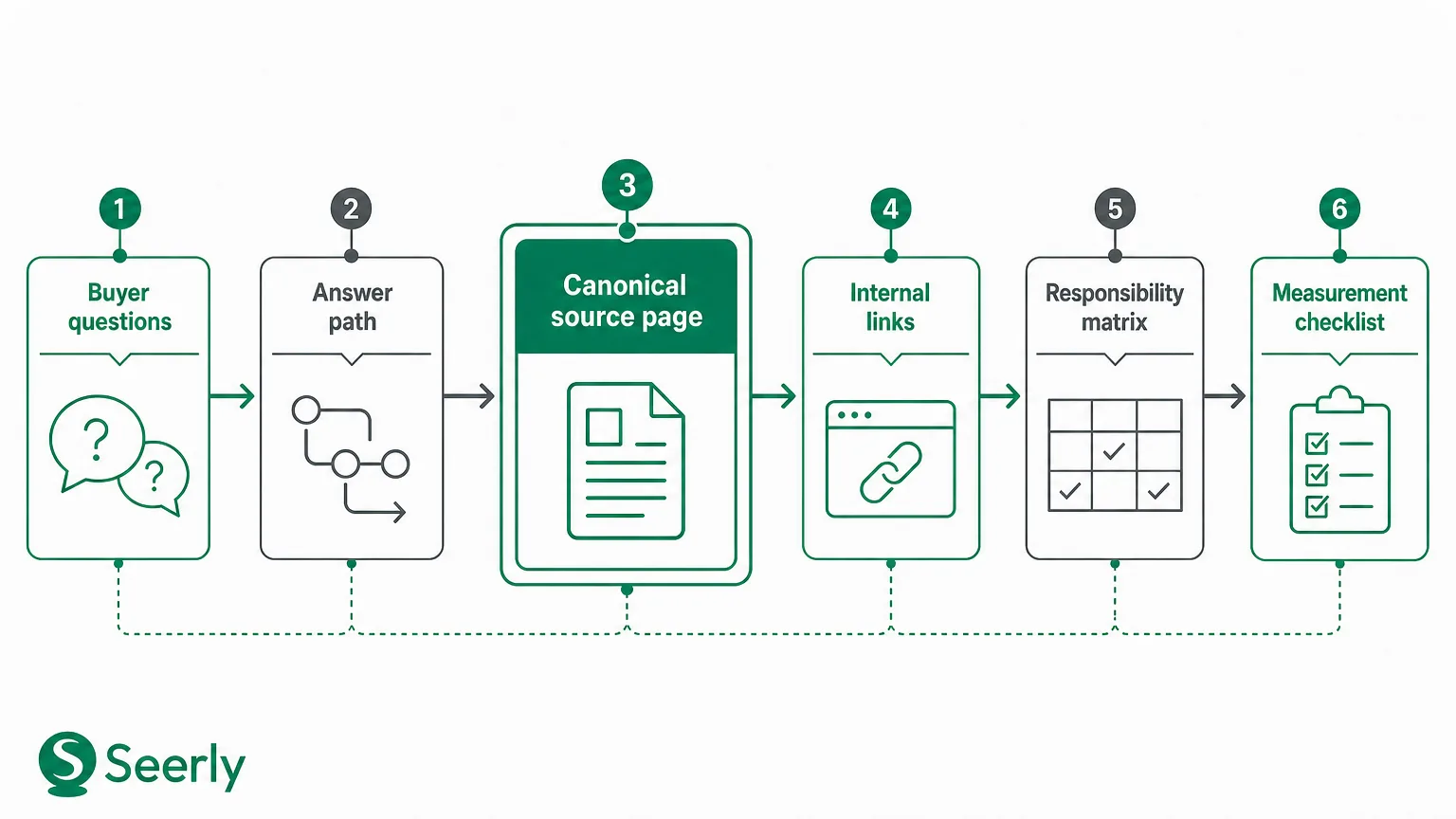
Assign clear ownership: marketing owns customer-facing claims and product naming; product or commercial owners approve pricing and availability; development owns deployment quality; and a designated web owner coordinates the final evidence check. Teams that formalise this handoff can reduce recurring inaccuracies through a schema change-control process for marketing site facts.
Governance FAQ
Who should approve changes to schema markup?
Approval should match the type of fact being changed. A developer can safely implement a technical correction, but product naming should be approved by the product or brand owner, and pricing should be approved by the commercial owner. The final approver should confirm that visible content and structured data state the same thing.
How often should schema markup be reviewed?
Review it whenever a fact changes: a rebrand, new pricing, product retirement, support-channel change, acquisition, domain migration, or template redesign should trigger a check. In addition, run a scheduled quarterly audit of high-value pages such as the homepage, core product pages, pricing, and contact pages. This catches drift introduced by routine publishing work.
Does validation guarantee rich results, rankings, or citations?
No. A schema markup validator can verify syntax and vocabulary usage, while platform tools can evaluate feature-specific eligibility. Google states that structured data does not guarantee rich results, and no validator can guarantee rankings or citations in AI search experiences. Validation is quality control, not an outcome promise.
Make schema markup part of fact governance
The most valuable schema markup is accurate, visible, and governed. It gives search systems clearer signals about your organisation and software products while forcing an equally useful question internally: can we substantiate every important public claim on this page?
Start with an evidence-led site review in Seerly’s Foundations > Smart Audit > Readiness Check. Document priority fixes in Foundations > Web Presence, then track implementation through Execution > Tracked Actions. For teams building a more reliable foundation for AI search visibility, Seerly helps connect website quality checks with measurable improvement work.