How to Prioritize AI Search Channels When You Need Your First Visitors, Not Just Better Rankings
Marketing teams are often trying to answer a broader acquisition question: should they invest in a particular AI search channel, conversational tools such as ChatGPT, traditional search, or the specialist communities where buyers actually compare products? AI-assisted discovery now influences how buyers research, shortlist, validate, and revisit products. For an early-stage company, however, that does not mean every AI surface deserves equal investment.
A recent Trend Finder signal illustrates the practical demand behind this question: a post about “how to get traffic from ChatGPT” attracted 69 likes and 3.8K views on X. Operators are not looking for broad theory about AI search. They want a credible route to their first qualified visitors, conversations, and pipeline.
The right channel is not the most talked-about model. It is the channel where your buyer intent, retrievability, and measurement capabilities meet.
Why “Be Everywhere in AI Search” Is a Poor Strategy for Lean Teams
“Be everywhere” sounds ambitious, but it usually produces fragmented content and weak learning loops. A small marketing team may publish generic explainers, chase every new answer engine, and celebrate occasional brand mentions without knowing whether those mentions influence demand. That approach consumes scarce editorial, product marketing, and technical resources before the team has established what buyers actually need from them.
AI search discovery is not one channel with one set of rules. Conversational assistants respond to multi-step questions, Google AI experiences can support searches already tied to traditional query demand, and niche communities influence trust through practitioner discussion. Each surface rewards different evidence, content formats, and distribution patterns. Google itself has described its effort to bring more generative AI capabilities into Search, reinforcing that search behavior is evolving rather than being replaced by a single destination.
There is also a quality risk in treating AI visibility as an automatic win. Research and public testing continue to show that language models can present inaccurate claims confidently; one red-team assessment found that both ChatGPT and Google Bard could still spread misinformation.
For a lean team, the better goal is narrower: choose one discovery channel where you can publish durable proof, observe meaningful feedback, and improve your position over a quarter. Once that channel produces signs of qualified attention, expand with evidence rather than hype.
The Four Channel-Selection Criteria That Matter Most
A practical AI search strategy begins with business outcomes. Before deciding whether ChatGPT, Google AI experiences, or industry platforms matter most, assess each option against four criteria.
Buyer Intent Proximity
Start with the questions that appear immediately before a buyer takes action. “What is the best product category for our team?” is useful awareness intent. “Which alternatives fit a 50-person SaaS company with SOC 2 requirements?” is far closer to evaluation and potentially far more valuable.
A channel deserves priority when it reliably exposes your brand to questions near a commercial decision. For example, a technical workflow tool may find stronger early intent in developer communities and implementation comparisons than in broad conversational questions. Conversely, a new category creator may need explanatory content that helps buyers understand the problem before they can evaluate vendors.
Ability to Earn Retrieval
Retrievability is the realistic chance that a platform can find, trust, and use your content when responding to a relevant question. It depends on whether your page directly answers the question, demonstrates original expertise, and provides information that can be checked against credible sources. A page with vague positioning may rank somewhere in classic search, but it is less useful to an answer engine assembling a concise recommendation.
This is why evidence-led publishing matters. The research community has developed benchmarks specifically for evaluating factual grounding in large language models, a reminder that factual reliability is central to useful AI answers. Brands can support retrieval by publishing named methodologies, clear definitions, transparent data, dated research, and firsthand practitioner findings.
Speed of Feedback
Early-stage teams need a feedback loop faster than an annual SEO roadmap. Ask how quickly you can see whether the target questions produce impressions, citations, referral traffic, assisted conversions, or sales-call language. A channel with modest volume but observable feedback may be more valuable than a large channel where attribution is impossible.
Conversational discovery can reveal emerging questions quickly, especially where people ask for recommendations, workflows, or explanations. Classic search remains useful because query trends, rankings, and landing-page behavior are more established. The important point is not to confuse fast publishing with fast learning: content must be tied to a specific question set and tracked consistently.
Ease of Measurement
Prioritize channels where your team can build a baseline before making a large investment. If you cannot define the relevant questions, capture visibility, or connect exposure to downstream outcomes, the channel is not yet ready for a major content bet. Measurement does not need to be perfect, but it must support decisions.
Track whether your brand appears, how it is described, whether it is cited, and whether associated visitors progress. This aligns with the wider shift toward helping SaaS buyers find relevant products through AI search optimization built around buyer needs, not simply pursuing a higher count of unqualified sessions.
A Simple Prioritization Matrix for Early-Stage Teams
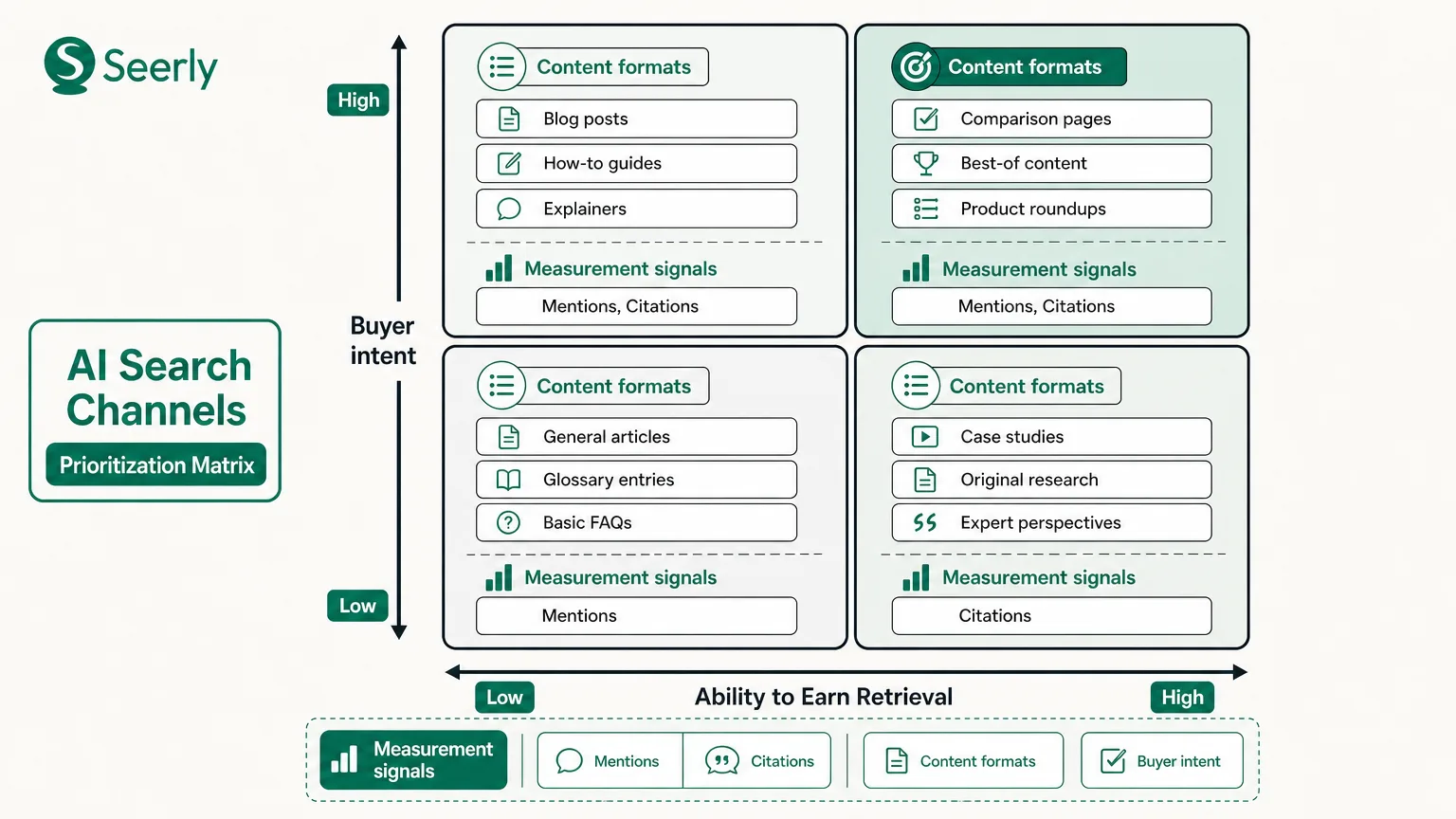
Use the matrix below to choose a primary channel based on your company’s current demand, evidence base, and marketing capacity. These are not mutually exclusive channels; they are sequencing choices.
| Channel | Best when you need first visitors | Best when brand demand is mature | What makes it retrievable | Primary measurement signal |
|---|---|---|---|---|
| Conversational discovery | Buyers ask broad, multi-step questions and need education | Buyers request direct vendor comparisons | Clear explainers, practitioner evidence, comparison pages | Brand mentions, referral visits, assisted demos |
| Answer-engine visibility | You have a focused set of decision questions | You can defend category leadership with research | Structured answers, original data, source-backed claims | Query coverage, citations, answer share |
| Classic search support | You need dependable demand capture and landing-page data | You have established category and non-brand demand | Strong information architecture and intent-specific pages | Organic clicks, qualified conversions, rankings |
| Niche surfaces | Your category depends on peer validation or technical trust | You have advocates and recognizable expertise | Hands-on examples, community contributions, transparent results | Referral quality, discussion share, influenced pipeline |
For most early-stage B2B teams, classic search support and niche surfaces provide the most controllable starting point. They can create initial demand signals through search-driven explainers, comparison pages, and visible practitioner contributions. Conversational discovery becomes more compelling when those assets already provide a credible evidence base that answer systems can retrieve.
More mature brands can invest more heavily in answer-engine visibility because they have proprietary data, category recognition, and a wider set of pages to support related questions. That does not mean startups should ignore these systems. It means they should target a narrow set of high-intent questions instead of trying to win every AI search alternative conversation at once.
What to Publish First for Each Channel
Your first content assets should match the job the channel needs to perform: create awareness, validate a claim, or capture direct evaluation demand. The most effective AI-ready websites do not publish one generic “ultimate guide” and expect it to work everywhere. They build distinct assets that give systems and buyers useful, verifiable material.
For Awareness: Create Benchmark Guides
If prospects do not yet understand the problem, publish a benchmark guide that frames the decision with original data or a transparent methodology. For instance, a cybersecurity startup could compare common response-time assumptions across company sizes and explain how the benchmark was assembled. This type of content gives conversational systems a concrete reference point while giving human readers a reason to trust the brand’s category knowledge.
Practitioner test results are particularly valuable here because they move beyond opinion. Include the environment, criteria, limitations, and results rather than only declaring a winner. That detail makes the page more useful for buyers and more defensible when an AI system needs grounded information.
For Validation: Publish Evidence-Led Summaries
When buyers already recognize the category but question whether a solution works, publish concise summaries of the evidence. These can include implementation findings, before-and-after workflows, research roundups, or budget education that shows the cost of maintaining the status quo. The goal is not to force a product pitch into every answer; it is to make your expertise easy to validate.
Use precise headings that match buyer language, such as “What does implementation cost?” or “When does this approach fail?” A structured page helps both readers and retrieval systems identify the relevant section. It also creates a useful sales-enablement asset for prospects who need to justify a decision internally.
For Evaluation: Build Comparison Pages
Comparison pages are appropriate when buyers already know the alternatives and need tradeoffs. Avoid superficial feature grids that imply every company is identical. Explain who each option suits, where the differences matter, what switching costs exist, and which assumptions should change the recommendation.
This format is especially effective for conversational and classic search support because it addresses naturally comparative questions. Keep claims balanced and cite evidence where possible. A credible comparison can earn more trust than an aggressively self-serving page, particularly when AI systems are synthesizing recommendations from multiple sources.
For Direct Questions: Produce Concise Explainer Pages
Some buyer questions deserve a focused page rather than a long guide. Define a term, explain a process, answer a pricing question, or clarify a technical requirement in direct language. These pages should lead with the answer, then provide context, examples, and links to deeper resources.
Concise pages work best when they reflect questions your sales, support, and customer-success teams already hear. They also give your content program coverage across adjacent queries without diluting your flagship assets. Build them from real customer language, then update them as new objections and evaluation criteria appear.
How to Measure Whether Your Chosen Channel Is Working
Clicks are useful, but clicks alone are an incomplete measure of AI search discovery. An AI-generated answer may create awareness without producing a direct referral, and a prospect may later search for your brand, visit through another channel, or mention your company on a sales call. Measurement should therefore combine visibility with evidence of commercial influence.
Start with a query set of 20 to 40 buyer questions. Divide it by awareness, validation, and evaluation intent, then record your baseline presence across relevant answer engines and search experiences. For each query, note whether your brand is present, how accurately it is described, whether your owned content is cited, and which competitors appear.
Next, connect that visibility to site and pipeline signals. Watch for referral traffic where available, growth in branded searches, changes in direct traffic, page engagement, demo assists, and recurring language in sales conversations. A rise in citations without any increase in qualified interest may suggest that your content is educational but too distant from the buying decision.
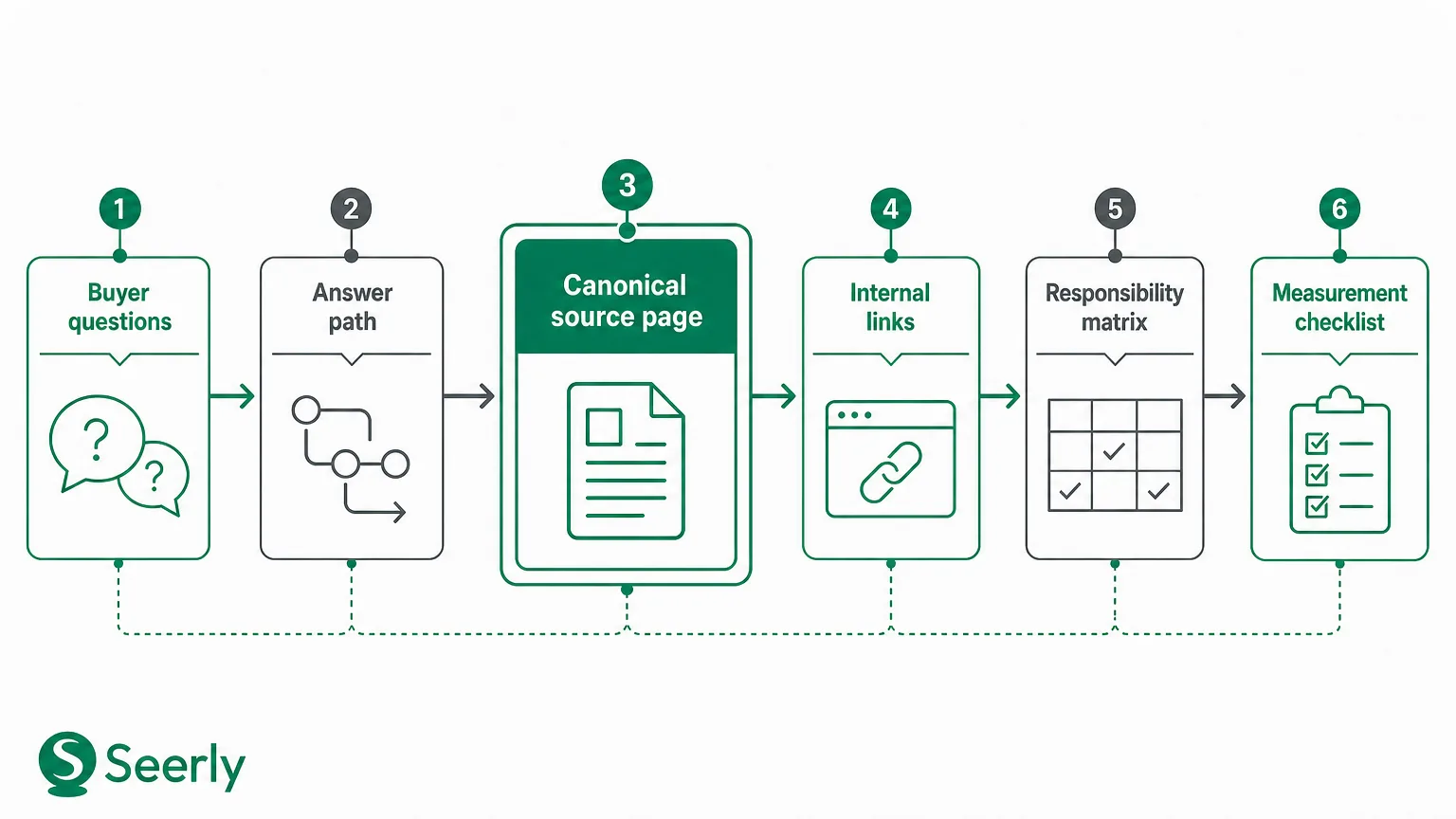
Finally, use a consistent review cadence. Seerly helps teams monitor how their brand appears across answer engines, compare visibility rankings for target questions, and identify whether citations reinforce or distort brand reputation. This turns AI search optimization into data-driven management: publish, observe, improve, and expand only when the evidence supports it.
FAQ
Should teams prioritize ChatGPT before Google AI experiences?
Not automatically. Prioritize the environment where your buyers are most likely to ask commercially meaningful questions and where your team can observe results. If your strongest opportunity is established search demand, Google AI experiences and classic search support may be the better first investment; if buyers need guided exploration, conversational discovery may deserve earlier attention.
How long do AI search feedback loops take?
Expect an initial learning period of roughly one quarter, not a few days. You can assess whether your content is published, indexed, and beginning to appear within weeks, but meaningful patterns in visibility, citations, and assisted demand need repeated measurement. Faster progress comes from a focused question set and high-quality assets, not from publishing at maximum volume.
What content formats are easiest for AI systems to cite?
Pages with direct answers, clear structure, concrete evidence, and transparent sourcing are generally more useful than promotional copy. Benchmark guides, evidence-led summaries, balanced comparison pages, and concise explainers all work when they answer a specific question thoroughly. Because factuality remains a difficult challenge for language models, as shown by research on self-checking generated claims, brands should make important statements easy to verify.
Choose One AI Search Channel, Then Earn the Right to Expand
The goal is not to win every AI search conversation immediately. Choose one channel for the next quarter, define the buyer questions that matter most, publish the evidence those questions require, and measure whether your brand begins to surface accurately.
As visibility grows, expand to adjacent channels with the same discipline. Use Seerly to monitor your AI search discovery across providers, understand how your brand is represented, and build the trusted authority required for durable AI-ready visibility.