Reference content or comparison pages? A decision framework for AI search content strategy
Your next content budget could fund a broad educational resource, a product comparison, or an implementation guide. Each serves a legitimate buyer need, but none deserves priority simply because it belongs to a supposedly “AI-friendly” format. The harder question is where your team can supply evidence that buyers need and existing sources do not adequately provide.
A useful AI search content strategy starts with that decision, not a publishing quota. It connects the buyer’s question, the sources appearing across relevant search experiences, and the evidence your organization can credibly contribute. This guide provides a practical framework for comparing those opportunities, scoring the next investment, and choosing a page format that earns its place in the editorial calendar.
Why one content format cannot serve every AI-search question
An early-stage buyer asking what a category means needs a different answer from someone deciding whether a product meets a security requirement. A reference explainer can establish terminology without resolving a purchasing trade-off. A comparison can clarify that trade-off without explaining how to deploy the chosen solution. Treating these questions as interchangeable produces pages that cover the subject but leave the reader’s actual decision unresolved.
The source landscape also varies between search experiences. An empirical study reported AI Overviews for 51.5% of representative real-user queries in its sample, with substantially different retrieved source sets across Google Search, AI Overviews, and Gemini. That figure describes the study’s sample, not a universal appearance rate for every market or query category. Its practical implication is that teams should observe source patterns rather than assume traditional rankings reveal every AI-search opportunity.
Google’s documentation provides another reason not to treat a search result as a single, fixed source list. Its AI features may use query fan-out to run multiple related searches across subtopics and data sources. A complex evaluation question may therefore involve evidence about capabilities, limitations, costs, and implementation - not just a page containing the product category’s main keyword. This supports planning around the question’s evidence requirements rather than imposing one preferred page type.
Before commissioning content, review a consistent set of high-value buyer questions across the search experiences your audience uses. Record the question wording, date, engine, visible sources, page formats, and important claims. Repeat observations to distinguish recurring patterns from isolated appearances. The goal is not to reverse-engineer a permanent formula; it is to identify where your expertise matches an observable information gap.
The four intent groups that deserve different evidence
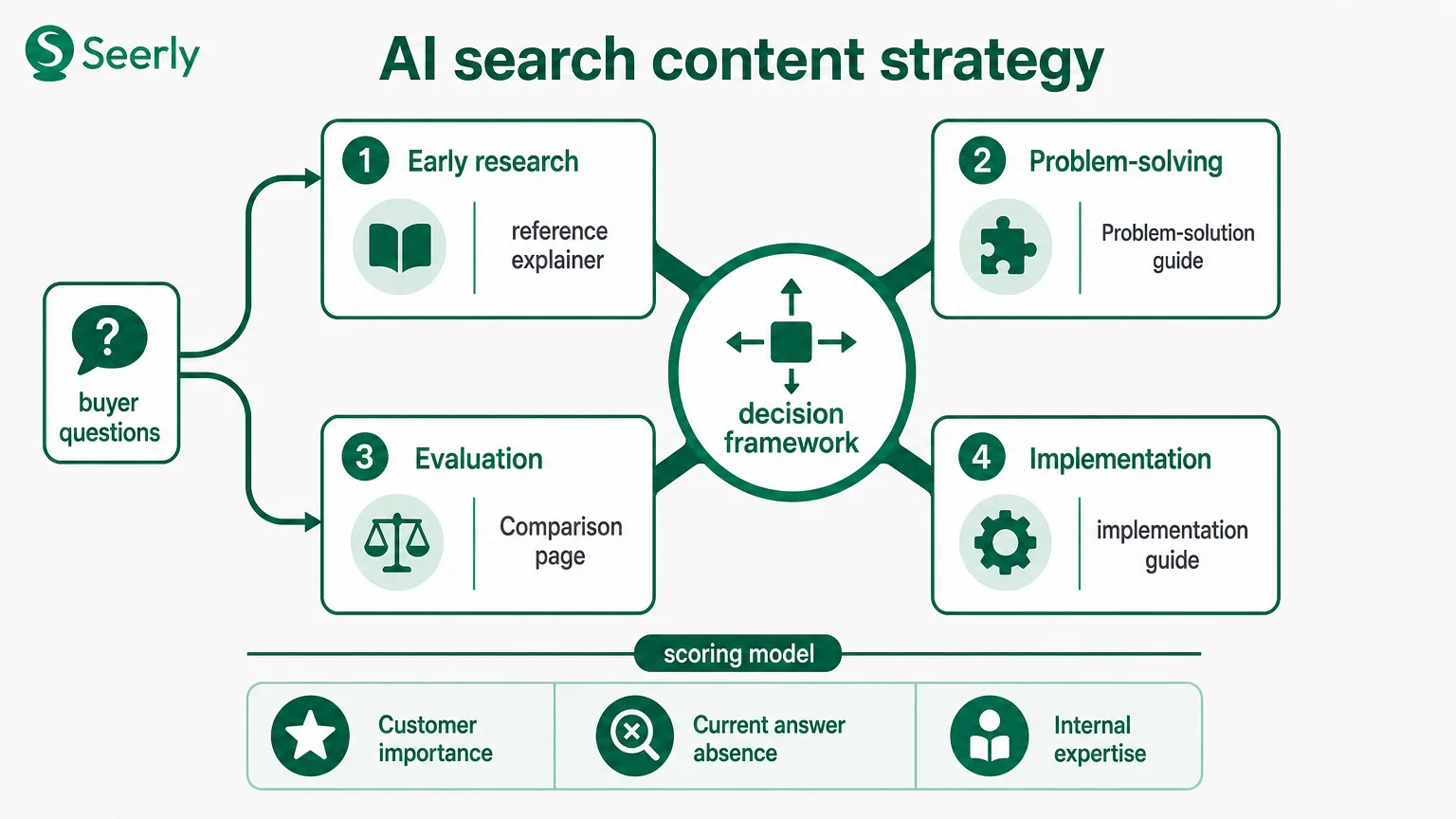
Buyer intent is more useful when it describes the task a person must complete, rather than merely labeling them “top” or “bottom” of funnel. Someone researching a category may already influence a major purchase, while an existing customer may need an implementation answer. Classify the question by the decision it supports, then choose the page structure that makes the necessary evidence easiest to understand.
| Intent group | Example buyer question | Best-fit page | Evidence the reader needs | Common failure |
|---|---|---|---|---|
| Early research | “What is customer data integration?” | Reference explainer | Clear definitions, category boundaries, examples, related concepts, and authoritative references | Repeating definitions without explaining distinctions |
| Problem-solving | “Why do customer records keep duplicating?” | Problem-solution guide | Diagnostic steps, likely causes, alternative remedies, prerequisites, and verification checks | Presenting the product as the solution before diagnosing the problem |
| Evaluation | “Should we use a native connector or an integration platform?” | Comparison page | Consistent criteria, capability evidence, costs, limitations, and scenario-specific trade-offs | Declaring a universal winner or comparing unequal options |
| Implementation | “How do we migrate without losing consent records?” | Decision-support resource or implementation guide | Prerequisites, sequence, ownership, validation, rollback conditions, and acceptance criteria | Offering generic steps without operational safeguards |
A reference page wins when misunderstanding the category is the main obstacle. Its value comes from making distinctions clear: what belongs in the category, what does not, and when the concept matters. A problem-solution guide needs a different structure because readers must distinguish symptoms from causes. It should help them determine whether the proposed remedy applies before asking them to act.
Comparison pages and implementation resources require more explicit constraints. A useful comparison explains which option suits which situation, including cases where your own offering is not appropriate. An implementation guide must help readers recognize readiness, complete the work, and verify the outcome. These formats can link to supporting explainers without reproducing an entire educational library inside every page.
The categories are starting points, not rigid publishing rules. A comparison may need a short definition section, and an implementation guide may include a decision table. The governing question is whether each section helps the reader complete the primary task. Combining formats is useful when it resolves dependencies; it becomes counterproductive when it obscures the answer.
A scoring model for choosing the next content investment
Once you have a shortlist of buyer questions, score each proposed page against the same criteria. The model below is a planning template, not a validated predictor of AI citations or revenue. Its purpose is to make assumptions visible so that content, sales, product, and subject-matter experts can challenge them. Set the weights before scoring candidates to reduce the temptation to justify a preferred topic afterward.
Use a 1-5 scale, where 1 indicates a weak opportunity and 5 indicates a strong one. Attach a short evidence note to every score, such as a documented sales objection, an existing-content audit, or repeated source observations. Missing evidence should be labeled uncertain rather than converted into an optimistic score. Review uncertain, high-impact assumptions before committing production time.
| Criterion | Weight | A score of 1 means | A score of 5 means |
|---|---|---|---|
| Customer importance | 25% | Peripheral curiosity with little demonstrated relevance | A recurring question that materially affects buying or successful use |
| Current answer absence | 20% | Your existing content answers the question adequately | No adequate owned answer exists, or the current answer is materially incomplete |
| Competitor ownership | 15% | Competitors rarely appear for the question | Competitors repeatedly shape the answer while your relevant perspective is absent |
| Citation-source relevance | 15% | Observed sources offer little support for your proposed format or expertise | Comparable sources appear, and your evidence directly fits the question |
| Internal expertise | 10% | The team would largely summarize other publishers | Available specialists can explain mechanisms, edge cases, and trade-offs |
| First-party proof availability | 15% | Supporting artifacts are unavailable or cannot be published | Relevant documentation, examples, tests, or other publishable evidence are ready |
Calculate the total as:
Priority score = Σ [(criterion score ÷ 5) × criterion weight]
The maximum is 100 points. “Current answer absence” concerns your own usable coverage; “competitor ownership” concerns who currently shapes the external answer. Keeping them separate prevents a competitor’s visibility from being mistaken for proof that you need another page. A strong existing resource may need an update rather than a new URL.
Citation-source relevance also needs careful interpretation. If observed answers consistently rely on official technical documentation, a lightly researched commercial comparison may be a poor fit. A detailed implementation resource supported by product documentation could be more appropriate. Conversely, repeated use of evaluation guides may support a comparison opportunity - but does not guarantee that a new comparison will be selected.
Use two safeguards after calculating the score. First, do not commission a claims-heavy page until the evidence required to support it is available. Second, compare production effort, maintenance obligations, and uncertainty when scores are close. A high-scoring opportunity can justify a research assignment before it justifies publication, while a smaller update may resolve the same buyer need more efficiently.
For teams managing this process across many questions, editorial workflows organized around missing answers and existing page improvements can help connect the research backlog to publishing decisions. The important discipline is preserving the reason each item entered the queue. A topic title alone does not explain what evidence the finished page must add.
What makes a page more than commodity content
A page is not differentiated simply because it is longer, newer, or formatted as a comparison. Google recommends non-commodity, helpful, reliable, people-first content that provides value beyond common knowledge. Its broader guidance also asks whether content provides original information, research, analysis, and substantial additional value. For editorial planning, the practical test is what a reader can understand or decide after reading your page that competing resources do not adequately explain.
Use the following checklist during briefing and review. Each requirement should correspond to something visible in the finished article, not an intention recorded in the brief. If the team cannot identify the artifact, explanation, or evidence that satisfies an item, the page needs further work. Not every page needs original research, but every page needs a defensible contribution.
-
Original examples: Include a worked scenario, annotated artifact, or demonstration that explains the mechanism. Label invented teaching scenarios as hypothetical, and never present them as customer experiences or measured results.
-
Explicit constraints: State relevant conditions such as organization size, deployment model, permissions, geography, or product version. Explain when the advice stops applying and what changes under different conditions.
-
Transparent methodology: For comparisons and tests, identify selection criteria, procedures, assumptions, and limitations. Readers should be able to distinguish documented capabilities from editorial judgments.
-
Responsible caveats: Explain disadvantages, unresolved questions, and circumstances favoring another approach. Avoid presenting incomplete evidence as proof of universal superiority.
-
Maintained factual claims: Assign an owner to claims about pricing, features, compatibility, and regulations. Record review dates and update the underlying evidence when those facts change.
-
Traceable support: Link consequential claims to documentation or other appropriate sources. Distinguish what your team directly observed from what an external source reports.
Consider a migration guide that merely advises readers to “test the integration.” That instruction names an activity but does not provide enough information to perform it reliably. A stronger guide specifies what to test, which records to inspect, what constitutes failure, and who approves the next step. Those details make the content more useful without requiring an unsupported performance claim.
Evidence quality and technical accessibility should also be reviewed separately. Google says pages must be indexed and eligible to appear with a snippet to qualify as supporting links in its AI features. That is an eligibility condition, not a promise of inclusion. An AI search readiness check can complement editorial review, but technical fixes cannot supply missing expertise or substantiate an unsupported comparison.
A worked prioritization example
Consider a hypothetical team at a B2B integration software company choosing one substantial content project. It has three candidates: a reference page explaining customer data integration, an evaluation page comparing native connectors with an integration platform, and an implementation guide for migrating consent records. Assume the team has reviewed buyer questions, audited its current pages, and recorded recurring source patterns. The following scores are illustrative planning inputs, not customer results or measured performance.
| Criterion | Weight | Reference page | Evaluation page | Implementation guide |
|---|---|---|---|---|
| Customer importance | 25% | 3 | 5 | 4 |
| Current answer absence | 20% | 2 | 5 | 4 |
| Competitor ownership | 15% | 2 | 4 | 3 |
| Citation-source relevance | 15% | 4 | 4 | 3 |
| Internal expertise | 10% | 4 | 5 | 5 |
| First-party proof availability | 15% | 2 | 5 | 4 |
| Weighted total | 100% | 55 | 94 | 76 |
In this scenario, the reference topic has the broadest estimated search demand. However, the company already has an adequate introductory answer, and the proposed replacement would add few original examples. Its category expertise is relevant, but the evidence gap is relatively small. The sensible action is a targeted update, not necessarily the next major production investment.
The evaluation page wins because the hypothetical evidence supports a more consequential opportunity. Buyers repeatedly need to choose between two approaches, the company lacks a usable answer, and competitors appear in the observed source set. Product specialists can contribute architecture diagrams, documented capability boundaries, and a consistent comparison method. These inputs support a page that explains trade-offs rather than simply asserting that the company’s preferred option is better.
The implementation guide remains valuable, especially because internal expertise is strong. Its lower source-relevance score reflects uncertainty about whether the proposed guide matches the sources appearing for the sampled questions. The team should investigate that uncertainty and confirm the publishable validation steps before production. It should not discard the guide merely because another candidate scored higher.
The resulting decision is specific: commission the evaluation page first, improve the existing reference page, and continue evidence gathering for the implementation guide. If the evaluation evidence proves unavailable or source observations change, revisit the scores. After publication, monitor whether the page appears for the intended question set, whether the brand is described accurately, and whether relevant visitors take useful next steps. Compare like-for-like observations without treating every visibility change as a causal content result.
Choose the evidence gap before the format
A strong AI search content strategy does not choose educational coverage or conversion-stage content as a permanent winner. It chooses the page that best serves an important buyer question with evidence the team can credibly provide. Reference explainers, comparisons, and implementation resources each deserve investment when the question and observed source landscape support them.
Start by inventorying your highest-value buyer questions and classifying the task behind each. Compare your existing answers with the sources appearing across relevant search experiences, then score the opportunities using documented evidence. Create - or substantially improve - the one page where your expertise can add the most decision-useful information. That is a more defensible budget decision than choosing a format first and searching for a reason to publish it.
Frequently Asked Questions
Should we create a new page or update an existing one?
Update an existing page when it already serves the buyer question and can be strengthened with the missing evidence; create a new page when the question represents a distinct task that current content does not adequately answer.
Does a higher priority score guarantee AI search visibility?
No. The score helps teams compare documented opportunities, but it does not predict citations or rankings; keep monitoring relevant search experiences and revise decisions as evidence changes.