How to compare SERPs across locations without mistaking local variation for ranking loss
A regional marketing lead sends a screenshot: “We’ve dropped from position 3 to position 11 in Germany.” An hour later, someone in London searches the same words and sees the brand at position 4. Both may be reporting honestly. Neither has yet proved a loss.
That awkward gap is the real work behind SERP tracking Google. Google changes results based on where the search happens, the language settings, the device, the wording used, and the mix of result features on the page. A position is not a universal property of a URL. It is an observation made under a set of conditions.
For agencies and in-house teams reporting across markets, that distinction prevents expensive false alarms. The process below helps you capture those conditions, inspect the page itself, and decide if a difference needs work or more evidence.
Definition: A controlled SERP comparison measures the same query under matched market, language, device, date, and search-page conditions before interpreting a change as rank movement.
Why SERP tracking Google shows different results to different people
Google’s own description of ranking says results reflect many factors, including the meaning of the query, content relevance, and the user’s context, such as location and settings. Its overview of ranking results makes a useful point for reporting: Google is trying to return a useful answer for the search in front of it, not maintain one frozen list for every person.
Location has the loudest effect on searches with local intent. Search “accountant,” “pizza delivery,” or “emergency plumber” in Manchester and Leeds, and the page may feature different businesses, maps, and landing pages. A country-level search can differ too, especially where pricing, shipping, regulation, or local publishers affect what users need.
Language can shift results even when the query text stays in English. Google may favor pages written for the search language, pages marked for a market, or pages that have earned stronger signals in that country. Google’s guidance on managing multilingual and multi-regional sites explains why teams should treat language and region as separate settings. French speakers in Canada and France do not form one search market.
Device matters because mobile pages have less screen space and different feature layouts. Personalisation plays a smaller role than many people assume when teams use a clean environment, but signed-in accounts, recent activity, and browser settings can still muddy a spot check. And the page keeps changing: a map pack may appear at 09:00, then a video block shows later after Google reassesses query intent. Messy? A bit. Unusable? No.
Build a controlled comparison record before you judge movement
A screenshot alone is weak evidence. It records what someone saw, but rarely tells you enough to reproduce it. I’ve seen teams spend half a day arguing over a “drop” that turned out to be a mobile search in the wrong city. Not ideal.
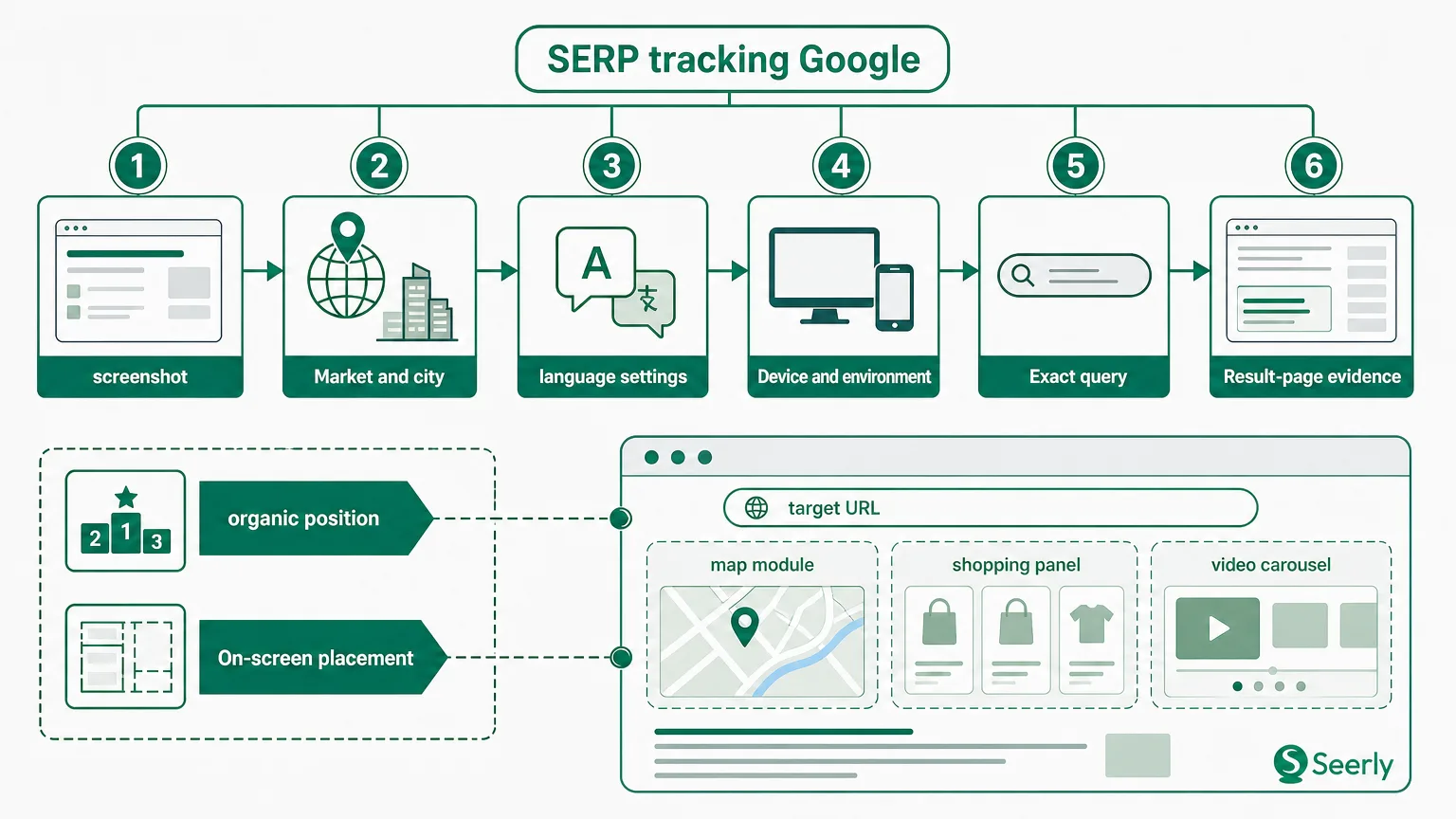
Use a record that someone else can rerun without asking follow-up questions:
-
Market and city: Record the country and, for local or service-area queries, the specific city or postcode proxy. “US” will not settle a dispute about a result in Austin versus Dallas.
-
Language settings: Capture the Google interface language and the search language where it differs. Write
English (United Kingdom)rather than justEnglish. -
Device and environment: Note desktop or mobile, browser, signed-in status, private browsing status, and any location simulation method. A tracker should log the same settings every time.
-
Exact query and timestamp: Copy the query rather than paraphrasing it. Include date, time, and time zone, since a live page can change during a news event, sale, or product launch.
-
Result-page evidence: Save the full first-page capture, the target URL, organic position, paid placements, and every major feature above it. Keep the raw data too, not only a polished report.
The thing is, a controlled record does not make Google static. It makes your conclusion testable. Teams running multiple accounts can borrow the governance principles in Seerly’s guide to enterprise rank tracking governance, particularly the habit of documenting who changed a tracking setting and when.
Separate a rank drop from a page-layout change
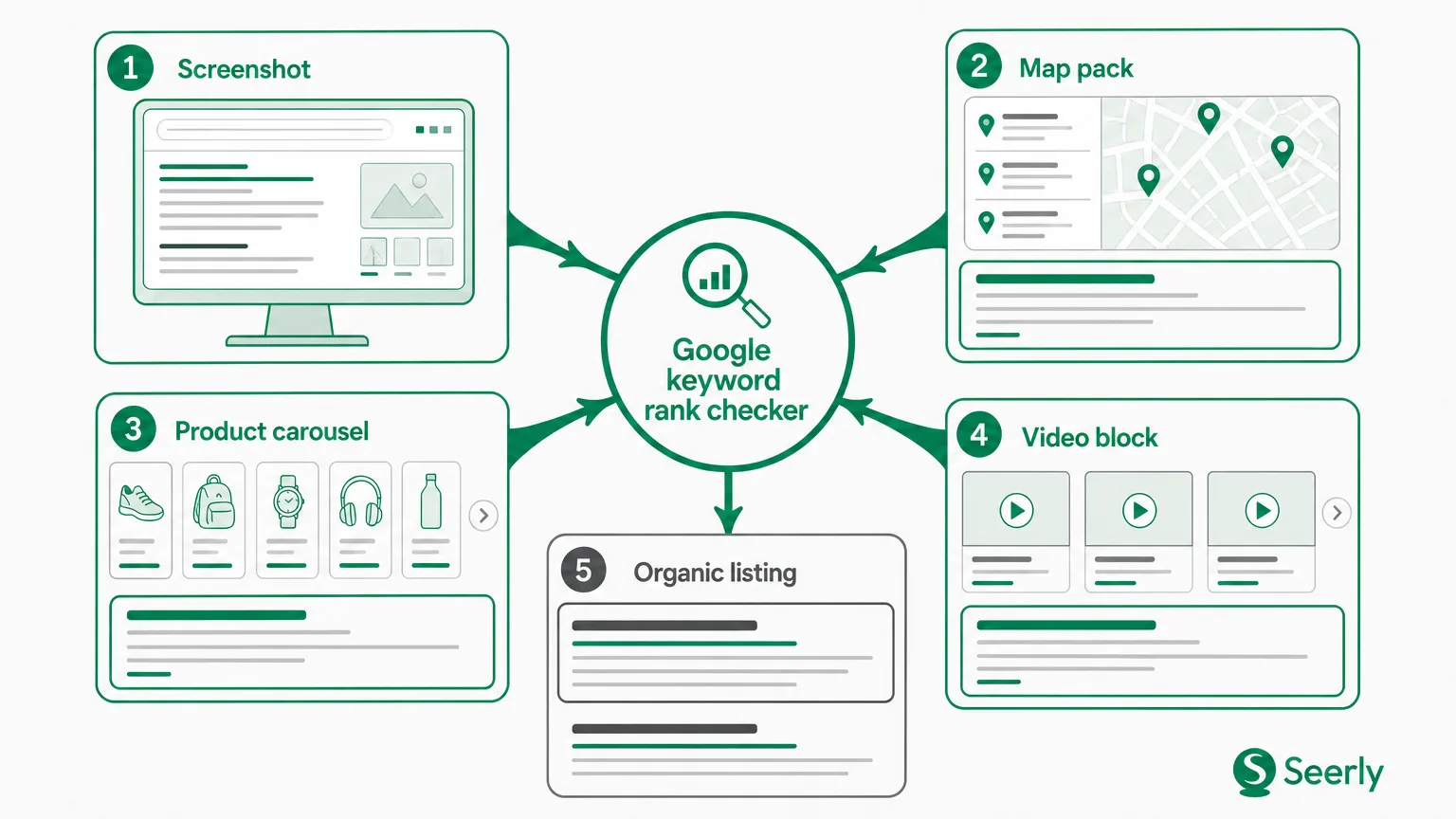
A brand can keep the same organic position while losing a great deal of on-screen exposure. That happens when Google inserts a map pack, shopping unit, answer panel, video carousel, or a large news feature above the traditional listings. The numerical rank has not moved. The human experience has.
Picture two desktop results for “running shoes for flat feet.” On Monday, your category page sits as the third organic listing, below two ads. On Thursday, it still sits third among organic listings, but a shopping panel and video carousel now appear above it. A report that says “rank unchanged” is technically correct. A report that says “traffic risk: none” is not.
Use two labels in your comparison sheet:
| Measurement | What to record | Why it matters |
|---|---|---|
| Organic position | Position among standard organic listings | Tracks movement against competing pages |
| On-screen placement | Modules and paid units above the target | Explains what a searcher sees before reaching it |
Look at the target page too. Did Google swap your product page for a guide? Did the title change? Is the indexed page still the one you intended? Google’s ranking systems guide notes that multiple systems work together to surface useful results, which is one reason a single “rank cause” is often a fiction.
A worked investigation across three markets
Suppose Northstar Travel reports that its “family holidays in Spain” page fell from position 5 to position 14 in Spain. The agency’s first check finds position 6 in the UK and position 7 in Ireland. A rushed conclusion would blame the Spanish content. The evidence says: slow down.
The team reruns the exact query on desktop, using Spanish language settings and Madrid location controls, at the same local hour across three days. The result settles at positions 12, 13, and 12. That repeatability matters. They then compare the result pages, not only the rank column.
Madrid now has a map module, Spanish publishers with current package offers, and a larger block of holiday-specific results. Northstar’s page still loads, remains indexable, and keeps the same canonical URL. The competitor pages are more locally framed, with euro pricing, Spanish cancellation terms, and departure-city references. The UK page has none of that local pressure.
So the documented conclusion reads: confirmed movement in Spain, limited to a commercial local-intent result set; no matching decline in the UK or Ireland; competitor pages better match current Spanish search context. That is narrower, and more useful, than “global rankings are down.”
Before changing copy, check the measurement setup against the common causes documented in why Google keyword rank checker results differ. Tiny mismatches in location or device can create a very convincing bad story.
When to act, and when to keep monitoring
Not every variation deserves a ticket. A one-day shift from position 6 to 8 for an informational query may be noise. A repeated move from 3 to 12 for a high-value page in the market that produces sales deserves attention.
Use this decision path:
-
Can you reproduce the result under matched conditions? If no, log it as inconclusive and rerun it over the next few days.
-
Does it affect a business-relevant query or landing page? If no, watch the pattern before pulling people into a response.
-
Does the change appear across the same market and device more than once? If yes, inspect the page, the competitors, and the result layout.
-
Did the target URL change, disappear, or lose technical eligibility? If yes, investigate site changes, indexing, canonicals, language targeting, and page quality before rewriting content.
Honestly, I prefer thresholds that fit the account instead of a universal “three-position rule.” A move from 2 to 5 can hurt a high-converting commercial page more than a move from 36 to 20 helps a low-demand query. Pair rank records with clicks, leads, or revenue where you can. Rankings are evidence, not a verdict.
Put the investigation into a client-ready update
Clients don’t need a lecture on every Google variable. They need a clear statement of what changed, how confident you are, and what happens next. Avoid presenting a single screenshot as certainty.
Use language like this:
-
Confirmed movement: “Under matched Madrid, Spanish-language desktop checks on three dates, the page moved from an average organic position of 5 to 12. The result page also gained local travel modules above organic listings.”
-
Inconclusive movement: “The original alert could not be reproduced under matched settings. We are monitoring the query for seven days before assigning a content or technical response.”
-
Expected geographic variation: “The page ranks differently in Spain and the UK, which aligns with distinct local result sets and competitor pages. We are treating these as separate market baselines.”
Frequently asked questions
Should we report one global position for a keyword?
No. Report a market-specific position, then state the language, device, and date behind it. A blended average hides the local conditions people actually search under.
Does incognito mode remove all variation?
It reduces account history effects, but it does not remove location, language, device type, or changes to the result page. Private browsing is one control, not the whole method.
How long should we monitor before changing a page?
For a meaningful alert, rerun matched checks across several days and inspect business data. Move sooner when the target URL disappears, indexing breaks, or a high-value market shows a repeatable decline.
Before your next ranking review, add market, language, and device fields to the sheet. Then rerun one recent alert under matched conditions before assigning an action owner. The result may still call for work. But at least it will be work based on evidence.
Learn more at Seerly.