AI sentiment monitoring across markets: an escalation playbook for brand teams
How to turn inconsistent AI-generated brand narratives into a documented, market-specific risk process.
A brand can receive two very different answers to the same buyer question within minutes. Ask in English from the UK and the answer may describe the company as established and well-reviewed. Ask in Spanish from Mexico and the response might question pricing, repeat an old product claim, or suggest that proof of customer satisfaction is thin. Neither answer is a complete picture. Both can affect a buyer’s next move.
That’s the awkward part of AI sentiment monitoring. A negative answer isn’t automatically a crisis, and a positive answer doesn’t settle the matter. What matters is the pattern: where the narrative appears, what claim it makes, how often it returns, and whether the brand can support or correct it with evidence.
For teams working across regions, a generic sentiment score is too blunt. You need a record that preserves local language, market context, prompt wording, and the exact answer observed. Then you need rules that prevent a loud internal opinion from becoming the escalation system. The aim is simpler than it sounds: every negative signal should have context, a severity level, an owner, and a dated next step.
Start AI sentiment monitoring with a market evidence map
Before comparing markets, capture the evidence in a consistent format. Otherwise, a team ends up comparing a German answer to a broad English-language prompt with a French answer to a highly specific buyer question. That comparison tells you very little. Different wording creates different retrieval paths and different claims.
Definition: An AI sentiment evidence record is a dated entry that captures the exact conditions under which a brand narrative appeared, the sentiment expressed, and the evidence needed to assess it.
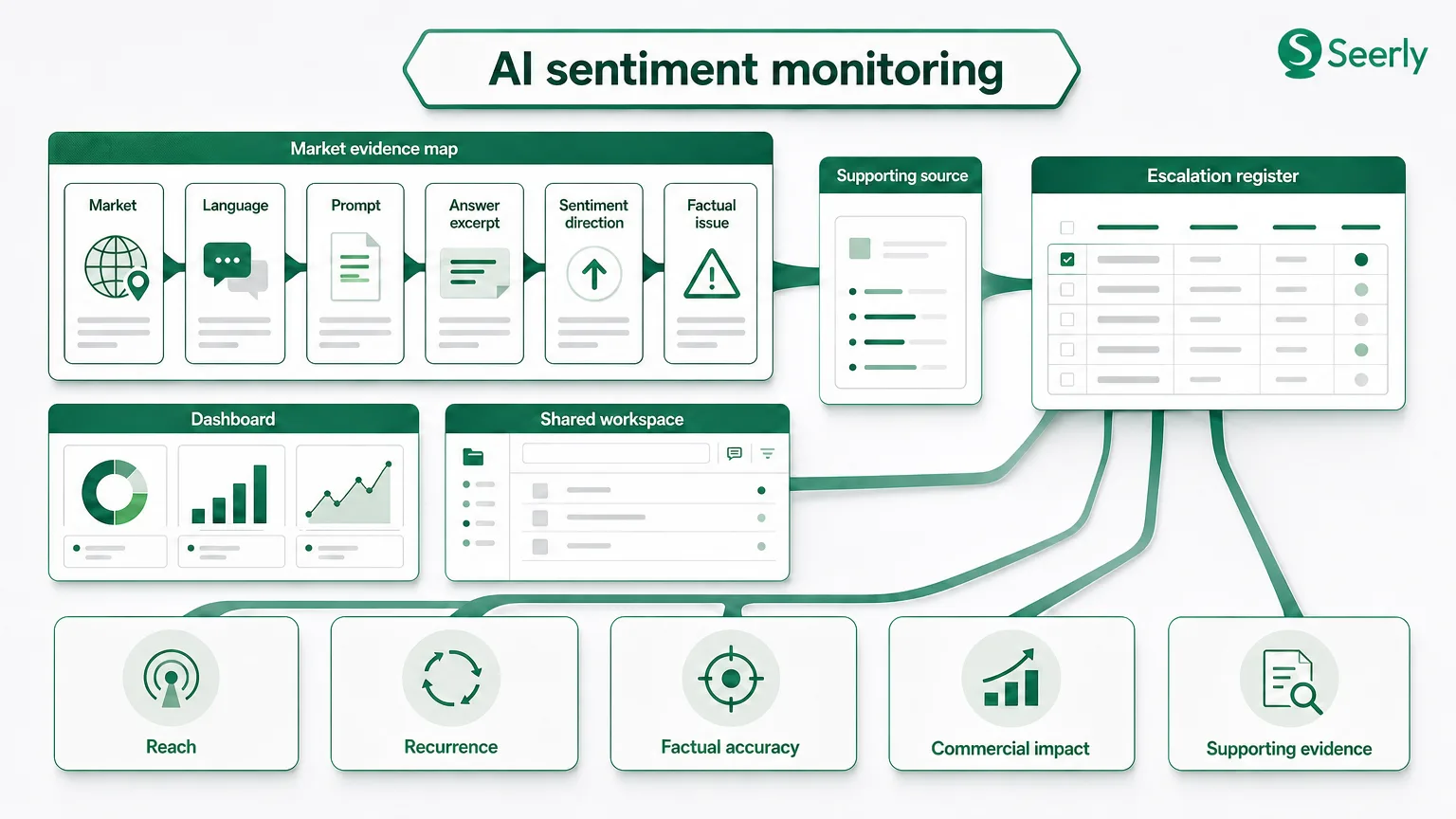
A workable register needs the following fields. Keep it in one shared workspace, not in screenshots scattered across regional Slack channels.
| Field | What to record | Why it matters |
|---|---|---|
| Market | Country or defined commercial region | A claim may be local rather than global |
| Language | Prompt and answer language | Translation can alter meaning and tone |
| Prompt or scenario | Exact buyer question and context | Small prompt changes can produce different narratives |
| Answer excerpt | The relevant wording, copied verbatim | Teams need to assess the actual claim |
| Sentiment direction | Positive, negative, mixed, or uncertain | Direction alone should not set severity |
| Factual issue | What may be wrong, missing, or misleading | Separates tone from a verifiable problem |
| Supporting source | Pages, reviews, listings, or documents referenced | Shows what the claim rests on |
| Date observed | Date, time, platform, and account context | Narratives change and need retesting |
A prompt should describe a real decision moment. “Is Brand X trustworthy?” has value, but it’s vague. “What are the main limitations of Brand X for mid-market teams in France?” gives the team something they can investigate. Pair broad reputation prompts with commercial prompts about pricing, suitability, customer support, reviews, safety claims, or competitor alternatives.
The way I see it, teams often make one early mistake: they translate the prompt but not the scenario. A buyer in one market may care about local availability or regulatory fit, while a buyer elsewhere worries about implementation support. Use local teams or agencies to review the question set before testing. A literal translation can sound oddly formal, or worse, it can miss the real concern.
For repeatable work, pair the register with a documented test cadence. Seerly’s cross-provider monitoring workflow is useful reading for teams that need to compare prompt results without treating one observed answer as permanent truth. Run the same high-risk scenarios at an agreed interval, then record material changes instead of overwriting the old evidence.
Which negative answers deserve escalation?
An answer can feel unpleasant without creating a reputation risk. “Some customers find the product expensive” may be a fair summary of public feedback. A response that says a brand lacks a feature it has offered for two years is different. One is criticism. The other may distort a buying decision.
The distinction gets clearer when teams compare signals by evidence, recurrence, and buyer consequence. Don’t escalate every unfavorable phrase. That produces alert fatigue, and alert fatigue turns a serious issue into another ignored dashboard notification.
| Signal | Default response | Why |
|---|---|---|
| Isolated criticism grounded in a real opinion | Monitor and retain evidence | A brand can’t and shouldn’t erase fair criticism |
| Repeated factual inaccuracy | Verify, correct source records, retest | Recurrence suggests a persistent source or content gap |
| Missing independent proof | Build an evidence plan | Absence of proof requires work, not invented claims |
| Unfavorable competitor comparison | Review claim basis and comparison context | The risk rises if the comparison is false or commercially material |
| Claim likely to mislead a buyer | Escalate promptly | Product suitability, safety, pricing, or compliance claims can carry direct harm |
Take a fictional software example. An answer says, “Brand A has weak customer support,” based on two old forum posts. That may call for monitoring and customer-team review, especially if the comments describe a past issue. But if the answer repeatedly states, “Brand A does not offer support in Italy,” while a current local support page and customer contract say otherwise, the issue is factual. The web owner should inspect the relevant pages, and the market lead should confirm the local service model.
Competitor comparisons need a little more patience. “Brand B has more reviews” may be accurate, even if the team dislikes it. “Brand B is the only compliant option” carries more risk if the statement is unsupported or if it affects regulated purchasing decisions. The test is not “does this make us look bad?” The test is “could a reasonable buyer act on a misleading claim?”
Language also complicates sentiment. Research on sentiment analysis has long shown that sentiment signals can shift across language and domain, including when words carry different meanings in context. The SemEval multilingual sentiment task is a useful reminder that classification is not a universal truth machine. Human review belongs in the loop, especially for sarcasm, idioms, and locally loaded terms.
Set severity rules before the next difficult call
When no severity rubric exists, the person with the strongest view often wins. That’s not a sound method. A regional marketer may see a worrying answer as urgent, while legal sees insufficient evidence to act. Both perspectives matter, but they need a shared set of questions.
Score each issue on five dimensions: reach, recurrence, factual accuracy, commercial impact, and supporting evidence. Use a simple 0 to 2 score for each dimension. A total score creates a starting point, but the team should still record why a serious claim received its final tier.
-
Tier 1: monitor. Use this tier for isolated criticism, unclear sentiment, or a claim supported by legitimate third-party opinion. Review it during the next scheduled cycle, and keep the evidence available if it returns.
-
Tier 2: investigate. Use this tier when an answer repeats across prompts or markets, when proof is missing, or when a competitor comparison may influence shortlists. Set a named owner and a short investigation deadline, such as five business days.
-
Tier 3: correct or respond. Assign this tier to verifiably false claims with a plausible commercial effect. The team should identify the source material, update inaccurate first-party records where appropriate, and retest the relevant scenarios after publication.
-
Tier 4: urgent review. Reserve this for claims that could mislead buyers on safety, legal status, regulated use, pricing commitments, or serious misconduct. Bring legal or compliance into the record early, preserve screenshots and dates, and set a same-day review target where practical.
No scoring model removes judgment. It disciplines it. The NIST AI Risk Management Framework treats risk work as a process of governing, mapping, measuring, and managing, which fits this problem well. A score is not a verdict. It’s a way to stop a team from skipping the questions that matter.
The proof gap: what one review signal can and cannot say
Here’s a worked example based on a narrow but useful finding: user-review availability was the worst negative aspect, with 25% negative references, or one out of four observed references. That does not prove widespread dissatisfaction. Four references are too few for that kind of claim. It does tell the team that independent proof deserves attention.
Say an AI answer in one market tells a buyer that the brand has limited customer review evidence. The first move is not to write glowing testimonials or ask employees to post reviews. That would create a bigger trust problem. Instead, inspect the claim like an auditor would.
Start with the public records. Are major business listings accurate, claimed, and current? Does the company have duplicate profiles, obsolete product categories, or an old address that makes a review trail hard to find? Then check whether existing reviews belong to the right regional entity and whether they reflect the current offer. A review page in English may do little for a buyer looking in another language.
Next, ask customer-facing teams for a legitimate feedback route. A post-sale request can invite genuine, verified feedback without dictating what the customer should say. Keep the ask neutral, respect local consent rules, and don’t filter out unhappy customers. The goal is evidence, not applause.
Finally, document the limitation if the proof does not exist yet. A register entry might read: “Independent review volume in Market X remains limited. Listings verified on 14 May. Customer feedback request approved. No claim of broad review coverage until evidence grows.” Honest gaps are less risky than polished fiction. They also give leadership a clear picture of what work remains.
Teams using Seerly’s sentiment monitoring tools can log that issue beside the relevant prompts and market evidence rather than treating it as a vague reputation concern. That record matters when the same proof gap appears again six weeks later.
Give every issue an owner and a clock
A sentiment finding with no owner is just a screenshot with a worried caption. The handoff should happen when the issue enters the register, not during the next monthly meeting. Start with the function closest to the fix, then bring in other people only when the evidence requires it.
Marketing owns the evidence record and initial classification. The marketing lead captures the prompt, answer excerpt, market, and initial severity. For Tier 2 and above, they should open a dated issue record within one business day and name the person accountable for the next action.
Customer teams check operational truth. If an answer claims poor support, unavailable service, or a recurring product limitation, customer operations can confirm whether the narrative reflects current experience. They should return evidence, not just reassurance: service coverage pages, policy wording, trend data, or a clear statement that the claim cannot be verified.
Web owners correct public records. They review product pages, help content, local landing pages, and business listings for stale or contradictory language. Avoid stuffing pages with defensive statements. Publish clear facts that a buyer can verify, then note the URL and publication date in the register.
Legal or compliance reviews material claims. Their role is to assess legal exposure, approved wording, record retention, and any action involving misleading public statements. For sensitive issues, they should receive the original answer, the prompt, the market context, and the supporting evidence. A paraphrase is not enough.
Leadership approves Tier 4 decisions and unresolved trade-offs. If a correction has commercial, legal, or brand consequences, leaders need a short decision brief: what appeared, where it appeared, why it matters, what evidence supports the finding, and what the team recommends. Keep it to one page. Nobody wants a 40-slide deck when a buyer-facing claim may be wrong.
For response timing, set expectations in advance: Tier 1 at the next review, Tier 2 investigated within five business days, Tier 3 assigned within one business day, and Tier 4 reviewed the same day. Deadlines will differ by company and market. The useful part is that nobody has to invent them during a tense call.
What should leadership see each month?
Leadership does not need a pile of answer excerpts. They need evidence of exposure, movement, and unresolved decisions. Avoid declaring that the team “controls sentiment.” No one controls every public opinion or every generated answer. The team can measure patterns, improve factual source material, and show where risk remains.
A monthly update works well when it answers six questions:
- Which markets did we test? Include language coverage, core prompts, and any markets not yet reviewed.
- What themes recurred? Group issues such as review availability, pricing confusion, product capability, or support expectations.
- Which factual risks remain open? State the severity, owner, age of the issue, and blocked decision.
- What did the team change? Record updated listings, corrected web content, validated documentation, or customer-feedback work.
- What evidence is still missing? Call out proof gaps plainly. Don’t disguise them with a colorful score.
- How did severity change? Show issues moved down only after retesting confirms that the relevant narrative no longer recurs in the monitored scenario.
A small table keeps the conversation honest:
| Market | Recurring theme | Current tier | Owner | Next evidence due |
|---|---|---|---|---|
| UK | Pricing description differs by prompt | 2 | Marketing lead | Current pricing page review |
| Italy | Local support availability claim | 3 | Web owner | Updated service wording |
| Mexico | Limited review evidence | 2 | Customer team | Listing audit and feedback plan |
The thing is, movement matters more than a vanity score. An issue moving from Tier 3 to Tier 2 means the team corrected a factual problem but still needs repeat testing. An issue staying at Tier 2 for three months may point to a missing internal decision, not a monitoring failure.
Frequently asked questions
How often should teams run AI sentiment monitoring?
Start weekly for high-risk buyer questions and monthly for broader reputation prompts. Markets with active product launches, changing prices, or open Tier 3 issues may need more frequent checks. Keep the cadence stable long enough to spot recurrence rather than reacting to every odd answer.
Should a team respond publicly to every negative AI answer?
No. Public responses can amplify a weak signal and create a permanent record around a fleeting answer. Investigate the source material first, correct factual records where needed, and involve legal or compliance when a claim could mislead buyers or create regulatory exposure.
Can a sentiment score replace human review?
No. Sentiment labels are useful for sorting evidence, but local language and commercial context change the meaning of an answer. A mixed response that contains one false pricing claim may deserve faster action than a plainly negative answer grounded in real customer criticism.
What belongs in an escalation register?
Include the market, language, prompt, answer excerpt, severity tier, evidence links, owner, deadline, action taken, and retest date. Keep previous observations rather than replacing them. That history helps teams explain why a risk changed status.
Start with one market-segmented escalation register and the buyer questions most likely to influence trust or purchase decisions. Then use Seerly to monitor the evidence, keep owners accountable, and turn follow-up into a visible work queue. Learn more at seerly.app.