The AI Search Skills Matrix: What Content Teams Need to Learn Before Publishing Faster
AI can produce a usable first draft in minutes. That speed is valuable, but it can also create a costly illusion: that drafting was the bottleneck holding back organic growth. In practice, the difficult work begins after generation - deciding whether claims are true, whether the page answers a real search need, whether its structure is easy for people and AI systems to interpret, and whether the team can prove the page is discoverable after publication.
This distinction matters as AI becomes a normal part of knowledge work. Stanford’s AI Index reports that 78% of organizations said they used AI in 2024, but adoption alone does not create reliable content operations. Teams that treat AI content as a writing-speed tool can publish more pages without improving trust, search visibility, or conversion. Teams that build repeatable workflow skills can use AI to accelerate production while retaining editorial judgment and brand authority.
The practical goal is not to make writers faster at prompting. It is to help content teams make every AI-assisted page accurate, extractable, and measurable.
Why speed is the wrong first metric for AI content
The strongest case for AI content is often productivity. Research on a customer-support organization found that access to generative AI increased productivity by 14% on average, with larger gains among less-experienced workers. That finding is useful, but content leaders should avoid applying it too literally. A faster output rate does not guarantee that a page has original expertise, valid evidence, a clear information architecture, or a realistic chance of being found.
Publishing volume is an input, not an outcome. A team can double its monthly article count while also doubling the number of unsupported claims, duplicate angles, weak internal links, and pages with no clear measurement plan. Those problems may not be visible in a content calendar, but they become expensive when readers lose confidence, editors spend hours repairing drafts, or pages fail to earn rankings and citations.
The shift toward AI search also changes the definition of a successful page. In Pew Research Center’s browsing analysis, Google searches with an AI summary led users to click a traditional search result less often. For content teams, this makes visibility more demanding. A page needs to be useful enough to rank and satisfy readers, but it should also present clear answers, evidence, distinctive expertise, and trust signals that can support reuse in AI-generated responses.
Google’s guidance is similarly direct: generative AI can assist with content creation, but publishers remain responsible for creating helpful, reliable, people-first content. AI content therefore requires enablement across the workflow, not a library of prompts shared in a team channel. The organizations that scale safely teach people how to make decisions before, during, and after drafting.
The five capabilities missing from most AI content workflows
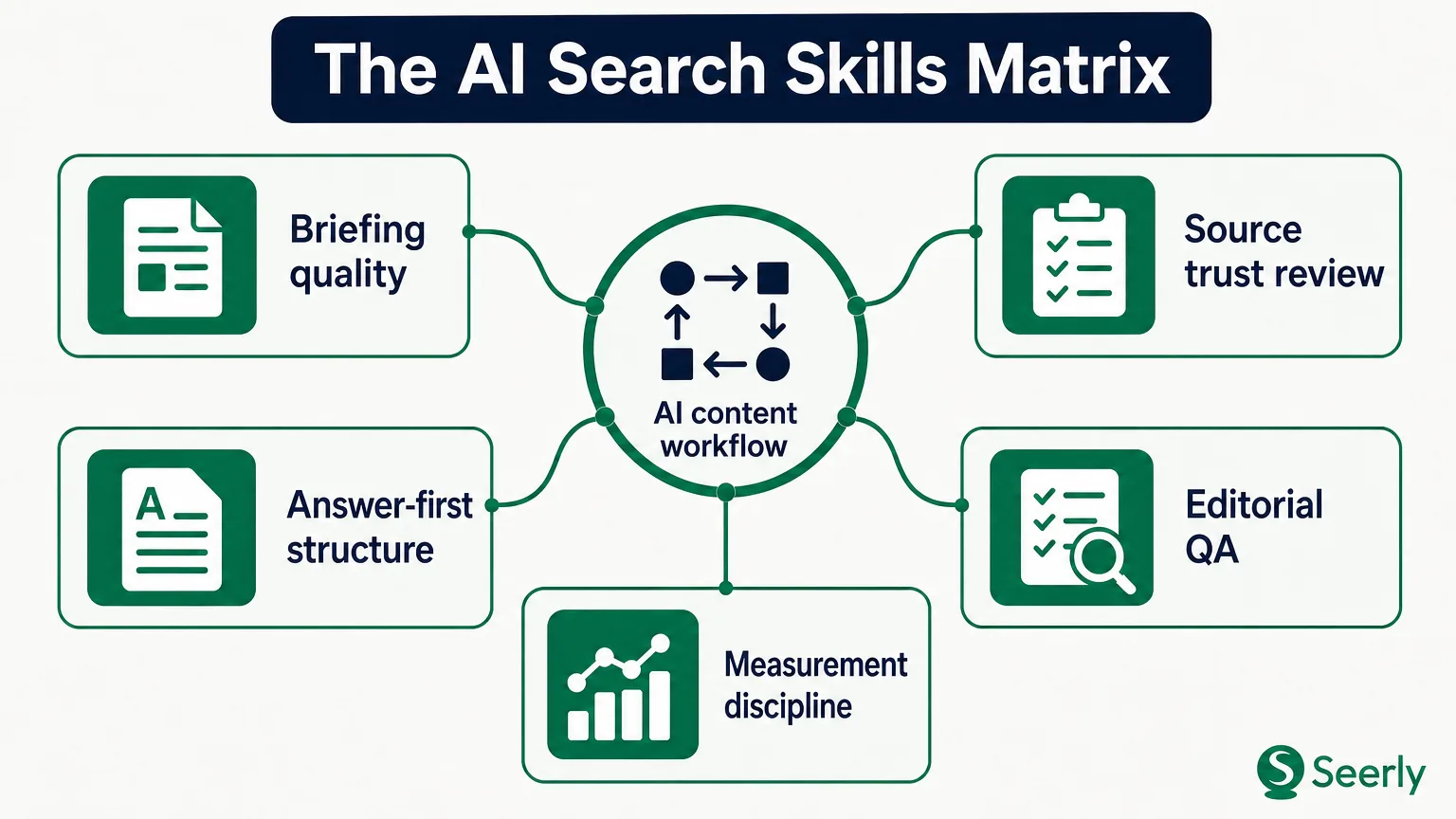
A durable AI content workflow rests on five connected capabilities. Weakness in one stage can undermine every stage after it. For example, a well-written draft cannot repair a vague brief, and a thoroughly fact-checked article still underperforms if it is difficult to retrieve or disconnected from the site’s wider content architecture.
1. Briefing quality
An AI tool can expand a brief, but it cannot reliably resolve an unclear strategic decision. Before anyone generates copy, the brief should define the target reader, the question being answered, the page’s business role, the point of view, the evidence needed, and the action a reader should take next. It should also identify what the article will not cover, which prevents the model from producing broad, interchangeable explanations.
For example, “write about AI content” is not a production brief. “Help an SEO manager create a quality-control process for AI-assisted B2B articles, using a role-based matrix and a pre-publish checklist” is. The second instruction gives the writer and the AI system a usable scope, a format, and a standard for relevance.
2. Source trust review
AI-generated prose often sounds certain even when the underlying information is incomplete, outdated, or fabricated. Teams need a source policy that distinguishes primary documentation, original research, recognized industry reporting, expert interviews, and unsupported web commentary. A source should be reviewed for authority, recency, relevance to the exact claim, and whether it supports the conclusion being drawn.
This is especially important for statistics, legal or financial statements, product capabilities, and competitive comparisons. The team should preserve source links and notes in the working document rather than trying to reconstruct proof at the editing stage. For high-risk claims, require a human owner to confirm the source directly - not merely accept an AI-generated citation.
3. Answer-first structure
AI-ready content is not a collection of keywords formatted as headings. It is a page with a visible logic: a direct answer, concise definitions, supporting detail, examples, limitations, and next actions. This structure helps readers scan quickly while making the relationship between a question and its answer easier for search systems to interpret.
Start substantive sections with the conclusion or recommendation, then explain the conditions behind it. If a reader asks, “Who validates AI content?” the answer should appear plainly before the broader governance discussion: the person closest to the claim’s domain owns factual validation, while an editor owns publication standards. This is not about writing for a machine; it is about reducing ambiguity for every audience.
4. Editorial QA
Editorial quality assurance must go beyond spelling, grammar, and tone. An editor should assess whether the draft makes claims proportionate to the evidence, distinguishes fact from inference, uses current terminology, avoids repetitive phrasing, and reflects the organization’s genuine experience. AI can make a draft sound polished before it is trustworthy, which is why fluency should never become the approval criterion.
Google’s spam policies specifically warn against scaled content abuse that produces many pages without adding value for users. A meaningful QA process protects against that risk by asking whether the page contributes something that could not be obtained from a generic synthesis. That contribution may be first-hand experience, proprietary data, a tested framework, expert interpretation, or a clearly explained operational method.
5. Measurement discipline
Content performance should be measured after publication, not assumed from output quality. Each page needs defined success signals: impressions for priority queries, organic clicks, engagement with key sections, conversions, assisted conversions, external citations where relevant, and AI search visibility for priority prompts. Different content types deserve different standards; a glossary page and a high-intent solution page should not be judged by the same conversion threshold.
Measurement also closes the training loop. If users leave after the introduction, the issue may be intent matching or page structure. If a page earns impressions but few clicks, title and snippet alignment may need work. If it performs in classic search but is absent from AI search discovery, the team should inspect answer clarity, evidence, originality, entity consistency, and the visibility of trust signals.
The skills matrix by role
An AI content program fails when everyone assumes someone else is responsible for quality. The matrix below assigns practical responsibilities across the production team. Roles may overlap in smaller organizations, but the responsibilities should still be explicit.
| Role | What they need to learn | Practical responsibility |
|---|---|---|
| Content strategist | Search intent analysis, audience segmentation, topic prioritization, evidence planning | Creates briefs that define the reader question, business purpose, unique angle, source requirements, and success metric before drafting begins. |
| Writer | AI-assisted research boundaries, interviewing, synthesis, source attribution, answer-first writing | Uses AI to accelerate outlines and drafts, then adds subject-matter context, verifies assigned facts, and makes the page useful rather than generic. |
| Editor | Claim calibration, style enforcement, originality review, accessibility, citation quality | Approves only drafts with clear reasoning, credible support, consistent terminology, and a distinct brand perspective. |
| SEO specialist | Query mapping, on-page structure, internal linking, technical discoverability, AI search monitoring | Ensures headings reflect user questions, internal links create topical paths, metadata supports the page’s purpose, and performance is measured after launch. |
| Content or marketing manager | Governance, resourcing, risk controls, performance reporting | Defines approval thresholds, assigns ownership for high-risk claims, audits workflow adherence, and prevents volume targets from overriding quality standards. |
The purpose of this matrix is not to turn every writer into a technical SEO specialist or every SEO into an editor. It is to make handoffs more intelligent. Writers should understand why structure and source quality matter; editors should know the intent and evidence requirements; SEOs should see the page before publication rather than after performance declines.
For teams building this operating model, an AI content governance workflow before publication can formalize approval responsibilities. Governance is not an administrative layer added after the work. It is the mechanism that lets a team scale AI content without losing control of brand reputation or search quality.
How to review an AI-assisted draft before it goes live
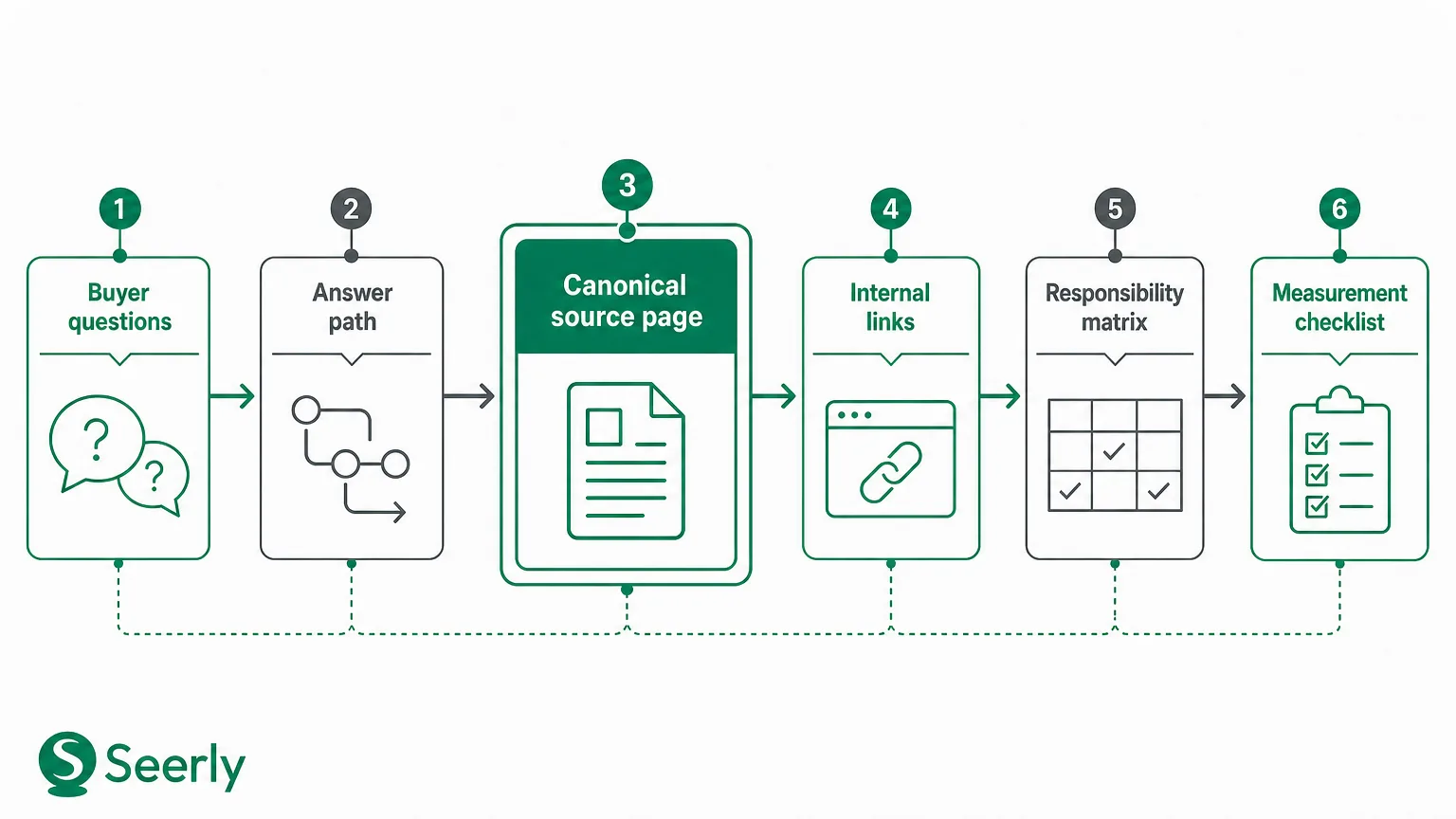
Use the following sequence as a repeatable AI content quality-control workflow. The order matters because it moves from factual integrity to discoverability and distribution.
1. Run a claim check
Highlight every statement that presents a fact, prediction, comparison, or recommendation. Ask whether it is genuinely necessary, whether it is stated with appropriate confidence, and whether it could mislead a reader if it were wrong. Remove claims that only create the appearance of authority without helping the reader make a decision.
A practical rule is that the more consequential a claim is, the closer the review should be to a primary source or qualified subject-matter expert. This approach aligns with the need for risk-aware AI use described in the NIST Generative AI Profile, which emphasizes identifying and managing risks throughout the AI lifecycle.
2. Run an evidence check
For every retained claim, inspect the actual source - not the AI’s description of it. Confirm the statistic, date, population, caveat, and conclusion. If the source supports only a narrow observation, narrow the copy rather than stretching the finding into a universal recommendation.
Also check whether the page contains enough original evidence. A source-backed article is stronger than an uncited draft, but a page built entirely from public summaries may still be interchangeable. Add expert commentary, examples from real workflows, documented testing, or a transparent explanation of how the team reached its recommendation.
3. Run a structure check
Read the draft only for organization. Can a busy reader identify the answer in the introduction? Does each H2 serve a distinct job? Do H3 sections expand the parent idea rather than introduce a disconnected topic? Are definitions, examples, tradeoffs, and actions placed where the reader needs them?
This is where teams should remove “AI-shaped” repetition: multiple sections that restate the same idea using slightly different language. Strong structure is selective. It gives each paragraph a purpose and makes the page easier to scan, quote, and reuse.
4. Run a retrieval check
A retrieval check asks whether someone - human or system - can locate the page’s essential answer quickly. Review the title, introduction, headings, descriptive links, schema implementation where relevant, and the clarity of named concepts. Make sure the page uses consistent language for the topic rather than rotating through vague synonyms that obscure relevance.
Originality is central here. Pages are more likely to contribute to AI search discovery when they provide evidence and perspective that other sources do not simply repeat. Before publishing at scale, teams should assess originality signals that keep AI-generated content from becoming interchangeable.
5. Run a distribution check
Finally, confirm how the page will enter the site’s content system. Add relevant internal links, identify existing pages that should link back to the new resource, ensure the URL and metadata are appropriate, and determine which newsletter, social, sales-enablement, or outreach route will support initial discovery. Distribution should be planned before publication, not treated as an optional promotion task afterward.
This final step also establishes the measurement baseline. Record the target queries, competing pages, initial visibility, and intended conversion action. Without that baseline, a team cannot tell whether AI content is improving business outcomes or simply increasing the number of URLs in the CMS.
A maturity model for scaling AI content safely
Most teams should not aim to become “advanced” overnight. The better approach is to identify the weakest stage in the existing workflow and raise its standard before increasing publishing volume.
Beginner: generation-led adoption
Beginner teams use AI mainly for outlines, drafts, repurposing, and headline ideas. Individuals may be productive, but work quality varies widely because there are no shared rules for sources, reviews, or accountability. Success is often measured in articles produced, which makes it easy to reward speed while missing growing quality risk.
The immediate priority is to introduce a standard brief, named reviewers, and a minimum source-validation requirement. Do not automate publication at this stage. Establish a reliable human approval path first.
Intermediate: workflow-led adoption
Intermediate teams have documented briefs, source expectations, editorial checklists, role ownership, and post-publish reporting. They understand that AI is one step in a broader workflow, not the workflow itself. The team can identify why a page was published, who approved it, what evidence it relied on, and how it is expected to perform.
At this level, leaders should improve consistency across topics and authors. Audit a sample of published pages each month for unsupported claims, structural weakness, internal-link gaps, and thin differentiation. Use those findings to update training, templates, and review standards.
Advanced: visibility-led adoption
Advanced teams connect AI content to a deliberate visibility and reputation system. They monitor priority topics and prompts, compare their pages with competing sources, test how pages are surfaced across search experiences, and use performance data to improve briefs. Their goal is not merely efficient production; it is dependable discovery built on accurate, distinctive, AI-ready content.
These teams also make governance measurable. They track error rates, revision cycles, time to approve, citation quality, search performance, and the share of pages meeting defined trust criteria. That allows leaders to scale intelligently because they can see whether faster production is strengthening or weakening the content system.
Frequently asked questions
Do writers need technical SEO knowledge now?
Writers do not need to own every technical SEO task, but they should understand the fundamentals that affect content usefulness and discoverability. That includes search intent, heading hierarchy, internal-link context, descriptive anchor text, answer clarity, and the difference between a claim and evidence. The SEO specialist remains responsible for technical implementation and performance analysis, while the writer creates copy that gives the page a clear informational structure.
Who owns validation for AI-assisted content?
Validation should have both a subject owner and a publication owner. The person or team with domain knowledge verifies factual, regulated, product-specific, or high-stakes claims; the editor verifies that the evidence is represented accurately and meets editorial standards. The content manager owns the process itself by ensuring no article goes live without the correct review path.
What if the AI draft sounds right but lacks proof?
Treat it as an incomplete draft, not a publishable article. Either find reliable evidence, interview a qualified expert, reframe the statement as a clearly labeled opinion, or remove it. A fluent sentence without proof is more dangerous than an obvious gap because it can pass through review unnoticed and undermine trust later.
Can AI create original content?
It can support original work, but it does not automatically create it. Originality comes from the inputs and judgment around the tool: proprietary data, first-hand experience, expert analysis, tested processes, distinctive examples, and a clear point of view. AI is effective at synthesis and acceleration; teams still need to decide what evidence and perspective make the page worth publishing.
Build skills before you build volume
The central lesson of AI content is simple: faster drafting only helps when the surrounding workflow can protect quality and prove impact. Briefing, source trust review, answer-first structure, editorial QA, and measurement are not slowdowns. They are the capabilities that turn AI output into credible content that can earn visibility rankings, strengthen brand reputation, and support AI search discovery.
Run one team workshop using the skills matrix in this guide. Score each workflow stage from one to five, identify the lowest-scoring capability, and improve that stage before raising publishing targets. When you are ready to monitor whether your AI-assisted pages are actually discoverable, Seerly provides a visibility layer for teams building trusted, AI-ready brand authority.