AI Content Governance Before You Publish: A Practical SEO Review Workflow for High-Stakes Pages

Teams are being asked to publish faster than their review process can safely handle. AI drafting tools have lowered production time, but they have also made it easier to ship pages with thin sourcing, recycled claims, and structurally weak copy that looks polished on the surface. For B2B marketing leaders and lean SEO teams, that creates a new problem: the bottleneck is no longer first draft creation. It is governance.
That shift matters because search performance is already under pressure. Organic click opportunity remains heavily concentrated at the top of results, with the highest-ranking positions capturing a disproportionate share of clicks. At the same time, new search interfaces are changing how users interact with pages and brands. Reporting on Google AI Overviews has shown measurable erosion in traffic opportunity for many publishers, which raises the cost of publishing weak or untrustworthy content. If fewer pages earn the click, and fewer citations are distributed broadly, each page needs to be more defensible before it goes live.
This is why practical search engine optimization advice now has to include content governance. The question is no longer just “how do we optimize a page?” It is “what must be checked before AI-assisted content is allowed onto a revenue-relevant page?” A useful answer is not “edit harder.” It is a repeatable workflow that reviews factual accuracy, brand risk, structural clarity, originality, and measurement readiness in the same order every time.
Why AI-assisted publishing needs a governance layer now
Most teams adopted AI because volume pressure is real. Editorial calendars are expanding, sales teams need more solution and comparison pages, and lean content functions are expected to support more segments without proportional headcount. That pressure is happening in a channel where SEO still matters materially for business visibility. A recent systematic review found organic search and SEO best practices continue to influence discoverability and business visibility across digital channels. So the temptation to scale production quickly is understandable.
The problem is that AI often accelerates the wrong part of the process. It can produce acceptable sentence-level copy while still introducing unsupported assertions, generic positioning language, or subtly duplicated page angles. Those issues do not always look severe during a quick read, but they compound across a site. On high-stakes pages such as solution pages, product pages, competitor alternatives, and regulated-industry content, that creates avoidable risk. A page can be grammatically clean and still fail as a search asset because it does not prove its claims, serve a differentiated intent, or present information in a way that search systems can interpret confidently.
Benchmarks across industries also show that performance gaps are wide enough that execution quality matters. SEO benchmark reporting from Semrush notes substantial variance in organic performance by vertical, authority, and execution maturity, while B2B SaaS reporting has shown strong differences in non-brand traffic and conversion opportunity between top performers and the rest of the market. In other words, scaling output alone is not the advantage. Publishing governed content that is clearer, more trustworthy, and more measurable is the advantage.
A governance layer also helps teams prepare for a broader visibility model. Search success increasingly includes whether pages are easy to interpret, summarize, and cite. That is why content teams should connect traditional SEO workflows with a stronger pre-publish QA process. Seerly has explored this from the angle of what makes a page easier for answer engines to interpret and cite. The practical implication is simple: governance is no longer just a legal or editorial function. It is part of search readiness.
The five review gates before anything goes live
A workable governance system should be light enough for weekly use but strict enough to stop weak pages from slipping through. The easiest way to achieve that is to define five gates and require each page to pass them in sequence.
1. Factual verification
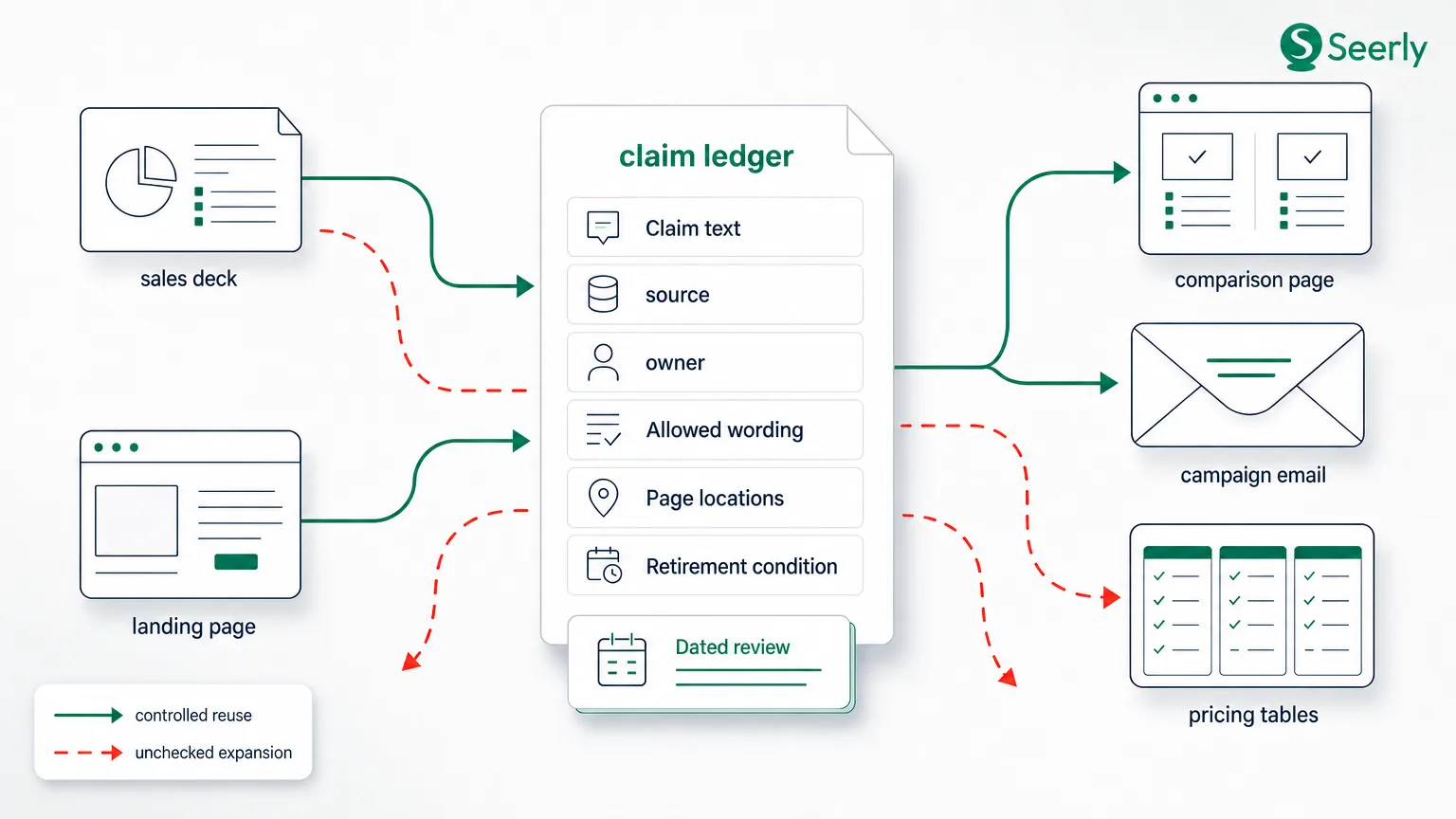
Every claim that could influence a buying decision should be checked against a source, product proof, or internal subject-matter owner. This includes market statistics, product capabilities, comparative assertions, compliance language, and any “best,” “leading,” or “proven” wording. If a statement cannot be sourced, it should be rewritten as opinion, qualified as directional, or removed entirely.
This matters because AI systems frequently generate claims that sound plausible without being verifiable. On a blog post, that may merely weaken trust. On a solution page, it can create legal exposure and undermine conversion. A strong rule is that any sentence that could be challenged by a prospect, competitor, or compliance reviewer needs visible support in your source file before publishing.
2. Brand-risk screening
The second gate asks whether the page creates messaging, legal, or reputation risk. That includes accidental promises, overconfident ROI claims, unsupported references to customer outcomes, prohibited industry language, and inconsistent category framing. AI drafts often overstate certainty because confident language is statistically common in training data. Your workflow should explicitly search for that pattern.
For B2B teams, this is where marketing and legal or product stakeholders need a clear handoff. Not every page requires a full legal review, but every high-stakes page should have a defined reviewer for sensitive language. Governance fails when responsibility is vague.
3. Structural clarity
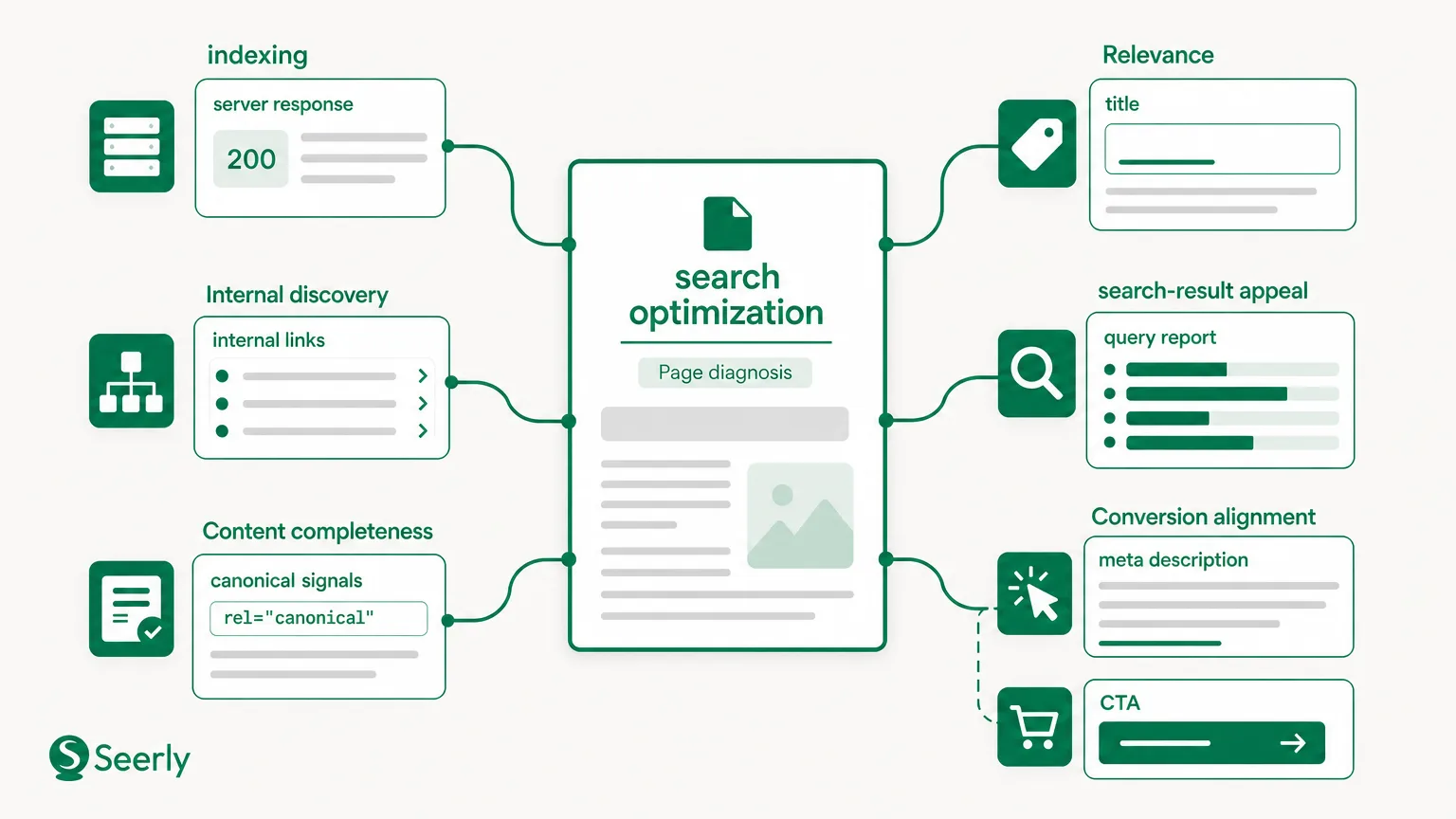
A page should make sense to a rushed buyer before it tries to impress an algorithm. Review whether the H1 reflects the actual intent, whether H2s answer the expected questions in logical order, whether examples are specific, and whether FAQs add unique value rather than padded keyword coverage. Good structure improves user comprehension first, but it also helps search systems parse what the page is substantively about.
If your team is refining content for AI-era discovery, this is where structure becomes especially important. Seerly has written about how content optimization for AI engines depends on clearer formatting, semantic grouping, and explicit answers. A structurally tidy page is easier to review, easier to trust, and easier to interpret.
4. Duplicate-angle control
Many AI-assisted programs create hidden duplication without repeating exact sentences. The page may target a different keyword but deliver the same argument, examples, and framing as three other pieces already on the site. That weakens differentiation and can spread authority across overlapping URLs instead of building a single best asset.
This gate should compare the draft against existing pages for overlap in intent, not just phrase repetition. Ask: does this page earn its own existence? Is it serving a distinct stage, persona, or use case? If not, merge it, redirect it, or reposition it before publishing.
5. Measurement setup
The final gate confirms that the page can actually be evaluated after launch. That means defining the primary query class, expected conversion action, internal links, schema if relevant, and monitoring plan for impressions, rankings, assisted conversions, and citation visibility where applicable. Teams often spend hours refining copy and then publish without a clear baseline.
That is a mistake because benchmark context matters. Industry reports continue to show large differences in click-through rate, visibility, and traffic efficiency by sector and ranking position. Without measurement setup, you cannot tell whether a page underperformed because of weak demand, weak intent matching, or weak governance.
A worked example of a pre-publish review on a solution page
Imagine a SaaS company preparing to publish a solution page for “AI search analytics for B2B teams.” The first AI-assisted draft looks polished. It has a strong headline, feature sections, customer-proof language, and an FAQ. On the surface, it appears publish-ready. Under governance review, however, several issues emerge.
First, the headline says the platform “helps teams dominate AI search visibility.” That is punchy, but it is not provable and may overpromise. The reviewer changes it to language tied to an observable outcome, such as improving visibility tracking or helping teams identify citation patterns. The body copy also claims “most buyers now rely on AI answers during research.” That may be directionally true, but unless the team has a source that directly supports that exact framing, the sentence should be narrowed or removed.
Next, the structure is checked. The original H2 sequence jumps from platform features to ROI claims to FAQs, which forces the reader to assemble the narrative themselves. A cleaner structure would move from problem definition, to workflow, to proof, to implementation questions. The revised page becomes easier to scan because each section answers a natural buyer question in order.
Then the examples are reviewed. The draft says the product gives “actionable intelligence” but offers no concrete output. The editor inserts a specific example, such as seeing which pages are being cited, where visibility is trending by topic cluster, and which page types need stronger source support. That converts abstract positioning into evidence of real utility.
Finally, the FAQ block gets scrutiny. AI-generated FAQs often repeat what the page already says in slightly different wording. That adds length without adding value. A better FAQ section would answer unresolved buyer concerns like implementation speed, data sources, reporting frequency, or how visibility measurement differs from traditional rank tracking. If the FAQ cannot surface net-new information, it should be trimmed.
This kind of review is not theoretical. It is exactly the operational layer teams need when turning AI-assisted drafts into durable search assets. It also complements a broader strategy for tracking visibility beyond classic rankings, because cleaner pages are easier to evaluate after launch.
Which checks should be manual and which can be systematized
Not every check deserves human time. The goal is not maximum review; it is intelligent review. The most efficient governance models separate judgment-heavy tasks from pattern-detection tasks.
Manual checks
Editorial judgment should remain manual for page intent, differentiation, examples, narrative clarity, and the strength of argumentation. A human reviewer is still better at recognizing when a page is technically accurate but strategically weak. Manual review is also essential for compliance-sensitive language, category positioning, and deciding whether a claim is persuasive or merely verbose.
This is especially true in B2B buying content, where trust is built through nuance. A human can detect when a page is hiding behind vague language like “streamline workflows” instead of explaining what actually changes for the buyer.
Systematized checks
Systematized checks work well for scanning repeated phrasing, flagging unsupported superlatives, identifying missing alt text or metadata, checking heading depth, validating internal link presence, and ensuring a measurement template is completed. AI-assisted QA can also help compare drafts against existing site pages to reveal likely duplication or topic overlap.
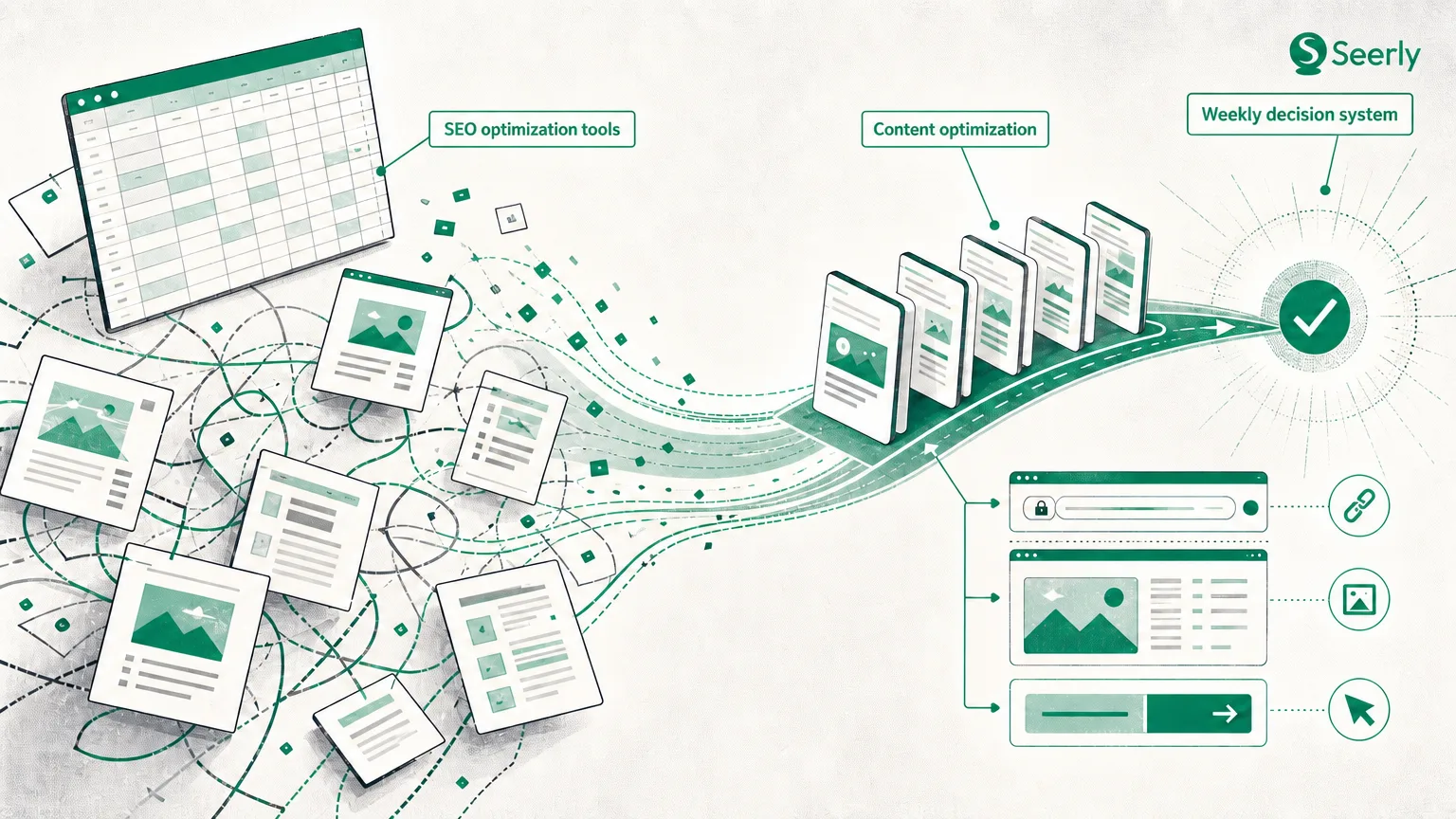
Template-based reviews are useful here. If every solution page must include a source log, claim owner, conversion goal, and post-publish KPI field, the process becomes easier to maintain across teams. This is where many organizations should look to SEO optimization tools: not to replace editors, but to automate consistency checks and route exceptions.
The practical split
A good rule is to automate what can be objectively flagged and reserve human review for what requires interpretation. If software can tell you a page has three unsupported superlatives, let it. If the question is whether the page makes a stronger argument than your competitor’s alternative page, that still needs editorial and strategic judgment.
Common failure patterns when teams scale AI content too fast
The same errors appear repeatedly when output scales faster than governance.
Repetitive phrasing
AI drafts often recycle sentence patterns across pages, especially in introductions, subheads, and CTA copy. This creates a site-wide sameness that weakens distinctiveness. It may not trigger duplicate-content problems in a strict technical sense, but it does reduce perceived originality and brand sharpness.
Empty claims
Phrases like “industry-leading,” “powerful insights,” or “transform your strategy” are common because they sound persuasive while saying almost nothing. They become dangerous when they crowd out specifics. Strong pages replace them with evidence, examples, or defined mechanisms.
Weak examples
Many AI-generated examples are generic composites rather than grounded scenarios. If your page discusses analytics, governance, or workflow improvement, the reader should be able to picture what a user sees, changes, or decides. Without that, the content may rank for broad intent but fail to convert.
Missing source proof
This is the most important failure pattern. Teams assume they will “add sources later,” but later rarely comes when production pressure is high. The result is a polished page with citation gaps embedded throughout it. Governance should treat missing source proof as a launch blocker, not a cosmetic issue.
Measurement blind spots
Some of the most expensive content failures are invisible because nobody defined success in advance. Benchmark studies continue to indicate SEO outcomes vary widely by site maturity, industry competition, and conversion design. If a page launches without a tracking plan, the team cannot separate poor execution from normal ramp time.
A governance scorecard teams can reuse every week
To make this operational, use a simple weekly scorecard. Score each category from 0 to 2.
1. Source quality
- 0 = key claims unsupported
- 1 = partial support, some weak or indirect evidence
- 2 = all material claims supported by reliable sources or approved internal proof
2. Claim validation
- 0 = exaggerated or challengeable wording remains
- 1 = most risky claims corrected, minor issues remain
- 2 = claims are precise, qualified where needed, and approved
3. Structural clarity
- 0 = confusing flow, thin sections, repetitive FAQ
- 1 = readable but uneven structure
- 2 = clear intent match, strong hierarchy, concise and useful supporting sections
4. Originality and angle control
- 0 = overlaps heavily with existing pages
- 1 = partly differentiated but still redundant
- 2 = distinct audience, use case, or page purpose
5. Measurement readiness
- 0 = no KPI or baseline defined
- 1 = partial setup with unclear ownership
- 2 = goals, query set, internal links, and monitoring plan documented
A page scoring 8 to 10 is publishable. A page scoring 5 to 7 needs revision before launch. A page below 5 should be reworked more fundamentally, because the draft quality or page strategy is likely off.
This scorecard also creates a useful management rhythm. Over time, teams can track where points are most often lost. If low scores cluster around source quality, the issue is research discipline. If they cluster around originality, the issue is topic planning. That turns governance from subjective editing into a measurable operating system.
Turn governance into a standing editorial QA routine
The best search engine optimization advice for AI-assisted publishing is no longer “produce more.” It is “publish with gates.” High-stakes pages need a governance layer that checks facts, screens risk, improves structure, prevents duplicate angles, and defines measurement before launch. That is how teams protect trust while still moving at the speed modern content programs demand.
The next step is to turn this checklist into a standing weekly editorial QA routine. Start with your highest-risk page types, score them consistently, and review where failures repeat. As your process matures, connect governance quality to downstream outcomes: cleaner rankings data, stronger engagement, and whether better-structured pages become easier for AI systems to interpret and cite over time. If you want to build a more disciplined visibility workflow around that idea, explore Seerly.