Building Brand-Aware Content Generation: Inline Comments, Images, and Guidelines in One Feedback Loop

Building Brand-Aware Content Generation: Inline Comments, Images, and Guidelines in One Feedback Loop
How structured content, contextual feedback, and governed brand inputs turn generation from a one-shot prompt into an editable system.
Generating an article is easy to demo. Making it possible for a team to shape that article—without losing context, brand consistency, or the reasoning behind each change—is the real engineering problem.
A conventional generation flow is linear: collect a prompt, produce a draft, and ask the user to accept or regenerate it. Real editorial work is not linear. Reviewers react to a specific sentence, ask for a visual to feel more like the brand, reject one claim while preserving the surrounding section, and refine the piece through several small decisions.
We introduced inline commenting and brand-aware generation to support that reality. The important shift is architectural: feedback, brand rules, approved imagery, generated assets, and article content must participate in one traceable loop. Generation becomes an editable system rather than a one-shot model response.
The document cannot be an opaque string
Inline feedback becomes fragile when the article is stored only as a large block of text. A comment attached to character 4,182 can point at the wrong phrase after an earlier paragraph is revised. Regenerating the entire document to fix one sentence can undo edits that the team has already approved.
The content workflow therefore needs a structured document contract. In our Content Marketing Studio flow, an article is represented as typed blocks—headings, paragraphs, lists, quotations, dividers, and image references—with inline marks represented separately from the text. Assets have stable identifiers and carry their own alt text, generation prompt, and local file reference.
That structure gives the system addressable units. A reviewer can discuss a paragraph or an image as an object rather than as a position in a mutable string. Renderers can later transform the same document into the project’s required format without forcing the collaboration layer to understand raw Markdown or HTML.
Inline comments are contextual instructions
A comment is more useful than a generic revision prompt because it carries location. “Make this more specific” means little by itself. Attached to a sentence about trend detection, it becomes a bounded instruction with the surrounding paragraph, section heading, and article goal available as context.
At a design level, every inline comment needs four things:
- An anchor: the block, passage, or asset the reviewer selected.
- An instruction: the requested change in the reviewer’s own words.
- Context: the section, article objective, audience, and relevant brand rules.
- State: whether the comment is open, applied, rejected, or resolved.
The state model matters because collaboration is not just text mutation. A team needs to know whether a request has been incorporated, whether the resulting change was accepted, and whether later edits made the original comment obsolete. Keeping the comment as a first-class record preserves that history.
Targeted regeneration protects approved work
Once feedback is anchored, the smallest safe unit can be regenerated. A sentence-level request may still require the full paragraph for coherence. A comment on an argument may require the surrounding section. A brand-image request may require the asset brief and nearby copy, but not the rest of the article.
The boundary should be explicit. The generation step receives the selected content, its local context, the document-level objective, applicable brand constraints, and the reviewer’s instruction. It returns a proposed replacement for that scope. The system then validates the replacement and applies it without silently rewriting unrelated blocks.
This is a product behavior with an engineering consequence: users need predictable diffs. If a narrow comment causes broad, unexplained changes, trust disappears. Local edits should remain local unless the system explains why a wider revision is necessary.
Brand guidelines must become executable context
Brand guidelines are often stored as a PDF, a slide deck, or a folder of logos. Those files are valuable to humans but too ambiguous to inject wholesale into every generation request. The system needs to translate them into context that can be retrieved and applied at the right moment.
A useful brand profile separates several kinds of instruction:
- Voice and tone: how the brand sounds, including preferred and disallowed phrasing.
- Messaging: positioning, proof points, product vocabulary, audiences, and claims that require evidence.
- Editorial rules: spelling, capitalization, heading style, reading level, and calls to action.
- Visual language: palette, composition, subject matter, illustration or photography style, and treatments to avoid.
- Asset policy: which logos, product screenshots, people, icons, or reference images are approved for use.
Not every rule belongs in every prompt. Voice and terminology shape the article draft. Visual language and asset policy shape an image request. A claim restriction may matter only to a paragraph about product capability. Retrieval should select the relevant subset while retaining a link back to the source guideline.
Brand images are references, not decoration
Approved brand imagery gives an image-generation system evidence about the brand’s visual identity. But attaching every available image is not enough. The system must know why an image is relevant: whether it demonstrates composition, palette, product appearance, iconography, or a subject that should remain visually consistent.
The asset record therefore needs more than a file path. It should carry a stable ID, intended role, descriptive metadata, usage constraints, and provenance. When a generated image is planned, the prompt can combine the article’s subject with the applicable visual rules and the smallest useful set of approved references.
The resulting asset must retain the generation prompt, alt text, and reference lineage. This makes the image reproducible enough to iterate, allows reviewers to understand which brand inputs influenced it, and prevents an unapproved image from quietly becoming a new source of brand truth.
Article and image generation share one brief
A common failure mode is to generate the article and its images as separate projects. The copy establishes one idea while the hero image expresses another. Captions repeat the text. A visual may follow the color palette but miss the audience or the point of the section.
We avoid that split by treating the content plan as the shared brief. The plan defines the audience, search intent, angle, claims requiring evidence, outline, call to action, and image plan. The article generator and image generator consume different slices of the same intent.
For a planned visual, the system combines the content role—hero, inline explanation, or social asset—with the section’s message, the brand’s visual constraints, selected reference images, and accessibility requirements. The article then points to the asset through its stable ID. Copy and image remain independently editable, but they are derived from the same editorial decision.
The end-to-end feedback loop
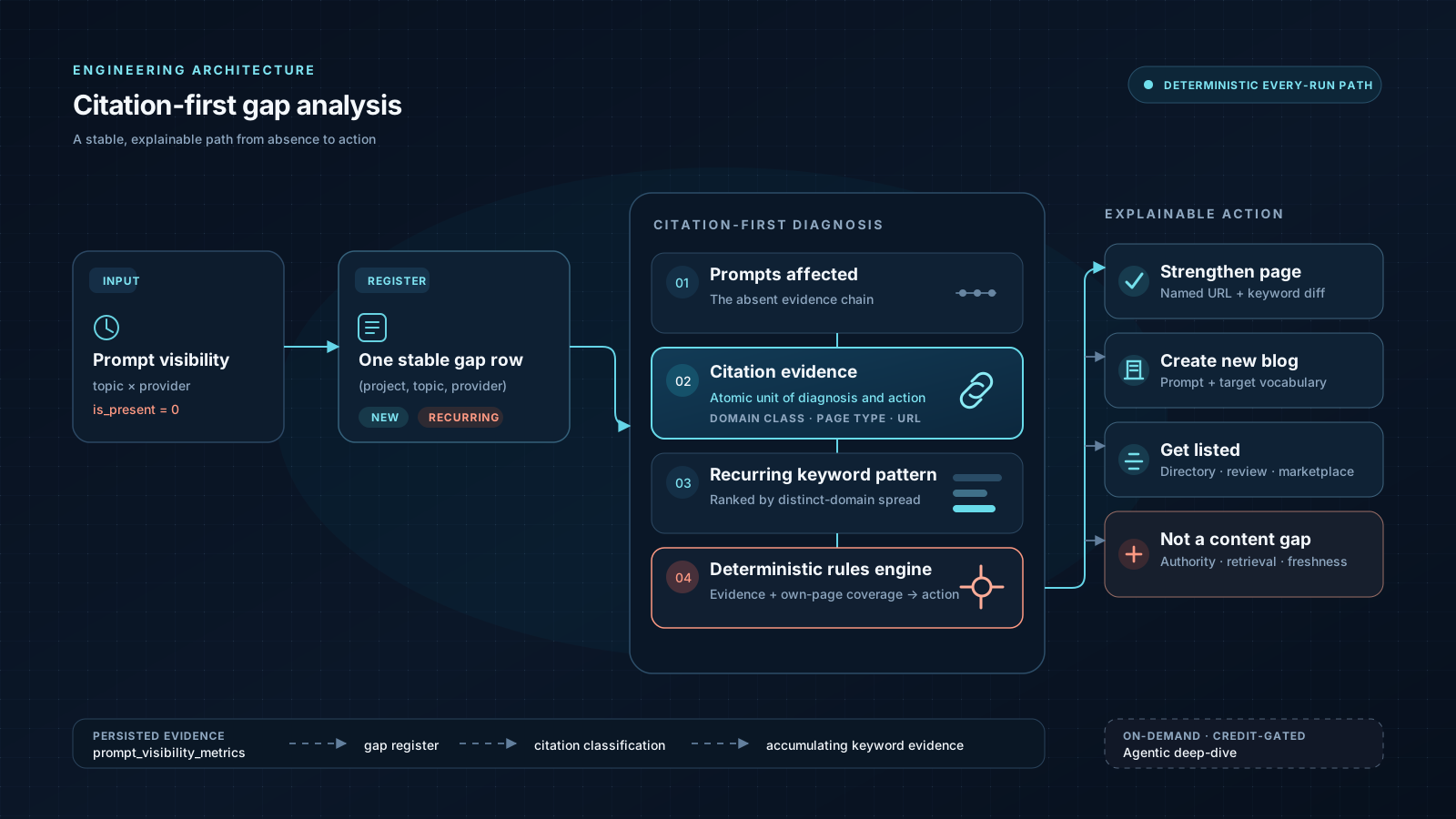
At a systems level, the workflow can be understood as a sequence of contracts:
- Inspect the destination. Infer the project’s format, frontmatter, filename, and asset conventions before drafting.
- Assemble context. Select the article objective, source evidence, relevant brand rules, and approved assets.
- Plan once. Create a shared editorial and visual plan so copy and imagery express the same idea.
- Generate structured content. Produce addressable blocks and explicit asset records rather than an opaque document.
- Review inline. Attach feedback to the smallest meaningful content or asset scope.
- Regenerate selectively. Apply the comment with local and document-level context while preserving accepted work.
- Validate. Check document structure, asset references, required metadata, and brand constraints.
- Render and publish. Transform the validated document into the destination format and retain lineage for future edits.
Each transition is inspectable. If a result feels off-brand, the team can ask whether the wrong guideline was retrieved, the wrong image was selected, the comment lacked context, or the regenerated scope was too broad. That is far more actionable than blaming a model for being inconsistent.
Validation is where brand intent becomes reliable
Generation can suggest; validation decides whether an artifact is ready to move forward. Structural validation catches missing asset references and malformed content. Editorial checks can detect disallowed terms, unsupported claims, missing alt text, or a call to action that conflicts with the plan. Visual review can confirm that the generated asset follows the intended role and approved brand constraints.
Some rules can be automated. Others require a human decision. The goal is not to reduce brand stewardship to a score. It is to surface the right evidence at the right stage so reviewers spend time on judgment instead of hunting for context.
A better collaboration model for generated content
Inline comments, brand guidelines, and brand images may look like separate product features. Architecturally, they solve the same problem: they make context explicit and attach it to the part of the work where it matters.
That produces a more disciplined generation system. Feedback is local and traceable. Approved content survives later revisions. Brand rules are retrieved intentionally rather than pasted indiscriminately. Images inherit the article’s purpose and retain their provenance. Validation sits between generation and publication.
The result is not simply faster drafting. It is a workflow in which people can direct the system with precision, understand why it produced an outcome, and improve that outcome without starting again. That is what turns content generation into content engineering.