Consulted Is Not Cited: What Counts as a Citation in an AI Answer
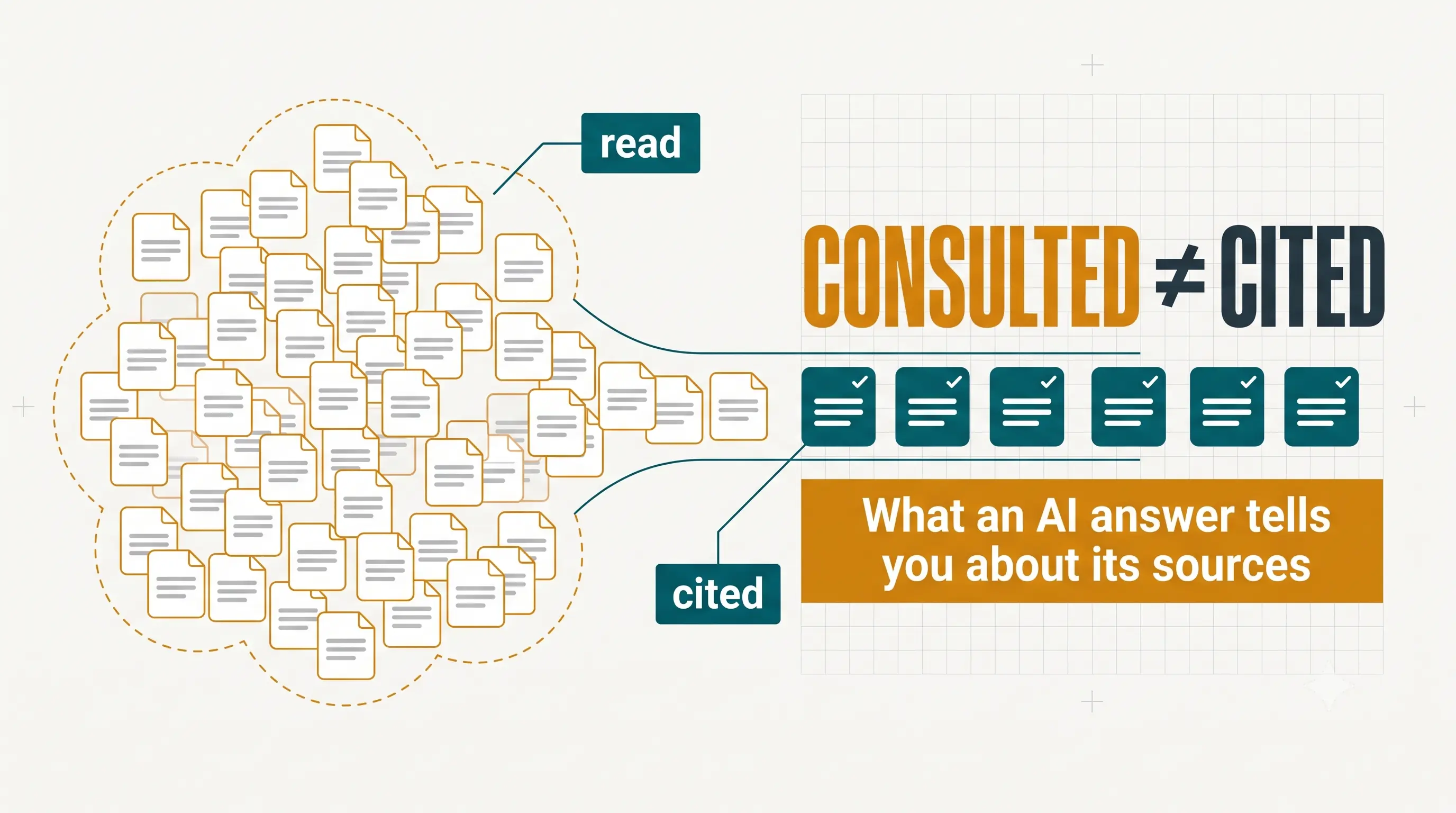
Across 861 ChatGPT answers that came with a full source list, ChatGPT listed 31,981 pages. It cited 4,817 of them, about one in seven.
Those two numbers can sit under the same label on a dashboard. So when a report says your brand was cited in an AI answer, it is worth asking what was counted.
Seerly tells a brand where it shows up in AI answers, and the citation is one of the numbers our customers act on most directly, because a cited page is a page a buyer can click. That puts a lot of weight on one word. Looking closely at answers from ChatGPT, Perplexity and Google AI Overview, we found that an answer comes with several lists of pages that all look like citations and are not.
This post describes how we count. It covers the goals we set, what an AI answer actually contains, the counting methods we weighed and turned down, and what a customer gets as a result. Our earlier post on citation mechanics covered how an engine chooses what to cite. This one is about measuring what it chose.
1. What we wanted the number to be
A citation count has to satisfy five things. Every rule in the rest of this post serves one of them.
- True to what a buyer reads. The count should describe the answer as a person sees it.
- Clickable. Every citation we report should be a page the answer sent the reader to. If a buyer could not have clicked it, it is not a citation.
- One page, one citation. A page that an answer points to in three ways is still one page.
- Stable when the answer changes shape. The engines redesign their answers without notice. The count should survive that.
- Never invented. Where we cannot tell which page an answer meant, we say nothing. We do not fill the gap.
The definition that falls out of these is short:
A citation is a page the answer sends the reader to.
"Sends" is the operative word. A page the engine retrieved, listed or suggested does not qualify. A page the answer itself points to does. Section 5 says exactly where that line sits.
2. The problem: three lists that look like citations
An AI answer does not come with one list of pages. It comes with up to three.
| List | What it is | Is it a citation? |
|---|---|---|
| Read list | Every page the engine opened while composing the answer | No |
| Inline citations | Pills or links in the answer that point the reader to a page | Yes |
| Related links | Suggestions for further reading, grouped under a chip or a "more" control | No |
In the answers we examined in September and October 2026, the engines differed in which of these they showed.
- ChatGPT showed a read list and a much shorter set of inline citations. The read list was the long "more sources" panel behind the answer.
- Perplexity showed a numbered source list and attached a subset of it to claims in the text.
- Google AI Overview showed a rail of cited sources and inline chips that point into that rail. It did not show a separate read list. It did show related links.
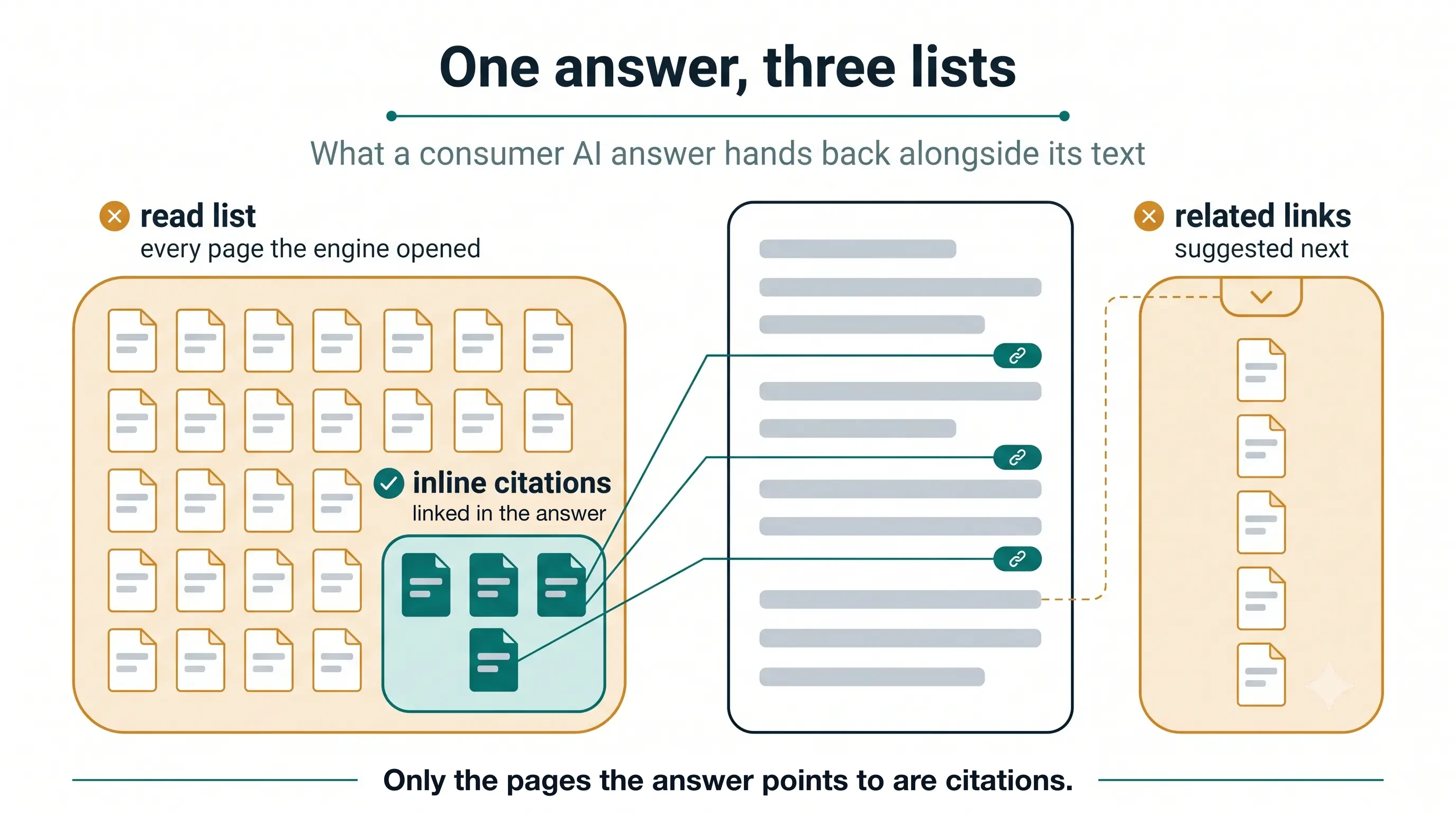
One answer, three lists. Only the pages the answer points to are citations.
All three lists are made of page addresses and titles, and all three can be counted. Only the second is made of pages the answer itself points to. The work is in keeping the other two out.
The related-links trap
Related links are the easiest of the three to miscount, because they look like citations in every way a quick check would test. We analysed 743 AI Overviews that carried them, 1,564 related links in all.
| A related link... | How often |
|---|---|
| also appears as an ordinary link in the body of the answer | 99.5% |
| points to a page that is also in the source rail | 44% |
So a link appearing in the answer body proves nothing about an AI Overview: almost every suggestion appears there. And nearly half of all related links point to a page the overview did cite, which makes the whole group look like sources. The other half were not cited anywhere.
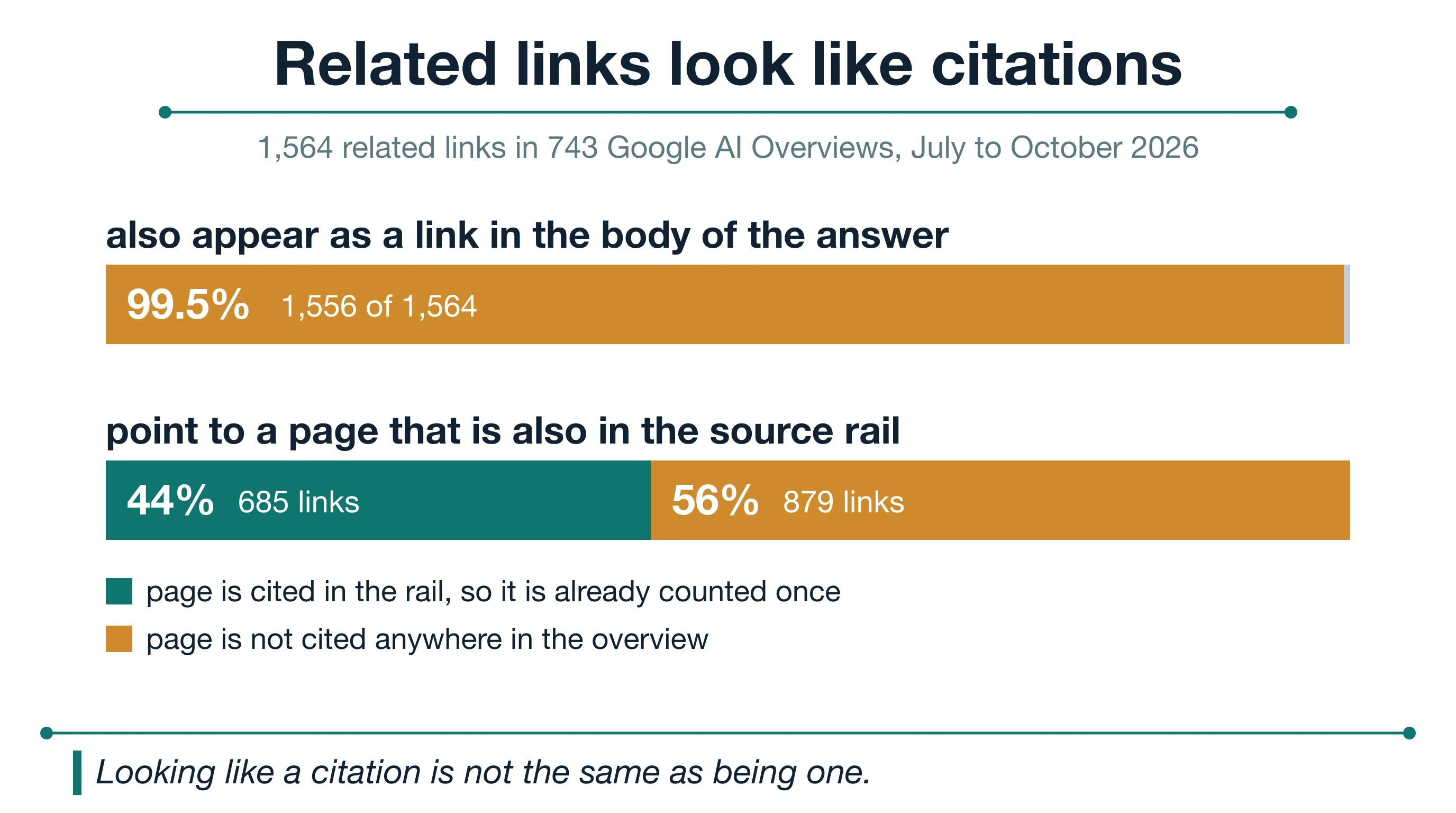
Related links in Google AI Overviews. Almost all appear in the answer body, and fewer than half point to a page the overview cited.
The test we use is the source rail itself. A true inline citation points at an entry in the rail. A related link hangs off a chip that is a menu of suggestions. If its page is in the rail, that page is already counted once, as a citation. If it is not, the overview never cited it. If an AI Overview has an empty source rail and no inline chips, it cited nothing, however many links its body contains.
What we decided: Seerly does not count related links as citations.
3. How much is at stake
None of this would matter if the lists were about the same size. They are not.
| Sample | Pages listed | Pages cited | Cited as a share of listed |
|---|---|---|---|
| ChatGPT, 861 answers with a full source list | 31,981 | 4,817 | 15% |
| Perplexity, 495 answers | 5,166 | 2,011 | 39% |
"Cited" here means distinct pages that carry a citation pill or are linked in the text of the answer.
The ChatGPT answers are from late July to October 2026. On average each listed 37 pages and cited between five and six. In the 800 of them where ChatGPT marked its sources, it marked 85% as background reading. Citation pills outnumber cited pages: across 4,836 ChatGPT answers from the same period there were 6.8 pills per answer on 4.9 distinct pages, because a pill marks a place in the text and one page can have several.
ChatGPT does not always show its full read list. In those 4,836 answers the source list was short, typically four entries, and about the same size as what was cited. The gap is a property of the full list, which is exactly the list a careless count would pick up when it is there.
The Perplexity answers are from late September and early October 2026. Almost all of them listed ten sources, and the middle half cited three to six. One answer in ten cited none of the sources it listed.
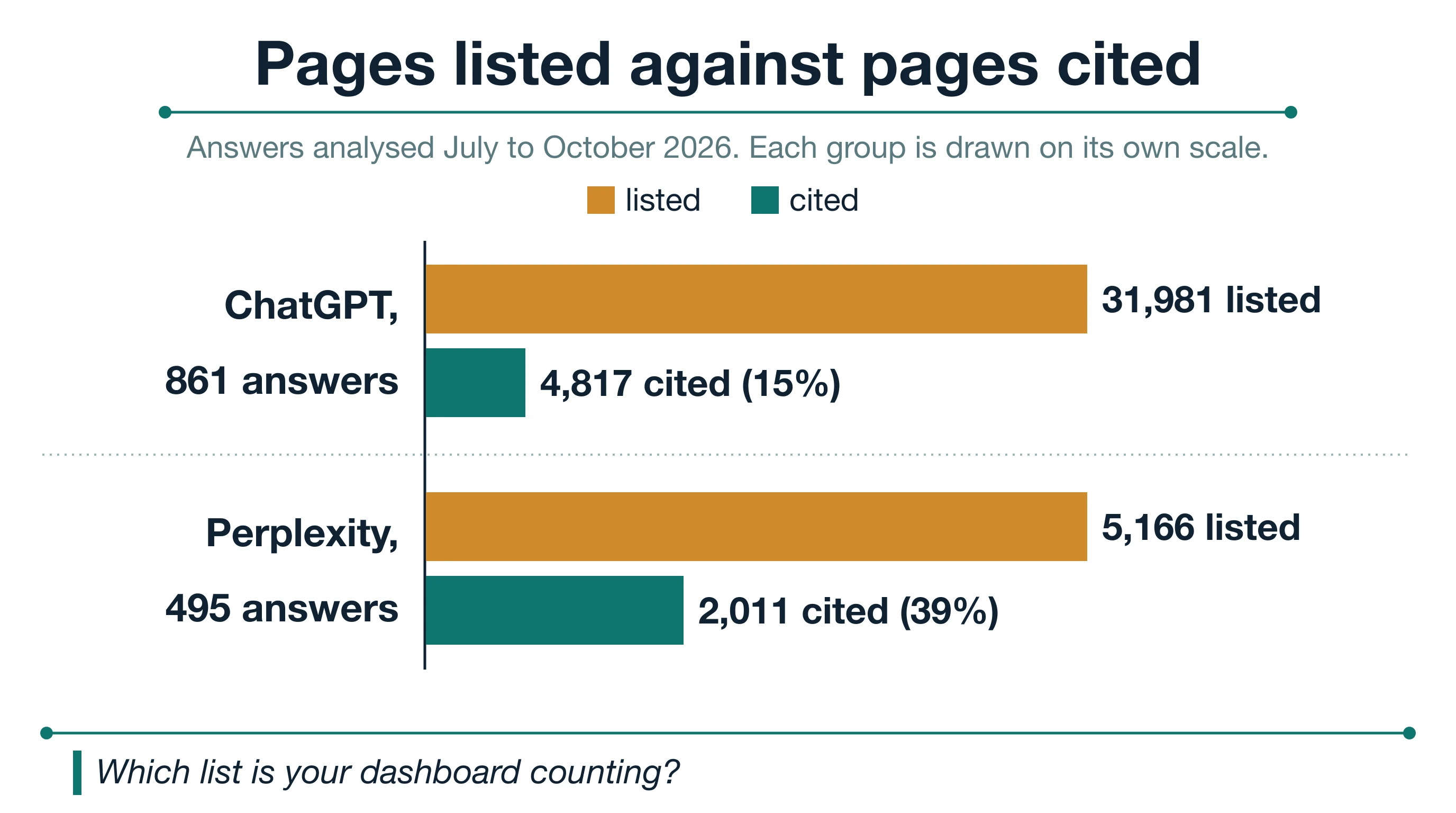
Pages cited as a share of pages listed. Answers analysed between July and October 2026.
A count that treated ChatGPT's whole source list as citations would have reported nearly seven times as many as those answers made. A "top cited domains" chart built that way would really be a chart of the domains ChatGPT tends to open. That is worth knowing, and it is a different fact from being cited.
What we decided: the read list is kept with every answer and never enters a citation count.
4. One answer is a draw
Two more properties of AI answers shaped the design.
The same question does not get the same answer
We took every prompt for which we had more than one answer from the same engine and compared each answer with the next one to the identical prompt. The measure is simple: the domains cited in both answers, divided by the domains cited in either.
| Engine | Pairs of answers | Typical overlap | Pairs sharing no cited domain | Pairs sharing more than half |
|---|---|---|---|---|
| ChatGPT | 3,919 | 33% | 16% | 23% |
| Perplexity | 276 | 25% | 25% | 18% |
| Google AI Overview | 2,396 | 33% | 9% | 19% |
Two answers to the same question typically share a third of their cited domains or less. One ChatGPT pair in six shares none at all. The answers in a pair are usually days or weeks apart, so this includes change over time as well as variation between runs. Either way, the citation set is not a fixed property of a question.
A single AI answer is one draw from a distribution. Read a citation off one answer and you are reporting the draw, not the engine.
What we decided: Seerly reports citation trends across many prompts and many answers over time, not as a reading from one answer. The main figure for a source is its share of citations: the citations that source received, as a proportion of all citations in the answers for the chosen period. Beside it, we report the number of answers about the brand that cited that source, because citation share and answer frequency tell us different things.
The searches behind the answer
Before an engine writes anything, it runs searches of its own. This is query fan-out, and we wrote about why it matters in our post on the prompt universe. Those searches are direct evidence of how the engine understood a prompt. In 158 ChatGPT answers that showed them, there were about 1.5 searches behind each answer on average, and most often one.
What we decided: where an engine shows the searches it ran, Seerly shows them beside the answer.
Google is a different case. The AI Overviews we examined did not show fan-out. What they showed beside the overview was related searches and "people also ask" questions. We keep those and label them as exactly that. They are what Google suggests a person might search next, not what Google searched to write the overview, and presenting them as fan-out would be inventing data. That is the fifth goal applied to something other than citations.
5. Never depend on one signal
The fourth goal, staying correct when an answer changes shape, turned out to be the one that drove the design.
The most familiar form of a ChatGPT citation is a pill at the end of a sentence. It is not the only one. In ordinary prose answers, the text itself often links to the pages it relies on, whether or not a pill sits beside the link. In the 4,836 ChatGPT answers above, pills accounted for 4.9 of the 5.5 cited pages per answer. The rest were pages linked only in the text, or listed as cited without a pill. And in October 2026 we saw a small number of ChatGPT answers assembled from components: boxes and rows, entity cards, image slots, and a dedicated citation component. In an answer built that way, a citation is a reference inside a component.
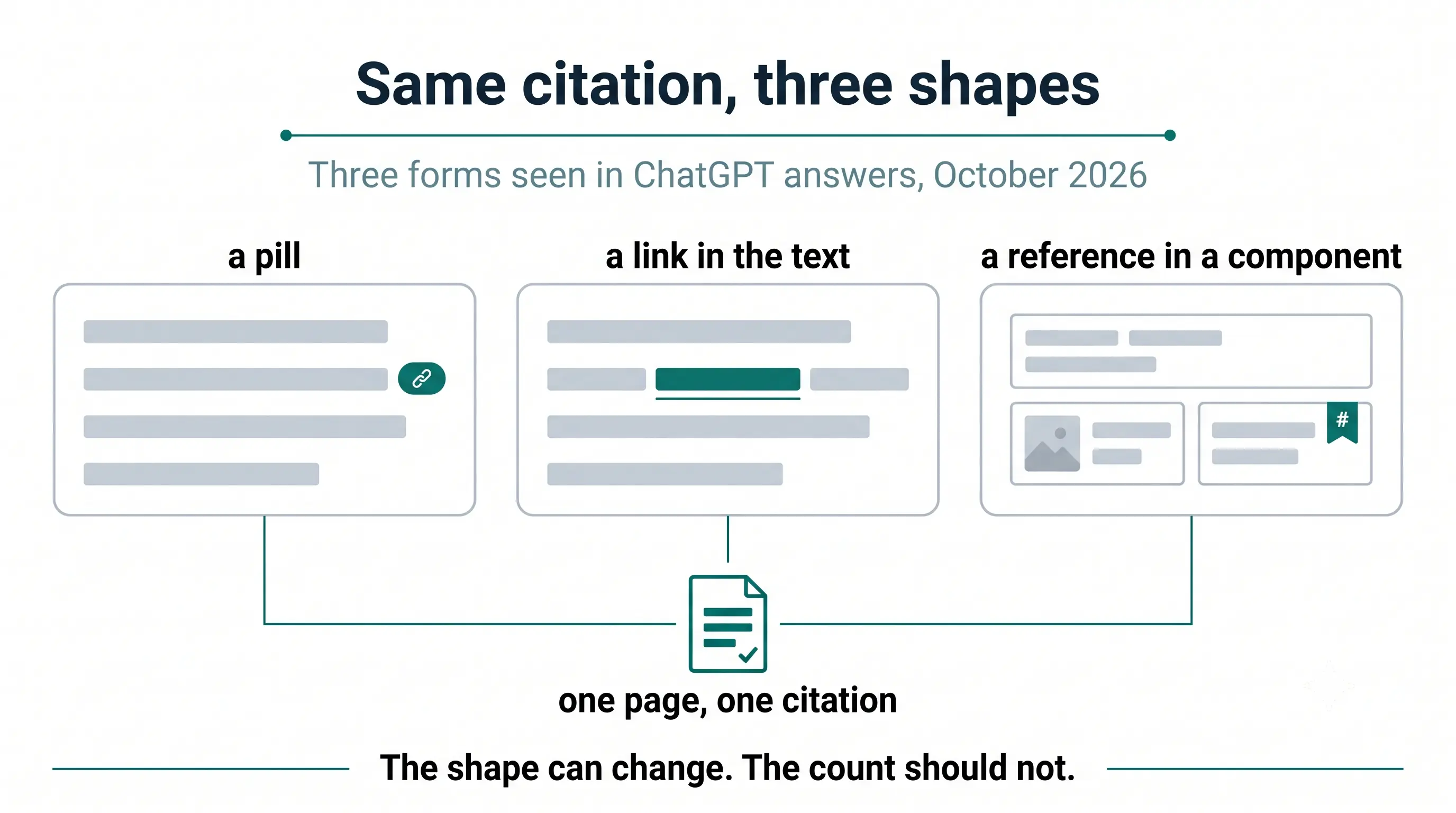
Where a citation lives is not fixed. It can be a pill, a link in the text, or a reference inside a component.
So the same citation can appear in at least three forms, and which form an answer uses can change from one week to the next. A counter built around one form will go quiet when the form changes.
The alternatives we considered
We weighed four ways of counting against the goals in section 1 before settling on a fifth.
| Approach | How it measures up | Verdict |
|---|---|---|
| Count every listed source | Reports nearly seven times as many citations as the answers made (section 3) | Rejected: fails "clickable" |
| Count citation pills only | Finds 4.9 of every 5.5 cited pages; misses the ones that appear only as links in the text | Rejected: fails "stable" |
| Resolve component references by their position in the source list | In the component-built answers we examined, reference order showed no usable correspondence with list order | Rejected: fails "never invented" |
| Include Google's related links | Raises the count with pages the answer does not point to (section 2) | Rejected: fails "clickable" |
| Merge every signal that marks a page as cited, one entry per page | Covers pills, links in the text and marked sources together; a page that appears three ways is counted once; a reference that cannot be resolved is left out | Adopted |
The design we adopted
For ChatGPT we read three signals: the sources not marked as background reading, the citation pills, and the links in the text of the answer. We merge them by page, so each page is counted once no matter how many of the three it appears in. No single signal is treated as complete, because each of them can be the one that is missing.
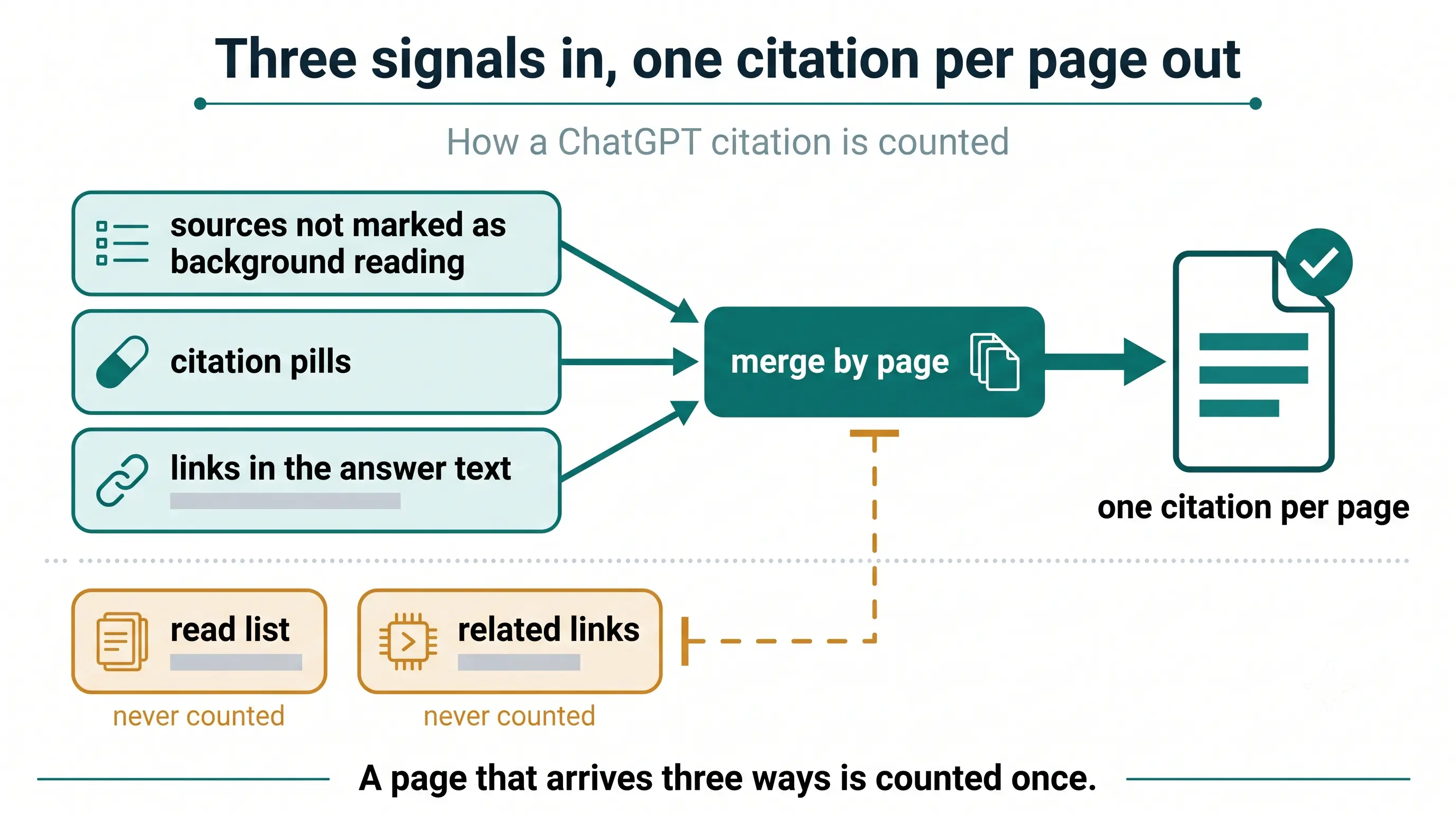
Three signals in, one citation per page out. The read list and related links stay outside the count.
The merge is specific to ChatGPT, because ChatGPT is where a citation moves between forms. Perplexity attaches its citations inline in the text and Google AI Overview lists its in the source rail, so each of those is read from the one place it lives. The difference is deliberate: in an AI Overview the links in the body include suggestions (section 2), so there we rely on the source rail alone.
Two rules sit around the merge, and both come straight from the goals.
No guessing. Where a reference cannot be resolved to a page, we do not assign it to one. A citation with no identifiable page behind it is not counted. We would sooner leave a citation out than report a plausible page that the answer may not have meant. An unresolved reference is still not the same thing as an answer with no citations, and a measurement should be able to tell the two apart. Keeping the full answer, below, is what makes that possible.
The answer is the record. We keep each answer exactly as it was given, alongside what we counted from it. This is the part of the design we would keep even if everything else changed. It means a new counting rule can be checked against real answers before it is adopted, so its effect is known before it is used. The record itself is never rewritten.
Where the line sits
Merging links from the answer text raises a fair question: is every link in an answer a citation? Under our definition, a link the answer writes into its own sentence counts, because the answer is sending the reader there. That includes a link that is navigational more than evidential. If an answer says a product is available on a particular page and links to it, we count that page.
What we do not do at this layer is judge whether a cited page supports the claim beside it. That is a different measurement, and section 8 comes back to it. What we exclude is everything the answer did not itself point to: pages it only read, and pages offered as suggestions.
6. What a customer gets
This is what the goals amount to for a marketing team using the product.
- A citation in Seerly is a page a buyer could have clicked. It is a distinct page the answer explicitly directs the reader to: through a citation marker, a link in the answer text, or a source presented as cited. Pages merely retrieved or suggested are excluded.
- Each page counts once. A page cited by pill, by link and in the source list is one citation, so a single well-cited page cannot inflate a total.
- The searches are shown. Where an engine shows the queries it ran, they sit beside the answer, which shows how it read the prompt.
- Trends are rates. They come from many prompts and many answers over time, so one unusual answer moves them very little. Each individual answer is still there to open and read.
- Nothing is filled in. If we cannot tell which page an answer meant, it is not attributed to anyone.
Five questions for any citation number
These are the questions we had to answer to build this. They apply to any citation number, including ours.
| Question | Seerly's answer |
|---|---|
| What counts as a citation? | A page the answer itself points the reader to: by a pill, by a link in its text, or as a source the engine presents as cited. |
| Which list is counted: pages read, pages cited, or pages suggested? | Pages cited. The read list and related links are kept and stay out of the count. |
| Is a page counted once, or once for every place it appears? | Once per page, however many ways the answer points to it. |
| Is it a rate over many answers, or a reading from one? | A share of all citations across many prompts and answers in a chosen period, shown with the number of answers behind it. |
| What happens to a reference that cannot be resolved? | It is left out. It is never assigned to the nearest plausible page. |
7. Checking this against outside research
We built these rules from our own analysis. It is worth asking whether others, looking from a different angle, see the same shape.
| External finding | What it corroborates |
|---|---|
| OpenAI's own developer documentation describes a web-search response as two separate things: a record of actions taken, including searching, opening a page, and finding text within a page, and a set of citation annotations on the answer text. It also notes that search queries are "usually (but not always)" included. (source) | Sections 2 and 4. The engine's maker separates pages opened from pages cited, and does not promise the queries. This documents the developer product, not the ChatGPT app, so we cite it for the distinction and not as a description of the app. |
| A peer-reviewed Stanford audit of four generative search engines, as they were in 2023, found that on average 51.5% of generated sentences were fully supported by their citations, and 74.5% of citations supported the sentence they were attached to. (source) | What comes next. A citation tells you where a reader was sent. Whether the page supports the claim is a second measurement. |
Neither source checks our figures. Both draw the same line we do, between what an engine opened and what it cited.
8. What comes next
Getting the count right is the first layer of four.
- A page is retrieved by the engine.
- A page is cited in the answer.
- The cited page actually supports the claim it is attached to.
- The citation shapes how the brand is represented or recommended.
This post is about the line between the first and the second. A citation tells us where an answer points its reader. It does not tell us whether that page supports the claim, whether the brand was described accurately, or whether the citation influenced the recommendation. A brand can be cited often and still be misdescribed. A competitor's page can be cited in support of a recommendation for someone else. A brand can be named prominently and not cited at all.
Those are separate questions, and each deserves its own measurement. Before we can say what a citation means, we have to be sure we counted it correctly.
A note on the numbers
The figures in sections 2 to 5 come from answers we analysed between July and October 2026: 5,037 from ChatGPT, 495 from Perplexity and 3,083 from Google AI Overview. A page is identified by its host and path, ignoring www. and a trailing slash. "A full source list" means an answer that listed twenty or more sources. They describe what we observed in those answers at the time. They are not industry benchmarks or permanent properties of the engines, which change often.
Further Reading
- Evaluating Verifiability in Generative Search Engines - Liu, Zhang and Liang, Stanford; Findings of EMNLP 2023 (peer-reviewed). Human audit of four generative search engines; the source of the 51.5% and 74.5% citation-support figures.
- Web search - OpenAI developer documentation. Describes search, open-page and find-in-page actions separately from citation annotations.
- How LLMs decide who to cite - Seerly Engineering. How an engine selects what to cite; the companion to this post.
- Keyword Research as a Proxy for AI Search Demand - Seerly Engineering. Why the searches behind an answer look so little like the prompt.
- From Analysis to Action - Seerly Engineering. What we do with citations once they are counted.