From Analysis to Action: Turning AI Visibility Gaps Into a Content Roadmap
Tracking AI visibility answers one question well: did the brand show up? Across a set of topics, run through ChatGPT, Gemini, Claude, Perplexity, and Google AI Overviews, you get a clean presence/absence signal per prompt per provider. That's the analysis half.
The harder half (the one that actually changes a customer's roadmap) is what happens after the dashboard says "absent." Absent where? Instead of what? And most concretely: what does someone on the content team open a doc and write?
This post is about the pipeline we built to answer that, how measuring the gap by keyword cluster evolved into measuring it by citation once we ran it against real production data, and why that sharper unit holds up against what the wider GEO/AEO research community has been publishing this year.
1. What a gap actually is
Before building anything, we had to settle one definition, because everything downstream inherits it.
A gap = a topic × provider where the brand has zero share of voice (no mentions, no citations) across that topic's discovery prompts, for that provider.
This comes directly from our presence tracking: whether the brand was recorded as present or absent, for every prompt, entity, and provider, on every run. It's discovery-only by design: sentiment prompts measure how we're talked about, not whether we occupy the territory at all, and mixing the two lets a sentiment-only run zero out a real absence streak.
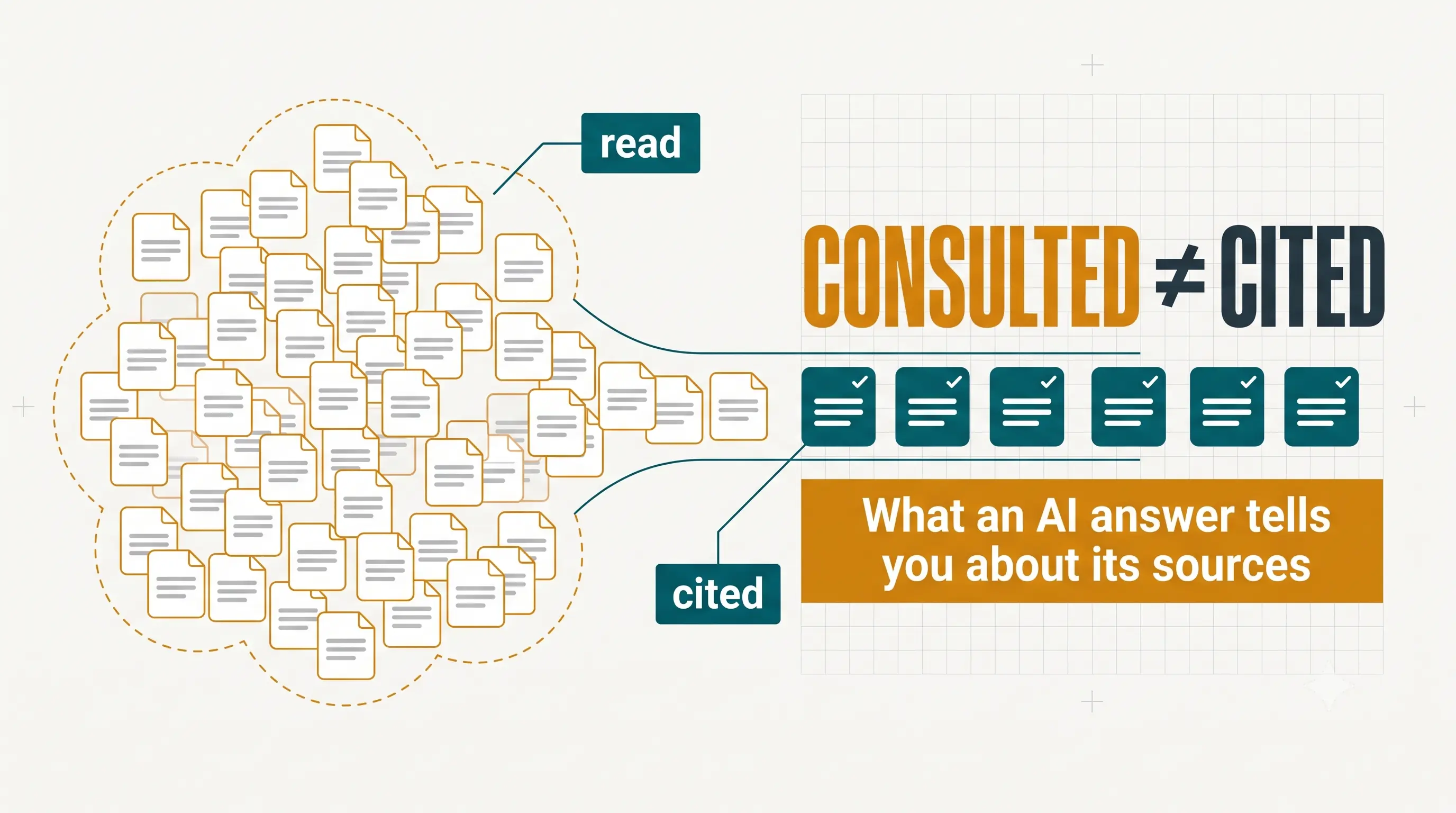
The important design decision is what everything else (citations, keywords, content) is allowed to be: evidence that explains a gap, not a gap of its own. We do not maintain a separate "citation gap count" and a separate "keyword gap count" that both need their own trend line. We validated this isn't just tidiness. On one project's run, of 140 discovery prompt×provider pairs, 135 were absent, 5 were mentioned-and-cited, and the part that mattered: zero were mentioned-but-not-cited. Citation absence was fully entailed by prompt absence. A separate citation-gap tier would have tracked the exact same curve under a different name.
That single run raises an obvious question: was the zero a fluke of one project's one run? To check, we repeated the same count across five independent random samples of five live projects each. Mentioned-but-not-cited pairs turned up in four of the five samples, at rates that varied a lot, from none in one sample to close to a third of that sample's "mentioned" pairs in another. Small samples are noisy by nature, that variance is expected, but the state itself is not a fluke: it's real, it recurs, and it's visible to the model but unsourced, which makes it the one gap state that deserves separate treatment rather than folding into the general absence count.
2. Finding the right unit to measure a gap by
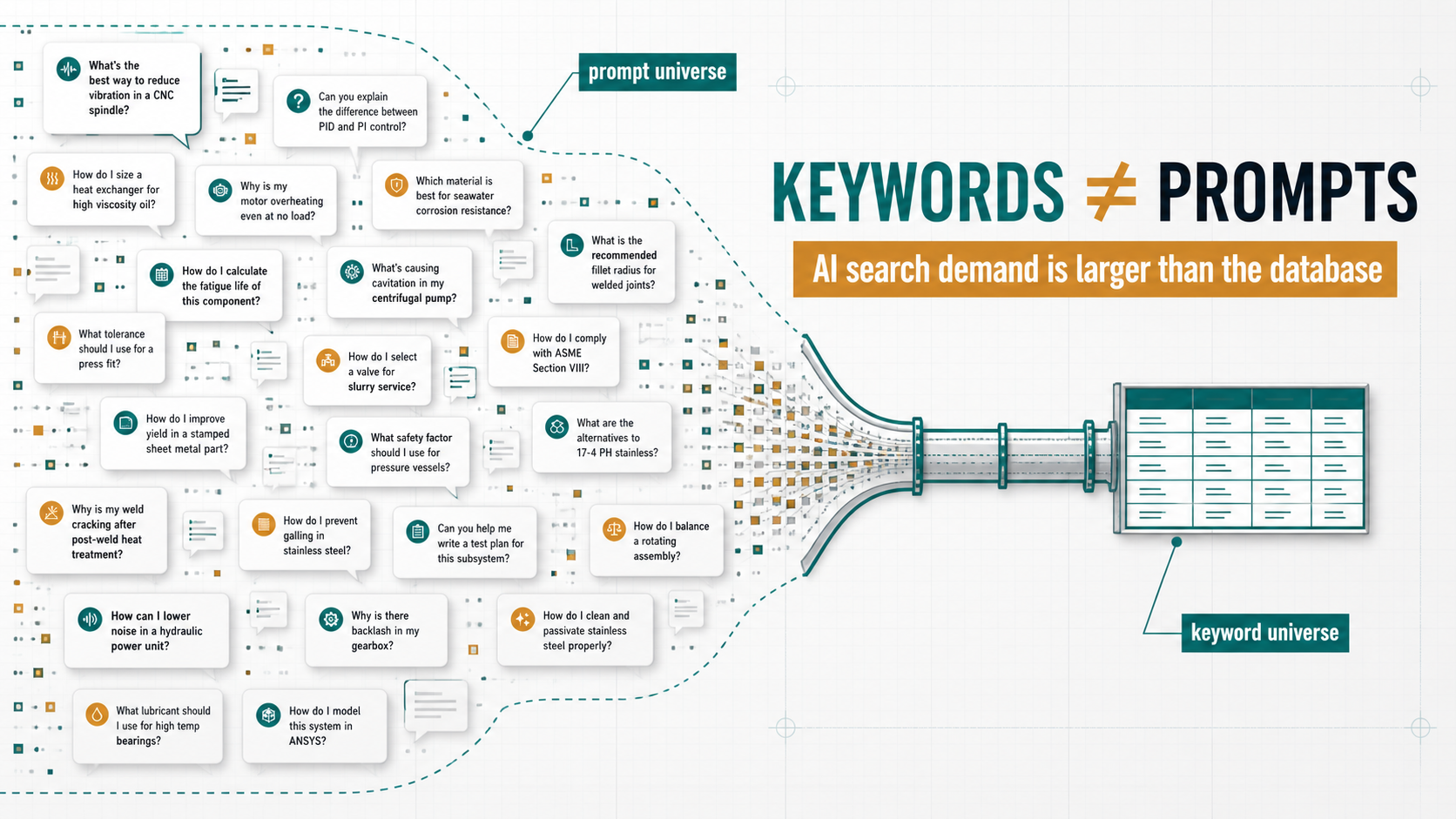
The first version measured a gap at the keyword-cluster level: run the citations from a brand-absent prompt through Google Ads' site-seed keyword expansion, cluster the resulting keywords, and turn each cluster into a card: "you're missing these 40 keywords your competitors cover." It was a reasonable starting hypothesis and we built it end to end: a three-stage job pipeline, persistent storage for the resulting clusters, and a drill-down UI from cluster → citations → prompts.
Running it against real production data is what surfaced a sharper, more actionable unit hiding underneath the cluster:
| What we measured by | What running it on real data showed us |
|---|---|
| A keyword cluster is a coherent unit you can put one call-to-action behind | The top cluster's citations were 5 homepages, 3 blogs, a clinic page, a marketplace listing, and a directory. No single CTA ("reorient this page," "write this blog") is correct across all of those |
| A cluster's label is a stable identity you can key rows on | Labels reshuffled run to run. Comparing two fresh runs on the same data, 5 of 8 labels changed, even with high-reasoning-effort labeling |
| Raw keyword volume is the headline number | Google Ads' close-variant matching inflated the top cluster's volume by roughly 39%: weight loss and its four near-duplicate phrasings were each counted as separate keywords |
| A competitor flag can be derived from "was a competitor mentioned on this page" | That logic flagged a directory site as a competitor, because a competitor happened to be mentioned on it. It conflates who owns the page with who's discussed on it |
What all four rows point to is the same underlying unit: the citation, not the cluster, is what's actionable. A cluster spans multiple pages with genuinely different actions attached to them. And a cluster's identity depends on LLM output, which drifts by construction, so it can't anchor a stable row in a register users check week over week.
3. The sharper version: citation-first, register-first
This version keeps the one gap definition from section 1, and restructures everything under it around the citation as the unit of evidence and action.
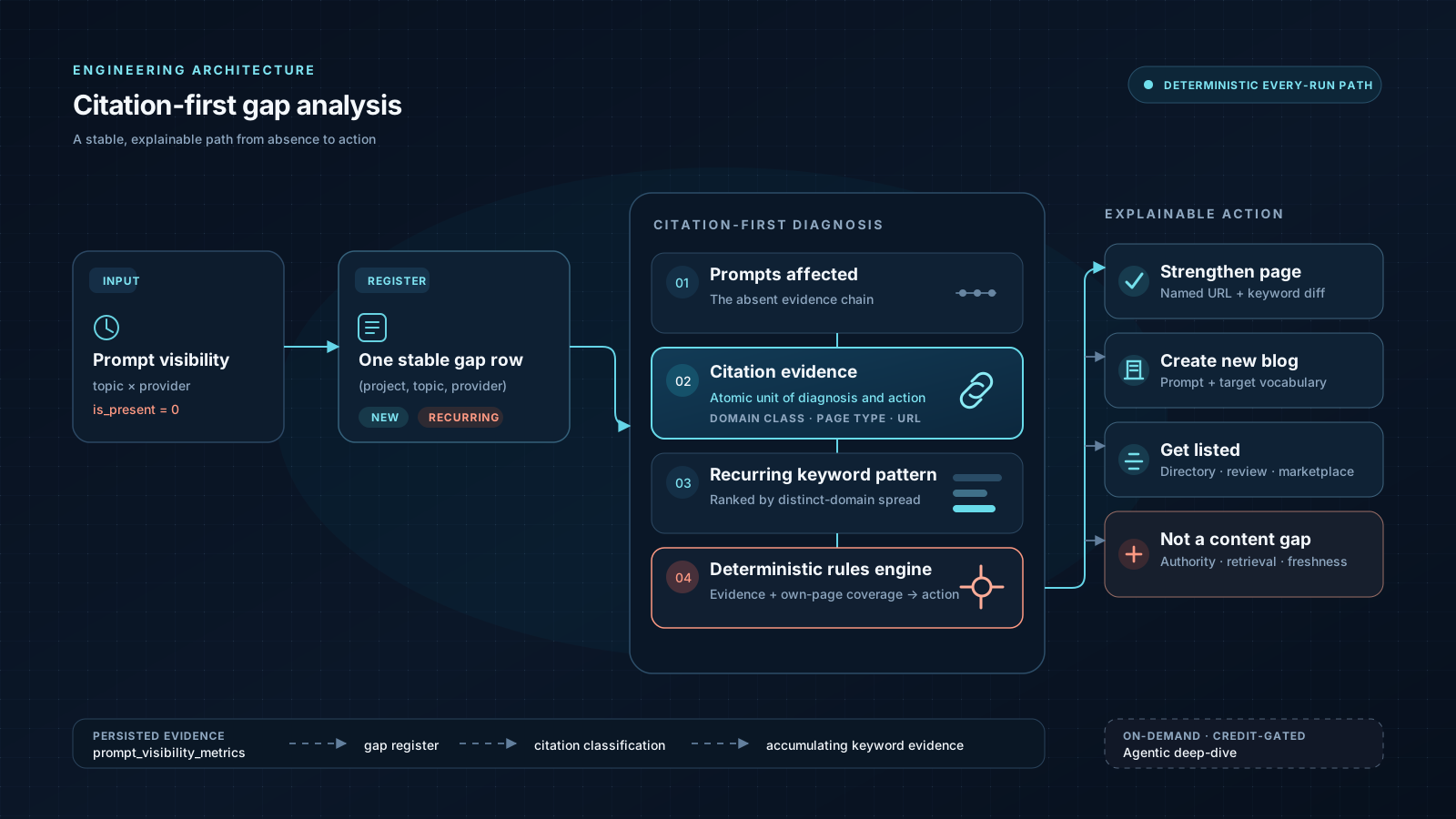
The gap register is the main surface: one row per open topic × provider gap, with a sparkline of that gap's absent-rate across runs and a status badge: new (first seen this period) or recurring (seen across multiple runs). Because the identity contains no LLM output, rows are stable by construction; a gap doesn't silently reshuffle into a different row because a labeling pass ran differently this week.
Clicking a gap opens a diagnosis panel with four layers, in causal order, not presentation order: each layer's data justifies the next:
- Prompts affected: the topic's absent prompts × providers, with the actual prompt text and topic name threaded through.
- Who's cited instead: per cited URL: a competitor-by-domain flag (not "was a competitor mentioned on this page", see the table above), page type (product/service · blog · homepage · directory/third-party), and how many times it was cited.
- What to target: the deduped keyword intersection across those citations (more on this below).
- Recommended action: output of a deterministic engine, described in section 5.
The trend strip above the register is deliberately simple: total open gaps per week, computed raw from whatever was measured that week: no carry-forward, no debounce. A missed provider run reads as a close-then-reopen. That's an accepted trade, not an oversight, because runs are admin-scheduled and normally complete; the raw per-run data is retained, so a debounce layer can be added later without touching what's already stored. "Closed / new" chips are a set-diff of topic × provider pairs between the two most recent measurement periods, at topic grain rather than individual-prompt grain, because topics are user-curated and stable while the underlying prompts churn on regeneration; churn in the chips has to mean an AI-visibility change, not a topic-list edit.
4. From citations to keywords: finding the pattern that recurs
Once a gap's citations are typed and classified, the question becomes: what, specifically, does the content that's winning here talk about that ours doesn't?
The naive approach (union every keyword from every citation) reproduces the same undifferentiated-bag problem the cluster-first version had, just at a smaller scale: a big pile of terms with no signal about which ones actually matter. The fix is a recurrence signal, not a size signal:
A keyword's importance = the number of distinct cited domains it spans, not how many times it was sighted.
Raw sighting counts just restate that a citation recurred; distinct-domain spread tells you the keyword is load-bearing across multiple competitors' winning pages, not an artifact of one page using it five times. Before that computation runs, a variant-dedupe pass collapses close phrasings (the fix for the 39% volume inflation in section 2) using the same fuzzy-signature primitives as our keyword-pool pipeline.
The results accumulate rather than get replaced on every run: each keyword is tracked per project and region, with when it was first seen, when it was last seen, and how many times it's recurred. A keyword that shows up again in next month's run isn't a new entry; it's the same one aging, which is what makes "this gap keyword has persisted for three runs" a meaningful, queryable fact instead of something you'd have to reconstruct from job logs. Presentation-level grouping still runs Leiden community detection over the accumulated keyword set, and we've written before about why graph-based community detection beats threshold clustering here, but the label is explicitly presentation, never identity. Nothing downstream keys off a cluster label anymore.
There's one more state worth calling out separately: present-but-invisible. If a keyword already sits in our own site-seed pool but the topic it belongs to is still absent, that's not "we have no content"; it's "we have content the model isn't surfacing." Same gap register entry, different action class: this is an authority/retrievability problem (schema, cross-references, freshness), not a content-creation problem, and treating it as "go write a blog" would be actively wrong advice.
5. The recommendation engine: rules, not agents, for the every-run tier
The action attached to each gap comes from a deterministic classifier (an explicit table, not an LLM call) because the always-on tier needs to be stable across runs, explainable to a customer who asks "why did it say this," unit-testable, and free to run on every project every week.
| Cited-instead evidence | Our side | Action |
|---|---|---|
| Competitor product/service page (incl. homepage) | Equivalent own page exists, but its keyword coverage is missing the gap keywords | Strengthen that page: named URL, keyword diff attached |
| Competitor product/service page | Own page exists and already covers the keywords | Not a content gap: this is authority/retrievability, never framed as "rewrite" |
| Competitor product/service page | No equivalent own page | Offering-page decision: flagged for a human call; we don't fabricate a "build this product page" CTA |
| Competitor blog | n/a | Create a new blog targeting the gap keywords (never "reorient an existing blog"; new content adds footprint rather than diluting it) |
| Third party (directory / review / marketplace / UGC) | n/a | Get listed: no paid/free claim, since that isn't reliably inferable from the citation alone |
Own-page matching runs superset → subset: shortlist our own pages by keyword overlap against title and description (a cheap DB query), gate by page type so a blog can't masquerade as a product page, then test whether the shortlisted page's own keyword footprint actually covers the gap keywords. Low confidence anywhere in that chain degrades to "create," never to naming a page we're not sure about; a wrong page reference is worse than a generic recommendation.
The agentic version (reading the competitor's actual page, working out why it specifically got cited, drafting the outreach) is a deliberately separate, later, credit-gated layer that runs on demand per gap rather than inside the analysis job. If the agents stack has a bad day, one request degrades, not the whole run. The bar for shipping this deterministic tier first: it has to be genuinely useful on its own, or the credit gate for the deep-dive reads as a paywall on basic functionality.
6. What the prompt gives you that the keyword can't
It's worth being explicit about the division of labor between layers 1 and 3 of the diagnosis panel, because it maps directly onto how a content brief actually gets written.
The keyword layer tells you what terms need to appear: the vocabulary a page has to use to be a plausible retrieval candidate. The prompt layer tells you what question the content has to actually answer, in the customer's own phrasing, because that's literally the text that was sent to the model and came back without the brand in it. A content brief built from keywords alone reads like a term list. A content brief built from the absent prompt reads like a question the piece is obligated to resolve, closer to how a person actually asked.
7. Checking this against what the rest of the field is finding
We built this from our own telemetry, but a design like this earns more confidence when independent research lands on adjacent conclusions for different reasons. A few 2026 findings line up closely enough with our design decisions that they're worth citing directly.
| External finding | What it corroborates |
|---|---|
| Profound's citation-pattern analysis found Wikipedia makes up 47.9% of ChatGPT's top-10 cited sources, while Reddit makes up 46.7% of Perplexity's, with Google AI Overviews spread more evenly across Reddit, YouTube, and Quora (source) | Why a gap is tracked per topic and provider, not just per topic. Each provider draws from a structurally different source pool, so a gap closed on one provider and wide open on another is invisible if you collapse providers into one number |
| In AirOps' 2026 State of AI Search research, only ~30% of brands stay visible from one run to the next, and just 20% stay visible across five consecutive runs (source) | Why we track new vs. recurring status per gap and deliberately chose no debounce: with this much run-over-run churn as the ambient baseline, smoothing it away would hide the exact volatility a customer needs to see |
| Muck Rack's own research found 82–84% of AI citations trace to earned/non-paid media (source), and a companion release put the overlap between the journalists PR teams pitch and the ones AI models actually cite at just 2% (source) | Why "third party" stays "third party" in our action matrix with no paid/free claim attached. The data says the outreach-to-citation link isn't reliably inferable, which is exactly why we don't fabricate one |
| BrightEdge's year-long AI Overview tracking found only about 17% of cited sources also rank in Google's organic top 10, a number that stayed flat (16.1%-16.9%) across six months of monthly measurement (source) | Why a citation-first gap analysis has to be its own build rather than a re-skin of a classic Semrush/Ahrefs keyword-gap report: the pages winning in AI answers are mostly not the pages winning in organic search, so the evidence chain has to be sourced from AI citations directly, not inferred from rank position |
| The Princeton GEO paper (peer-reviewed, KDD 2024) found that adding statistics, source citations, and quotations lifted citation visibility by 30-40%, while keyword density showed minimal effect on citation probability (source) | Why volume is explicitly a secondary ranking hint in our keyword layer, never the headline. The academic result and our production data point at the same thing from different directions: raw keyword frequency isn't what gets a page cited |
| Ahrefs' analysis of 17M AI citations found cited URLs average 25.7% fresher than organic-ranked ones (source) | A near-term extension we haven't built yet: freshness as an input to the "not a content gap" vs. "needs a refresh" split inside the authority/retrievability action class |
None of this tells us our specific numbers are right; that still comes from our own project data. What it tells us is that the shape of the problem (provider fragmentation, run-over-run volatility, earned-media dominance, citation sources diverging from organic rank, evidence-density mattering more than keyword density) is not something we're seeing because our sample is small. It's the ambient behavior of the ecosystem, and a gap-analysis system that ignores any one of those five facts will eventually produce a recommendation that doesn't survive contact with a real project.
8. Build order
Each phase ships independently useful, in this order:
- Register + trend: definite data only, no LLM anywhere: register rows and sparklines straight from the presence data we already collect, the trend line with closed/new chips, and moving the section to the top level out from under Citations.
- Diagnosis layers: competitor-by-domain classification, per-URL page typing, the accumulating keyword table with the recurrence signal, and inverting the drill order to citation-first.
- Recommendation engine: the deterministic action matrix from section 5, own-page superset→subset matching, and the present-but-invisible card.
- Agentic deep-dive: credit-gated, off the analysis run path, for the depth a rules engine structurally can't reach.
Phase 1 alone answers "are we improving?" with zero new tables. Phase 4 is the only phase that touches an LLM in the run-critical path at all; everything a customer sees by default is a deterministic function of measured data.
Closing
"Analysis to action" is not a bigger dashboard; it's a shorter, more literal path between "you're invisible here" and "here is the exact page to strengthen, the exact keywords it's missing, and the exact question it has to answer." The first version of that pipeline got the destination right from day one: turn absence into a recommendation. What running it against real data sharpened was the unit of work itself: a keyword cluster spans citations that want different, sometimes contradictory, actions, so the unit moved down to the citation. The version we're building now treats the citation as the atomic unit of evidence, keeps keywords as the "what to target" detail inside it, and keeps the prompt text itself as the closest thing we have to a content brief a customer didn't have to write themselves.
Further Reading
Every source below is linked to its own first-party page (company blog, official wire release, or peer-reviewed paper), not to an aggregator repeating someone else's number. One stat from an earlier draft, a "ConvertMate GEO Benchmark," was dropped after its domain failed to resolve at all; it appears to be a figure laundered across SEO content-mill sites with no verifiable primary source, and is replaced below with BrightEdge's directly-verified equivalent.
- AI Platform Citation Patterns: How ChatGPT, Google AI Overviews, and Perplexity Source Information - Profound, 2026. First-party breakdown of each platform's top-10 cited sources; the basis for keeping provider as a first-class dimension in the gap key.
- The 2026 State of AI Search - AirOps × Kevin Indig, 2026. Reports ~30% run-over-run and ~20% five-run brand visibility consistency, the baseline volatility our no-debounce, recurring-status design is built around.
- Earned media still drives 84% of AI citations - Muck Rack, 2025-2026. Analysis of 1M+ AI-cited links.
- Earned Media Still Drives Generative AI Citations as Press Release Visibility Grows - Muck Rack, official wire release, Dec 2025. Source of the 2% overlap between PR-pitched journalists and AI-cited sources.
- AI Overviews at the One-Year Mark: Presence, Size, and What They're Citing - BrightEdge, Feb 2026. Twelve months of daily tracking across nine industries; source of the ~17% organic-top-10 overlap figure.
- GEO: Generative Engine Optimization - Aggarwal et al., Princeton/Georgia Tech/Allen Institute for AI, KDD 2024 (peer-reviewed). The GEO-bench study behind the statistics/citations/quotations lift figures and the keyword-density finding.
- Do AI assistants prefer to cite fresh content? - Ahrefs, 2026. Analysis of 17M AI citations across seven platforms; source of the 25.7% freshness gap.