Building a Content Intelligence Loop: From Customer Publishing to Actionable Trends

Building a Content Intelligence Loop: From Customer Publishing to Actionable Trends
Why understanding what customers publish is an engineering problem—and how we turn changing market signals into useful guidance.
A customer’s publishing history is more than a collection of pages. It is a time series of decisions: which problems deserve attention, which language is gaining currency, which products are being repositioned, and which questions the market is beginning to ask.
That makes publishing activity valuable operational data. If we can understand what customers are publishing and place it alongside broader market movement, we can do more than report on past performance. We can help them decide what to explain next, what to refresh, and where an emerging opportunity deserves investment.
The hard part is not generating another list of content ideas. The hard part is building a trustworthy signal pipeline: one that observes change, separates momentum from noise, preserves the evidence behind every conclusion, and translates that evidence into guidance a customer can act on.
Publishing is a live model of customer intent
Dashboards usually treat published content as output. An engineering system should treat it as state. Every new article, revised product page, documentation update, comparison page, or change in topic emphasis modifies what a company communicates to both people and machines.
Looking at individual pages is useful, but the sequence is more revealing. A cluster of new implementation guides may indicate that a product is moving upmarket. Repeated edits to a category page may signal a positioning change. A sudden increase in questions about one workflow may show that customers are encountering a new adoption barrier.
Without this historical context, a recommendation engine can suggest work the customer has already done, chase a topic that does not fit the product, or miss the gap between what the company wants to be known for and what it has actually published. Understanding the corpus is therefore a prerequisite for useful guidance, not an optional analytics feature.
The engineering challenge: turn documents into signals
Web content is messy. The same idea can appear in a blog, documentation, a landing page, or a changelog. Titles change. URLs move. Pages are updated without an explicit version. Boilerplate can overwhelm the meaningful text. A reliable system must convert this irregular stream into a consistent representation before it can reason about trends.
1. Observe change, not just URLs
The ingestion layer needs to discover content, fetch it safely, extract the primary text, and retain enough history to identify meaningful revisions. Idempotent processing matters: repeated crawls should update a known document rather than create duplicates. Content fingerprints, canonical URL resolution, and explicit version records allow downstream jobs to distinguish a new page from a small edit or a complete repositioning.
2. Normalize without erasing meaning
Raw HTML is not a trend signal. We need a normalized model that preserves the document’s title, headings, entities, product references, questions answered, publication time, and source type. Semantic representations help group differently worded pages around the same underlying problem, while structured fields keep the result explainable and filterable.
3. Add time and context
A topic is not trending merely because it appears often. Trend detection needs a baseline. We care about velocity, acceleration, persistence, novelty, and source diversity. A sharp increase across independent sources is more meaningful than many near-identical pages from one domain. A durable rise over several observation windows should be treated differently from a one-day spike.
This is also where customer context enters the system. The same market trend can be central to one customer and irrelevant to another. Product vocabulary, existing coverage, target audience, business priorities, and current visibility all change the value of the signal.
A practical model for detecting useful trends
We treat trend detection as a ranking problem rather than a binary classification. Each candidate topic accumulates evidence, and the system evaluates several dimensions together:
- Momentum: How quickly is relevant publishing activity increasing?
- Durability: Is the signal persisting across observation windows?
- Diversity: Is it appearing across independent sources and formats?
- Relevance: How closely does it map to the customer’s products, audience, and priorities?
- Coverage gap: Has the customer addressed the topic well, partially, or not at all?
- Visibility opportunity: Would stronger coverage improve how the customer is discovered and understood?
- Confidence: How complete and consistent is the underlying evidence?
No single score should hide the reasoning. A composite ranking helps prioritize, but the dimensions must remain visible. That lets a customer distinguish a fast-moving but weakly relevant topic from a slower trend that is tightly aligned with their product and underserved by their current content.
Guidance must preserve the path back to evidence
A recommendation is useful only when a customer can answer three questions: What changed? Why does it matter to us? What should we do next?
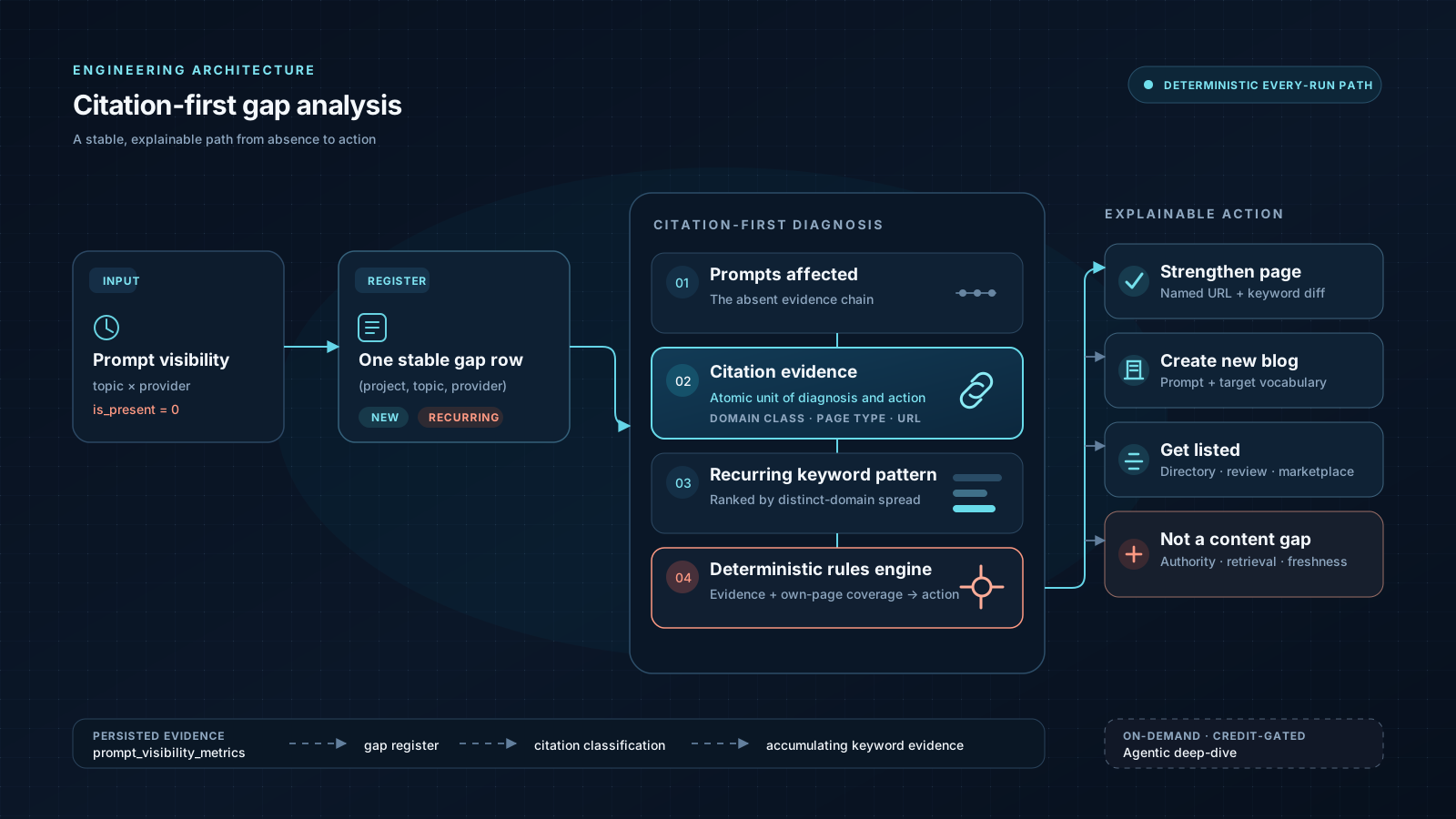
That is why our guidance begins with the signal rather than with generated prose. We connect the observed trend to the customer’s existing publishing footprint, identify the relevant gap, and then propose an action appropriate to the evidence. The output may be a new technical explainer, a refresh to an aging page, a stronger comparison, an FAQ expansion, or a decision to watch the signal until confidence improves.
Each recommendation should carry its own audit trail: representative sources, the time window in which movement occurred, the customer pages already covering the subject, the missing questions or entities, and the factors that affected its rank. The language model can help synthesize that material, but it should not be the source of truth. Retrieval, measurement, and lineage provide the truth; generation makes it easier to use.
This distinction is especially important as discovery expands beyond conventional search results. AI systems interpret a company through the consistency, specificity, and authority of the information available about it. Customers need to know not only whether a topic is popular, but whether their own published corpus gives people and machines enough evidence to understand their expertise.
Closing the loop turns recommendations into a product
A list of recommendations is a report. A system becomes a product when it learns from what happens next.
We guide customers through a closed loop: observe their corpus, detect meaningful market changes, explain the opportunity, recommend an action, and then measure the result after they publish. Did the new page cover the intended gap? Did the organization gain visibility for the right concepts? Did the trend persist? Did the recommendation arrive early enough to be useful?
Those outcomes improve future ranking. Accepted and rejected recommendations reveal relevance. Published work reveals execution patterns. Subsequent visibility reveals whether the intervention helped. Over time, guidance becomes better calibrated to the customer instead of remaining a generic content calendar.
Reliability principles behind the system
Because this pipeline influences customer decisions, several engineering properties are non-negotiable:
- Freshness is explicit. Every insight should show when its inputs were last observed and processed.
- Lineage is retained. A recommendation must be traceable to source documents, transformations, and scoring factors.
- Processing is idempotent. Retries and recrawls must not inflate counts or duplicate evidence.
- Tenant boundaries are strict. A customer’s private data and derived context must remain isolated.
- Uncertainty is visible. Sparse evidence should lower confidence instead of producing stronger language.
- Humans remain in control. The system proposes and explains; the customer decides what represents the brand.
These principles may sound less exciting than an AI-generated brief, but they are what make the brief worth trusting.
From content monitoring to decision infrastructure
The goal is not to encourage customers to publish more for its own sake. It is to help them publish with better timing, stronger evidence, and a clearer connection to how their market is changing.
When customer publishing and market trends are modeled together, content stops being a disconnected stream of assets. It becomes a feedback system: the organization can see what it has said, understand what the market is beginning to care about, decide where its perspective is missing, and measure whether the next publication changed its position.
That is the system we are building toward: not an idea generator, but an evidence-backed guide that helps customers turn a changing information landscape into deliberate action.