Social search or owned content? A measurement model for publishing decisions
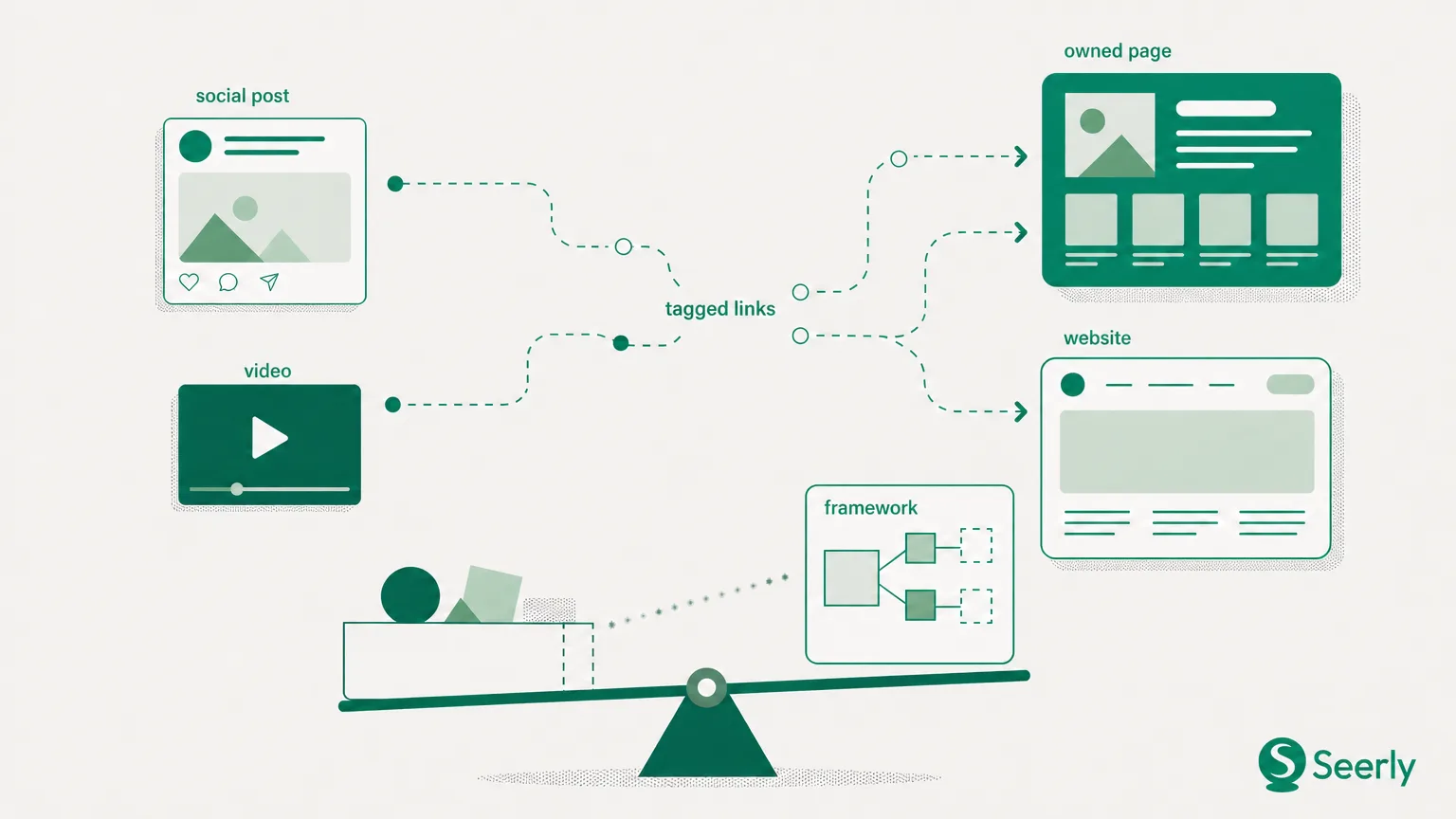
A topic earns strong engagement on social, but the website team sees little attributable traffic. Meanwhile, an educational page attracts search visitors without generating much conversation. Which deserves the next round of production budget?
The answer depends on what each asset is supposed to accomplish - and whether the reporting connects discovery with downstream behavior. Social search reporting should distinguish where people discover content, what evidence they encounter, and how they move toward conversion. This measurement model helps marketing managers choose between a social post, an owned page, or a coordinated investment in both.
Separate discovery from engagement
Likes, comments, and reach describe audience response or exposure, not necessarily search performance. A post can circulate through recommendations without answering an active search query. Conversely, useful search content can attract a smaller audience with a more specific need, making engagement totals an incomplete basis for investment.
Google says its new platform properties let site owners and creators track how social and video posts perform on Google Search and Discover. That distinction matters: visibility outside a platform is different from activity inside it. Teams should verify reporting availability and metric definitions before treating different discovery sources as comparable.
Use four separate measurement categories:
- On-platform engagement: Reactions, comments, saves, shares, and viewing behavior.
- External discovery: Exposure to a social asset through Google Search or Discover, reported separately.
- Referral traffic: Measured website visits following a link from social content.
- Assisted conversion: An observed social touchpoint preceding a later conversion within a defined reporting window.
Discovery within a social platform needs its own label, too. TikTok’s Creator Search Insights, for example, provides information about topics people search for, including content-gap opportunities. Such signals can inform editorial priorities, but they do not establish that a particular searcher subsequently visited your website.
The practical implication is simple: do not collapse these categories into one success score. Engagement helps diagnose creative resonance, discovery indicates visibility, and referral behavior helps assess the website handoff. Assisted conversions add journey evidence without proving that the social asset caused the outcome.
Build a cross-channel measurement map
Organize reporting around a shared topic identifier rather than a platform account or individual URL alone. Each topic should connect its query themes, social assets, owned pages, and conversion goals. This creates a comparable editorial unit while preserving the differences between channels.
| Field | Practical definition | What to record |
|---|---|---|
| Search query theme | A cluster of questions with similar intent | Observed wording, source, audience need, and whether wording is inferred |
| Destination type | Where the answer lives | Social asset, owned page, or coordinated assets; include IDs and URLs |
| Platform discovery | Visibility within a social platform | Search-origin views or impressions where available; separate recommendations and paid distribution |
| Referral visits | Website sessions attributed to social links | Source, medium, campaign, asset ID, and landing page |
| Engaged visits | Visits meeting a documented engagement definition | Consistent analytics criteria plus relevant actions, such as framework downloads |
| Assisted conversions | Conversions with an observed earlier social touchpoint | Conversion type, reporting window, attribution method, and deduplication rule |
| Owned-page visibility | Search exposure and traffic for the website page | Query themes, impressions, clicks, and landing-page performance |
| Evidence created for future reuse | Reusable material produced through the topic | Audience questions, sourced explanations, approved examples, research, and update dates |
Add external discovery of social assets as a separate metric group wherever reporting supports it. Google’s Discover reporting distinguishes Discover impressions and clicks from conventional search-query reporting. Do not invent query-level intent for a discovery surface that does not provide queries.
Connect the datasets through topic IDs, asset IDs, tagged links, and consistent reporting periods. For example, utm_source, utm_medium, utm_campaign, and utm_content can identify the social link and creative variation. Keep organic and paid distribution separate, and document consent restrictions, missing referrers, and unavailable metrics.
Most importantly, treat the topic map as an aggregate connection - not a person-level journey reconstruction. A query trend and a conversion trend may belong to the same topic without belonging to the same individuals. Report unavailable data as unavailable, rather than as zero.
Compare three publishing choices
Choose the publishing route based on the audience task and the evidence required to complete it. Fast commentary may need timeliness more than depth, while a durable explanation needs maintenance and a stable destination. Proof-rich decision content often benefits from coordinated assets, but only when the team can sustain both.
| Decision factor | Social first | Owned site first | Coordinated social and owned |
|---|---|---|---|
| Best fit | Fast commentary, terminology tests, emerging questions | Durable educational explanations and detailed reference material | Proof-rich decisions requiring discovery, explanation, and action |
| Control | Constrained by platform formats and distribution | Greater control over structure, updates, navigation, and tracking | Stronger central reference, with platform-dependent distribution |
| Shelf life | Potentially brief; search-led assets may remain useful | Designed for ongoing maintenance and reuse | Depends on refreshing the page and supporting assets |
| Conversion path | Native action or an additional website handoff | Direct access to relevant forms, products, and internal links | Social introduction followed by a deeper owned experience |
| Citation potential | Public accessibility and format affect reuse | Stable URLs and explicit evidence support reference use | Multiple accessible formats can serve different needs |
| Reporting confidence | Stronger for native activity than downstream journeys | Stronger for observed website behavior | Broader evidence, but more attribution gaps and deduplication work |
Use social first when the immediate question is whether an idea, phrase, or reaction deserves further investigation. Use the website first when readers need a complete explanation, verifiable evidence, or a meaningful conversion path. Choose both when each asset has a distinct job - not simply because cross-posting is possible.
None of these routes automatically improves AI search visibility. Accessible evidence and clear explanations are useful publishing qualities, but AI-answer inclusion requires separate observation. A topic appearing across several channels is not proof that those channels caused an AI citation.
Work through one campaign decision
Consider a fictional campaign for a software company exploring the topic “how to evaluate AI meeting summaries.” The campaign below is a planning example, not a customer case study or a report of achieved results. Its purpose is to show how teams can test terminology while building a durable decision resource.
Stage 1: Test the language on social
The team publishes a short video contrasting summary accuracy with action-item accuracy. It asks viewers which failure matters most and uses available search insights to compare audience terminology. The team tracks search-origin discovery where available, saves, substantive questions, and tagged website visits - without treating general reach as search demand.
Stage 2: Build the owned reference
If recurring questions justify deeper treatment, the team creates an evaluation framework on its website. The page explains scoring criteria, documents a reproducible testing method, includes only verified supporting evidence, and offers a relevant next step. Tracking covers owned-search visibility, referral landing behavior, framework downloads, qualified enquiries, and observed assisted conversions.
Stage 3: Connect the assets
The social asset introduces a question; the owned page answers it in depth. Follow-up posts address specific evaluation criteria and link to the relevant explanation rather than repeating a generic homepage CTA. At review, the team compares terminology, qualified visits, recurring questions, and production effort before deciding whether to expand.
This workflow turns social activity into editorial evidence without presenting comments as representative market research. It also gives the website a clear purpose beyond hosting a longer version of the post. A documented content intelligence loop can help preserve those observations for future publishing decisions.
Review performance and reallocate effort
Review topics monthly using comparable periods and a window appropriate to the buying cycle. Record changes in distribution, paid support, seasonality, and tracking before interpreting performance. Apply the following rules consistently rather than rewarding whichever channel reports the largest number.
-
Expand when query interest and qualified behavior align. Look for sustained growth in relevant query themes alongside useful website actions or substantive audience questions. Compare rates and volumes, because a small audience can produce unstable percentages. Expand the asset that addresses the demonstrated need.
-
Refresh when discovery grows but the handoff weakens. Rising exposure with weak qualified referrals may indicate a mismatch between the promise and destination. Check link placement, landing-page relevance, mobile usability, and the next step. Improve the transition before assuming the topic lacks commercial value.
-
Retain when assisted-conversion evidence is credible. Look for repeated observed journeys under a consistent attribution method. Separate assisted conversions from last-touch conversions and avoid adding overlapping totals. Where volumes are small, present the evidence as directional.
-
Consolidate when assets duplicate the same job. Compare audience intent and incremental usefulness rather than matching keywords alone. Keep distinct social and owned assets when they serve different tasks. Merge or stop maintaining versions that add little value.
-
Expand, redirect, or stop based on unresolved questions. Repeated relevant questions can justify a new section, demonstration, or supporting asset. Unrelated questions may reveal an audience mismatch rather than an expansion opportunity. Pause production when adequate testing produces neither useful discovery nor qualified downstream behavior.
Make the final decision explicit: expand, refresh, consolidate, maintain, or stop. Assign an owner, a reason, and the next review date. This makes the report an allocation tool rather than a retrospective activity log.
Reporting caveats for leadership
What can social search reporting show confidently?
It can show observed exposure, interactions, tagged referrals, website behavior, and conversions within documented measurement boundaries. It can also compare publishing routes and identify recurring audience questions. Confidence is strongest when definitions remain consistent and missing data is visible.
Can we say a social post caused revenue?
An observed journey can show that a social touchpoint preceded a conversion. It cannot, by itself, establish that the conversion would not have happened without that post. Causal claims require an appropriate experimental design, not simply an attribution report.
Does correlated visibility prove AI-answer inclusion?
No: social discovery, owned-search visibility, and AI citations are different observations. If AI visibility matters, measure relevant answer appearances separately and document the testing scope. An AI-readiness assessment can inform page improvements, but readiness is not proof of inclusion or commercial impact.
How should missing journeys be presented?
Label unobserved activity and attribution gaps explicitly. Direct visits, cross-device behavior, consent restrictions, and private sharing can leave incomplete paths. Neither assume that every later conversion was assisted by social nor conclude that untracked influence was absent.
Start with one shared monthly view
Social discovery and owned-site discovery are connected but distinct routes to visibility, evidence, and conversion. The goal is not to force them into an engagement leaderboard, but to understand which publishing choice serves each audience task. Better allocation follows from that distinction.
Choose one recurring topic and map its current social assets, owned pages, query themes, and conversion goals. Establish a shared monthly view with consistent definitions and visible limitations. Do that before shifting more production budget between channels.