The SEO Lessons Teams Learned the Hard Way in 2026
A peculiar pattern showed up in the conversations marketers were actually having this year. Generic predictions about AI search drew polite agreement. Postmortems drew people in. One Reddit thread centered on hard lessons from AI-shaped search collected 74 upvotes and 138 comments, a better signal of practitioner interest than another tidy “future of SEO” post.
That response makes sense. Plenty of teams had already lived through the uncomfortable version of the story: rankings held, traffic softened, and reporting had no clean explanation for the gap. Others saw their brand named in AI answers but could not trace a resulting pipeline. A few kept publishing at full speed, only to find that their content rarely reached the places where buying conversations now begin.
The old scorecard was neat. A keyword had a position, a page had sessions, and a monthly report connected the two. Ranked AI made that neatness feel artificial. Answer surfaces synthesize sources, users refine prompts, and a single query can end without a click even when a brand has influenced the decision.
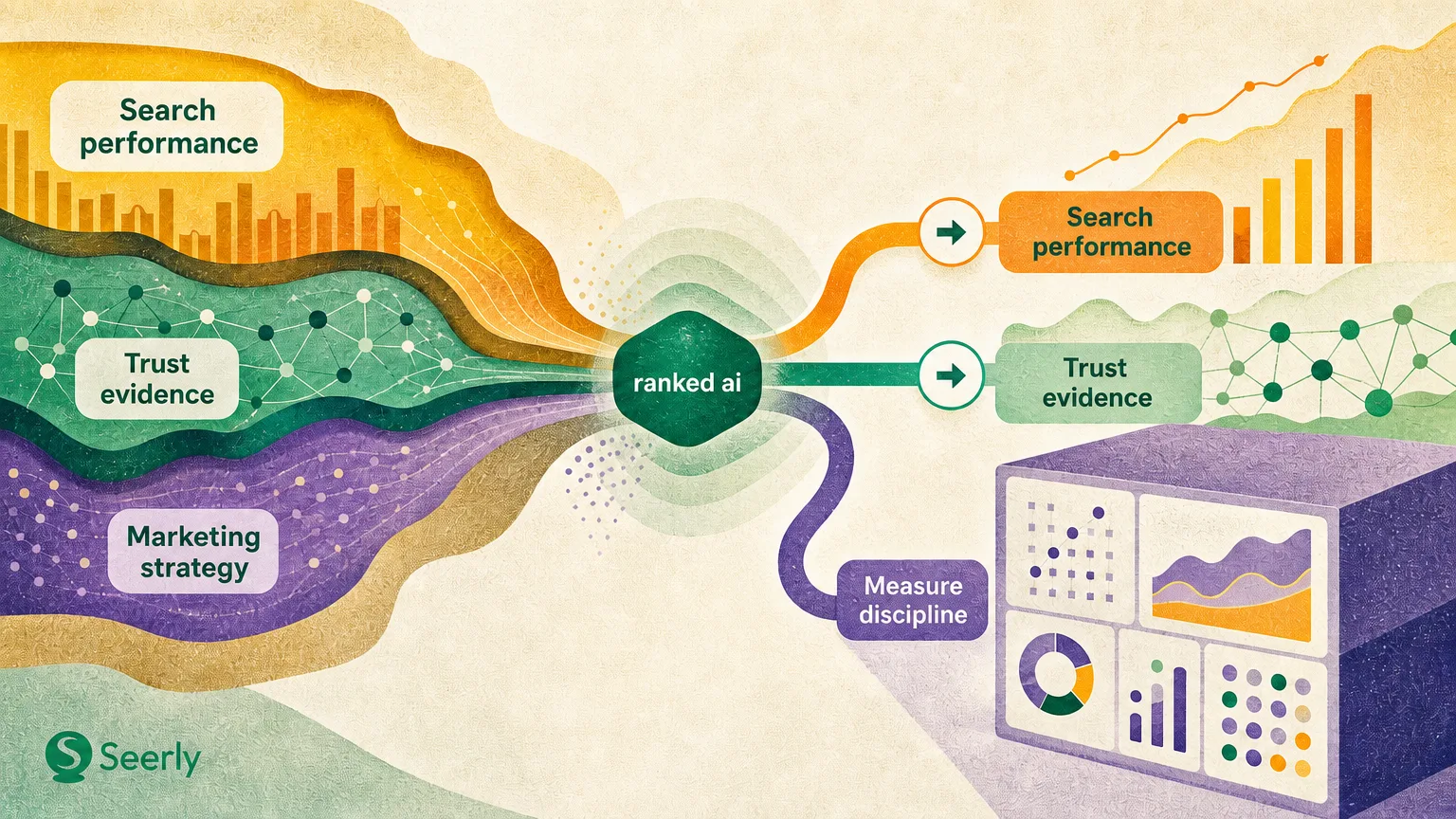
Definition: Ranked AI is the practice of tracking how often and how prominently a brand, product, or source appears in AI-generated answers across a defined set of prompts, alongside classic search performance.
The following lessons come from what operators had to unlearn. They are not a case for abandoning search. They are a case for treating discovery as a wider, messier system that demands better evidence.
What ranked AI exposed about the old scorecard
1. A high ranking could exist without meaningful clicks
Old assumption: A page in the top organic results would produce a predictable share of traffic. Teams treated position movement as an early read on business impact, then waited for sessions and conversions to follow.
What broke: For many informational searches, an AI-generated response can satisfy the first question before a user reaches the organic listings. The page may still rank well, yet its role has changed from destination to source material, comparison point, or ignored option. Search Console can report an impression, but it cannot tell a team whether an answer summarized their point, named their brand, or passed them over.
The technical backdrop shifted fast. The 2026 AI Index’s technical-performance review documents continued gains across model capabilities, which helps explain why answer quality now feels good enough for many early-stage research tasks. Better answers do not erase clicks. They redistribute them.
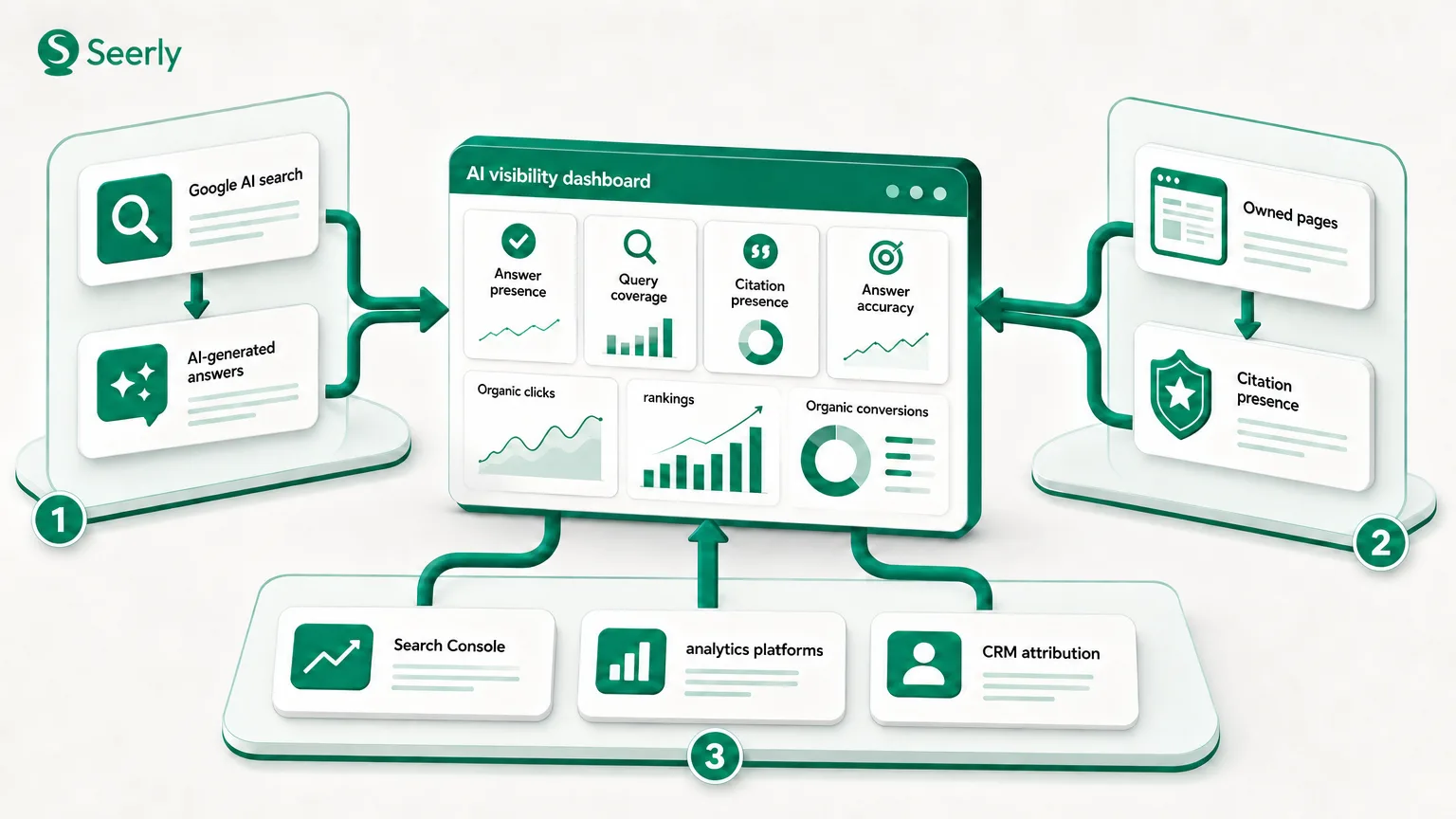
Replacement behavior: Report search performance in three layers: ranking position, answer presence, and commercial outcome. Take a set of high-intent queries, record the answer shown for each, then note whether your brand appears, how it is described, and whether the answer points users toward a next step. A number-one ranking with no answer presence is not failure. But it is no longer proof that the page carries the same traffic potential it did two years ago.
2. Being mentioned was not the same as being trusted
Old assumption: If an AI answer mentioned the company, the brand had won a placement. Many teams counted every mention the same way, whether it appeared as the first recommendation or as a passing example near the end.
What broke: Mention quality varies wildly. An answer that says, “Seerly is one option,” has a very different commercial meaning from one that says, “Seerly fits teams that need prompt monitoring and evidence for AI-search discovery.” One is recall. The other is a reason to evaluate.
There is another wrinkle. Model rankings themselves can be finicky. IBM researchers found that removing only a small number of preferences can alter top large-language-model rankings. If model leaderboards can move with a handful of judgments, marketers should be cautious about treating one AI answer as a permanent verdict on their brand.
Replacement behavior: Grade mentions, do not merely count them. A useful review labels each appearance by position, sentiment, factual accuracy, use case, and source support. Then separate “brand named” from “brand recommended.” The second category deserves attention because it reveals whether your proof points match the language buyers use when they ask for help.
3. Publishing more pages stopped looking like a distribution plan
Old assumption: A broad publishing calendar would eventually cover enough terms to create momentum. Teams used volume as a proxy for authority, even when individual pieces repeated the same claims with slightly different wording.
What broke: AI answers do not need ten near-identical pages from the same domain. They need material that answers a specific question cleanly, states a defensible point of view, and contains details worth repeating. A thin page may technically target a query while giving no one, human or machine, a reason to reference it.
I’ve watched content teams celebrate a 40-page sprint, then struggle to name the two pages a sales rep would actually send to a prospect. That is a rough meeting. More importantly, it reveals the mismatch between editorial output and buyer usefulness.
Replacement behavior: Treat each major piece as a distribution asset with a job. Build one page that clarifies a category, another that compares alternatives honestly, and a third that explains an implementation decision in plain language. Seerly’s discussion of how AI search helps SaaS buyers find the right product gets at the practical point: discovery content works better when it helps someone choose, not when it simply attempts to occupy more query space.
4. AI visibility without proof created fragile wins
Old assumption: Clear product copy and a handful of polished landing pages would be enough for a brand to appear reliably in answers. The assumption sounded reasonable until prompts asked for evidence, comparisons, pricing context, or implementation detail.
What broke: Broad claims travel poorly without proof. When a brand says it has strong reporting, users want to know what it tracks. When a tool claims it supports reputation management, buyers want to know what gets monitored and how teams act on findings. The gaps become painfully obvious in AI answers because vague language gets flattened into vague recommendations.
Honestly, this part is a pain. Proof takes more effort than publishing another opinion post. It requires named methods, examples, product documentation, independent references where available, and pages that state limits instead of hiding them.
Replacement behavior: Build trust signals into core content. Use original screenshots, methodology notes, customer-specific use cases when permission exists, author credentials, dated updates, and direct explanations of what the product does not cover. An AI-ready website should make factual extraction easy, but it should also give the reader enough substance to check the claim.
5. Tool adoption outran measurement discipline
Old assumption: Buying an AI monitoring platform would answer the strategic question. Teams collected screenshots, prompt outputs, and share-of-voice charts, then struggled to decide what action belonged in next month’s sprint.
What broke: Tools can make uncertainty look precise. A weekly percentage without the prompt set, competitor frame, model, country, or query intent behind it tells a very incomplete story. Worse, teams sometimes celebrated a rise in appearances while their brand appeared in irrelevant prompts or in answers that framed the product incorrectly.
The way I see it, ranked AI reporting needs the same discipline as any other measurement system. Define the audience, define the questions, keep a stable baseline, and record material changes to the test set. Otherwise the dashboard becomes a weather vane.
Replacement behavior: Create a prompt portfolio instead of tracking a random pile of queries. Include category questions, alternative comparisons, job-to-be-done prompts, objections, and branded questions. Track that portfolio monthly, annotate product launches and content releases, then connect changes to assisted conversions, demo quality, or sales-call language.
6. One discovery channel became a hidden concentration risk
Old assumption: Organic Google traffic could carry the majority of early research. It had done so for years, and many teams built editorial calendars around that single dependable tap.
What broke: Buyers now move between search results, AI answers, communities, review sites, newsletters, video, and peer conversations. Their route is rarely linear. A prospective customer may first hear a category term in an AI answer, look for social proof in a community, and search for a vendor only after a colleague shares a comparison.
So the practical question changed: where does your brand show up during the sequence? A company that appears only on its own site has little control over what people hear before the branded search.
Replacement behavior: Map the discovery paths around your buying process, then publish evidence in the places that fit each path. That can include expert-led articles, public documentation, comparison pages, and well-supported responses in communities where your audience already debates tools. Seerly’s engineering resources are a useful example of how detailed technical material can serve a different research moment than a top-level product page.
Where teams over-invested and under-invested
The pattern was rarely a total absence of effort. Most teams worked hard. They just put too much of that work into measures that no longer answered the business question.
| Over-invested area | Under-invested area | What changes in practice |
|---|---|---|
| Rank-tracking tools and daily position checks | Prompt-level reporting tied to intent | Track where the brand appears and how the answer frames it |
| Content volume | Proof-rich pages with a clear point of view | Publish fewer pages that answer a real buying question |
| One search channel | Multiple discovery paths | Build material for search, AI answers, peer validation, and direct evaluation |
| Aggregate mention counts | Accuracy and recommendation quality | Review whether mentions contain correct, useful descriptions |
A clean dashboard can still mislead. The data has to carry a decision. If a brand rises in AI answer appearances but the mentions describe it as a tool for the wrong customer, the work is not done. It has barely begun.
The quarterly audit worth doing now
Start with a small audit. Ten or twenty well-chosen prompts beat a giant list nobody reviews, and four focused checks can expose the work that deserves priority.
-
Check cross-surface presence. Run the same buyer questions through classic search and AI answer experiences. Record organic position, answer inclusion, wording, and competitor references rather than taking a screenshot and moving on.
-
Review source and mention quality. Look for claims that lack evidence, descriptions that feel stale, and competitor pages that own the comparison language. A useful finding names the content gap and the corrective page or proof asset.
-
Inspect trust signals on core pages. Confirm that authorship, dates, product details, case material, methods, and contact information are easy to find. Vague credibility cues rarely survive close scrutiny.
-
Test answerability. Ask whether a page answers a narrow question in the opening, defines terms, uses clear headings, and gives concrete examples. If a reader has to hunt for the point, an answer system may struggle too.
Frequently asked questions
Are rankings dead?
No. Rankings still reveal demand, competitive pressure, and the pages search systems consider relevant. Their weakness is that position alone no longer explains discovery or traffic. Keep rank tracking, but place it beside answer presence and commercial signals.
Should we still invest in SEO content?
Yes, provided the content earns its place in the buying journey. Pages should explain a category, resolve an objection, or help a prospect compare options with evidence. Publishing material that says little more than competitors already say is a poor use of editorial time.
How do we know whether AI discovery is helping?
Start with a fixed prompt set and record your brand’s presence, description, and cited supporting material over time. Pair that review with changes in branded search, assisted conversions, demo questions, and sales-call notes. Correlation will not prove every cause, but a documented pattern beats intuition.
Is ranked AI only relevant for large brands?
No. Smaller companies can gain ground because answer systems often reward specificity over brand size. A focused explanation of a narrow problem, backed by credible proof, can compete with a larger company’s generic category page.
The teams making progress in 2026 are not chasing a single number. They are building a defensible record of how buyers encounter their brand, what information those buyers receive, and where trust breaks down.
Benchmark your brand across AI answers and classic search in Seerly, then use the gaps you find to set the next content sprint.