A practical maturity model for generative engine optimization adoption
The 2026 CMO Survey reports that 41.5% of companies are already using generative engine optimization to get content into AI-generated search results. That’s a useful adoption signal from Duke University’s Fuqua School of Business. But it doesn’t tell us how many of those companies can connect the work to qualified traffic, conversion, revenue, or lasting brand preference.
Picture the budget review. A marketing director presents screenshots of AI answers mentioning the brand, while an agency shares a calendar of newly published content. Finance asks which decisions those observations changed, and whether the next investment has a defensible business case. The room gets quieter.
Generative engine optimization adoption needs a stronger test than “we’ve started.” Publishing content and checking answers can begin a learning process, but neither proves that a team has built an accountable program. The missing ingredient is a repeatable connection between observations, decisions, and subsequent measurement.
Marketing leaders and agency leads need that distinction before shifting money away from established search work. Otherwise, an emerging channel can become a collection of screenshots with an impressive meeting schedule. Busy, yes. Accountable, not yet.
The two survey findings discussed here don’t establish how many companies have crossed that threshold. Self-reported use and changing consumer habits are different measures from business impact. A useful maturity model should preserve that distinction instead of turning adoption percentages into implied returns.
Working definition: An accountable GEO program repeatedly measures how a brand appears in relevant AI-search answers, records the evidence behind changes, and uses that evidence to make investment decisions. Business connections may include attributable referrals or research into brand preference. Where causality remains uncertain, the reporting says so.
What has changed in the way buyers research?
A buyer asking “Which accounting platform suits a small agency with international clients?” gives a search system more context than “accounting software.” The question contains a business type and a practical constraint. Content that only repeats the product category may leave the buyer’s actual concern unanswered.
Gartner’s surveys of U.S. consumers conducted in 2025 found that 51% said generative AI had changed their research habits; among those respondents, 71% changed how they phrase queries. The denominator matters: 71% refers to the group reporting changed habits, not all surveyed consumers. Nor should a U.S. consumer finding automatically become a forecast for every B2B market.
For content teams, the practical response is to test questions containing purchase constraints, not merely category terms. A comparison page might need a clear explanation of eligibility or implementation limits. Helpful specificity beats adding an “AI-friendly” label to an unchanged article.
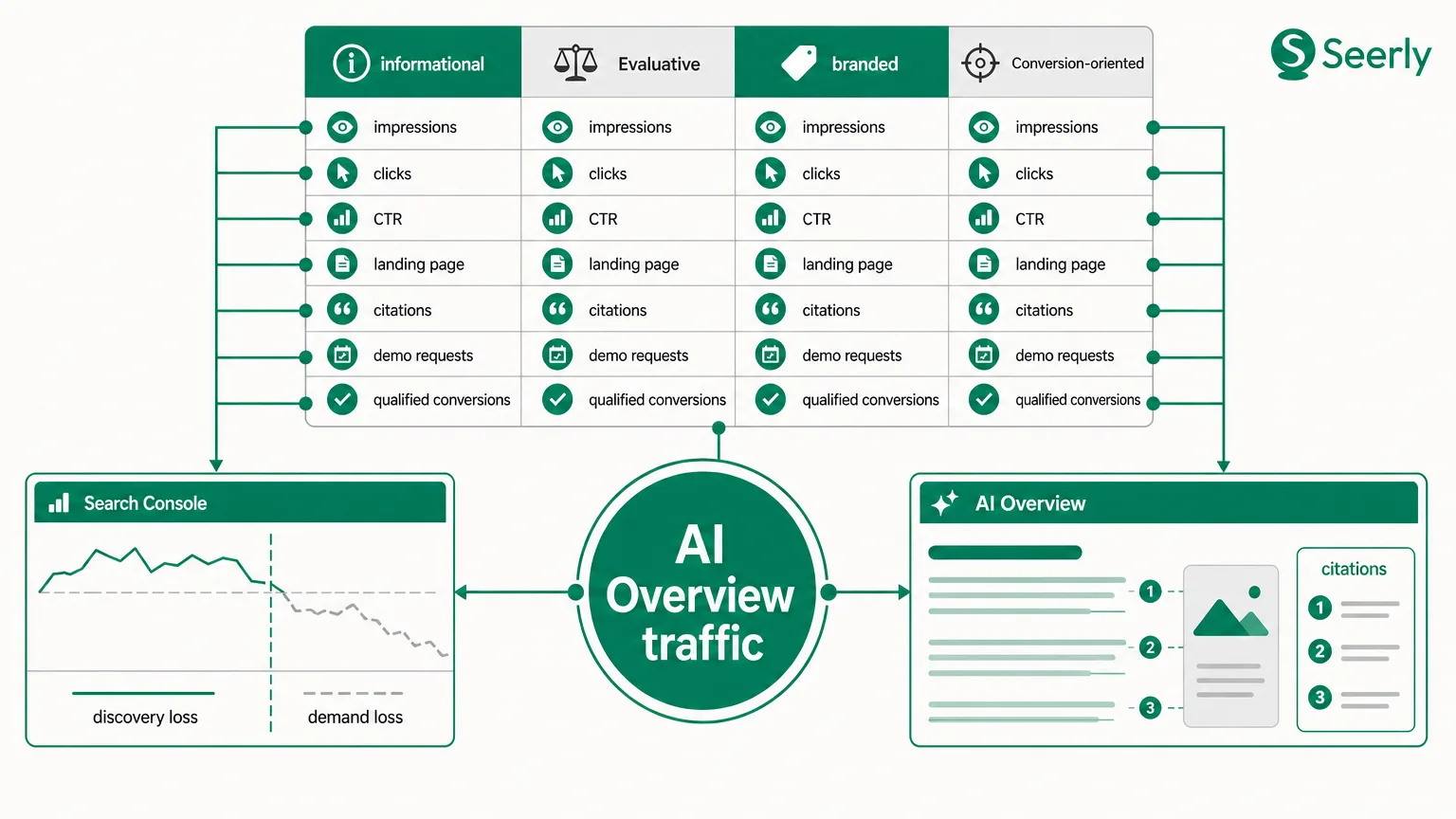
Measurement must follow the same logic. Track the question family and buying task, then examine whether the answer describes the brand accurately and cites suitable evidence. I’d keep organic-search performance beside those observations, because the investment decision concerns the whole discovery program.
Look, abandoning established search before understanding the overlap would be an expensive way to learn. A shared content improvement may help both channels, while an AI answer may produce no identifiable visit. Keep those possibilities separate in the reporting.
Which stage of generative engine optimization adoption describes your program?
A team with a dashboard can still be experimenting. A smaller team with a documented prompt set and a disciplined review process may have progressed further. Tool ownership is a poor substitute for operating capability.
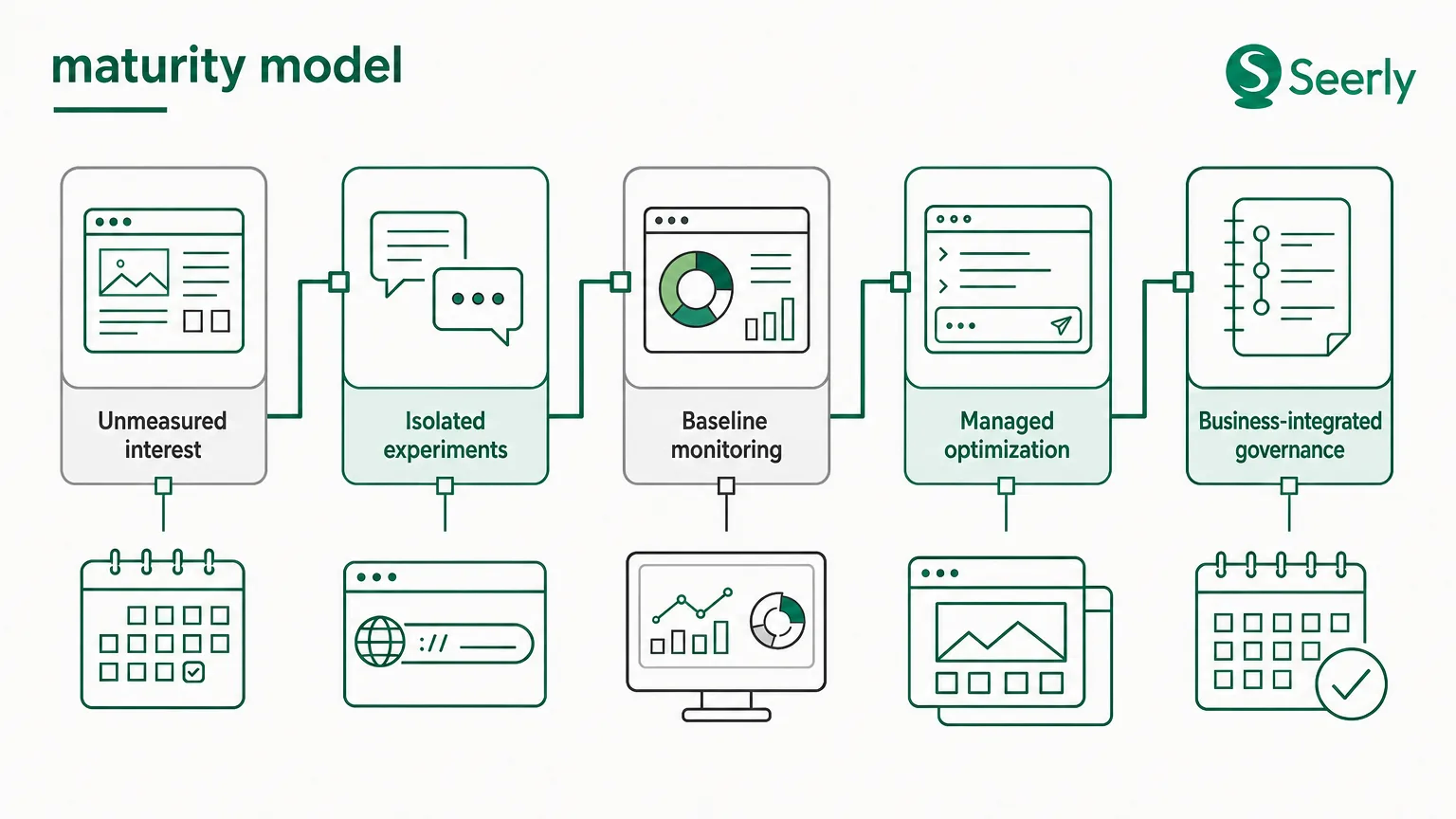
Use the following five stages as a proposed assessment framework, not an industry-certified standard. Score the highest stage your team can sustain across its priority work. One excellent campaign shouldn’t conceal an otherwise unmeasured program.
| Stage | Team behavior | Evidence available | Common risk | Next capability |
|---|---|---|---|---|
| 1. Unmeasured interest | Discusses GEO and checks occasional answers | Screenshots and anecdotes | Treating a striking answer as representative | Define priority questions and ownership |
| 2. Isolated experiments | Publishes or edits content for selected questions | Local before-and-after observations | Crediting content for normal answer variation | Establish a repeatable baseline |
| 3. Baseline monitoring | Repeats documented prompts across selected surfaces | Saved answers, source URLs, and comparable observations | Monitoring without making decisions | Connect findings to testable changes |
| 4. Managed optimization | Prioritizes changes and reviews subsequent observations | Change logs, repeated measurements, and business indicators | Mistaking correlation for incremental impact | Add cross-functional measurement and budget rules |
| 5. Business-integrated governance | Uses evidence in planning and reputation decisions | Outcome reporting with explicit attribution limits | Overclaiming precision or maintaining unnecessary complexity | Reassess coverage and decision value |
At stage one, curiosity is useful; the problem begins when leadership mistakes curiosity for coverage. Stage two adds real work, but isolated experiments can produce contradictory interpretations. Without a stable observation method, teams can’t tell whether a content edit preceded a lasting change or a lucky answer.
Stage three creates comparability. At stage four, the team starts making documented choices about what to fix and what to leave alone. Stage five connects those choices to business planning, including decisions to stop work that isn’t earning further investment.
Honestly, I’d score conservatively. If only one person can reconstruct the evidence, the capability is fragile. A mature program should survive a handover without requiring an archaeological expedition through someone’s chat history.
What evidence proves that a program is progressing?
“Brand mentioned” can describe several different situations. An answer might recommend the brand, include it as a weak alternative, or repeat an incorrect claim about it. Would leadership make the same decision in every case?
Use an evidence checklist before interpreting movement. Each item should have a documented method, not just a checkbox in a procurement spreadsheet. Seerly’s explanation of GEO and its measurement scope can help teams establish shared terminology before comparing reports.
-
Tracked prompts: Store exact wording and group prompts by buying task. Record why each question matters, using customer research or sales conversations where available. Keep a stable panel separate from exploratory questions.
-
Provider coverage: Name the answer surfaces and record the access method. Capture dates, language, and relevant session conditions. Don’t silently merge observations from different collection methods.
-
Answer accuracy: Compare statements against approved product facts. Distinguish factual errors from missing context or subjective recommendations. Assign someone with product knowledge to review disputed claims.
-
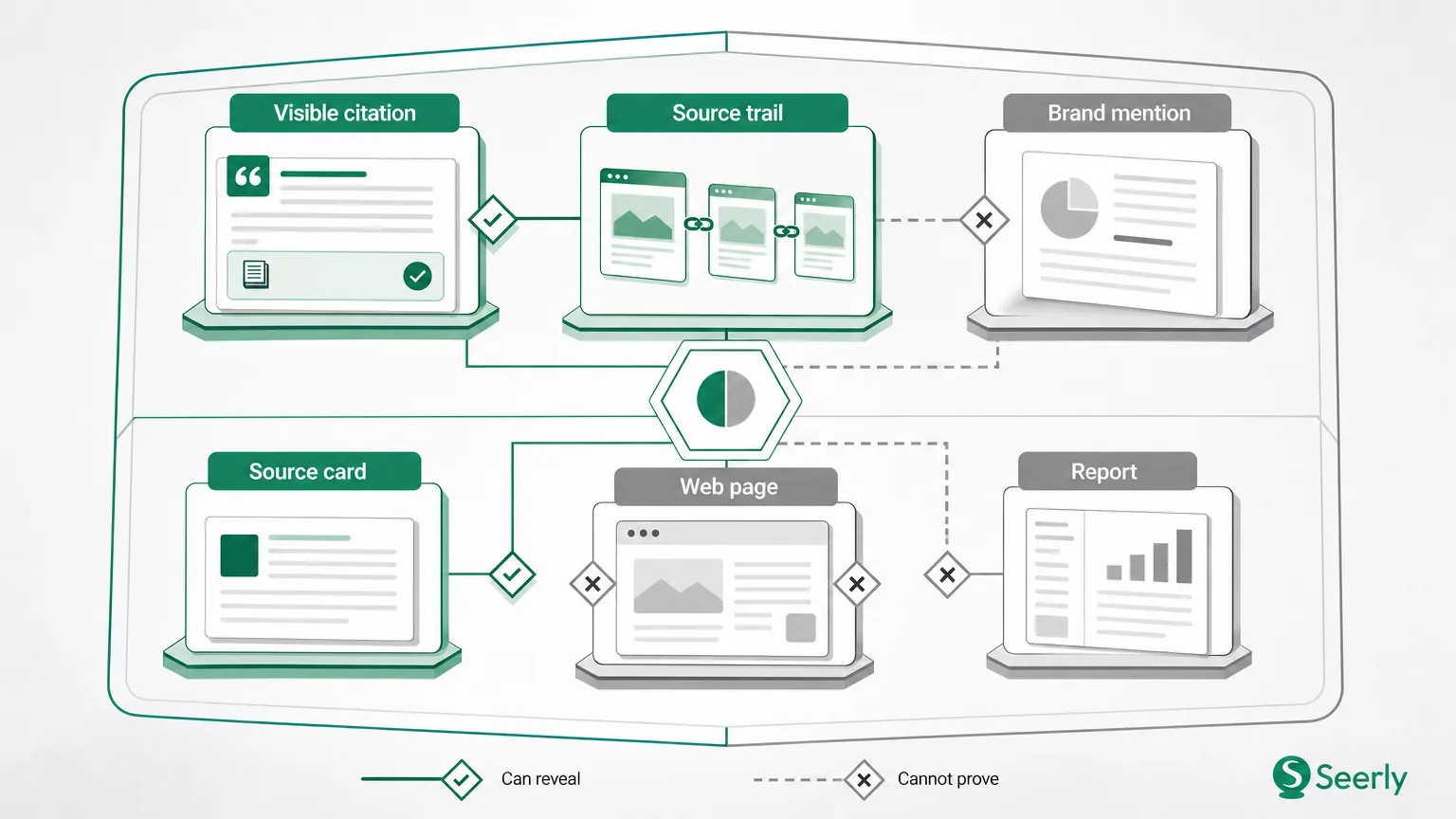
Citations and source context: Save cited URLs alongside the answer. Record whether the source actually supports the statement attached to it. Separate brand-owned evidence from independent sources.
-
Organic-search context: Review relevant page performance and conversions beside AI observations. Note concurrent SEO work or campaign changes. Avoid attributing every movement to the GEO project.
-
Competitor comparisons: Use the same prompt panel and collection conditions for each brand. Examine differences in factual treatment and cited evidence. Don’t convert a tiny sample into a market-share claim.
-
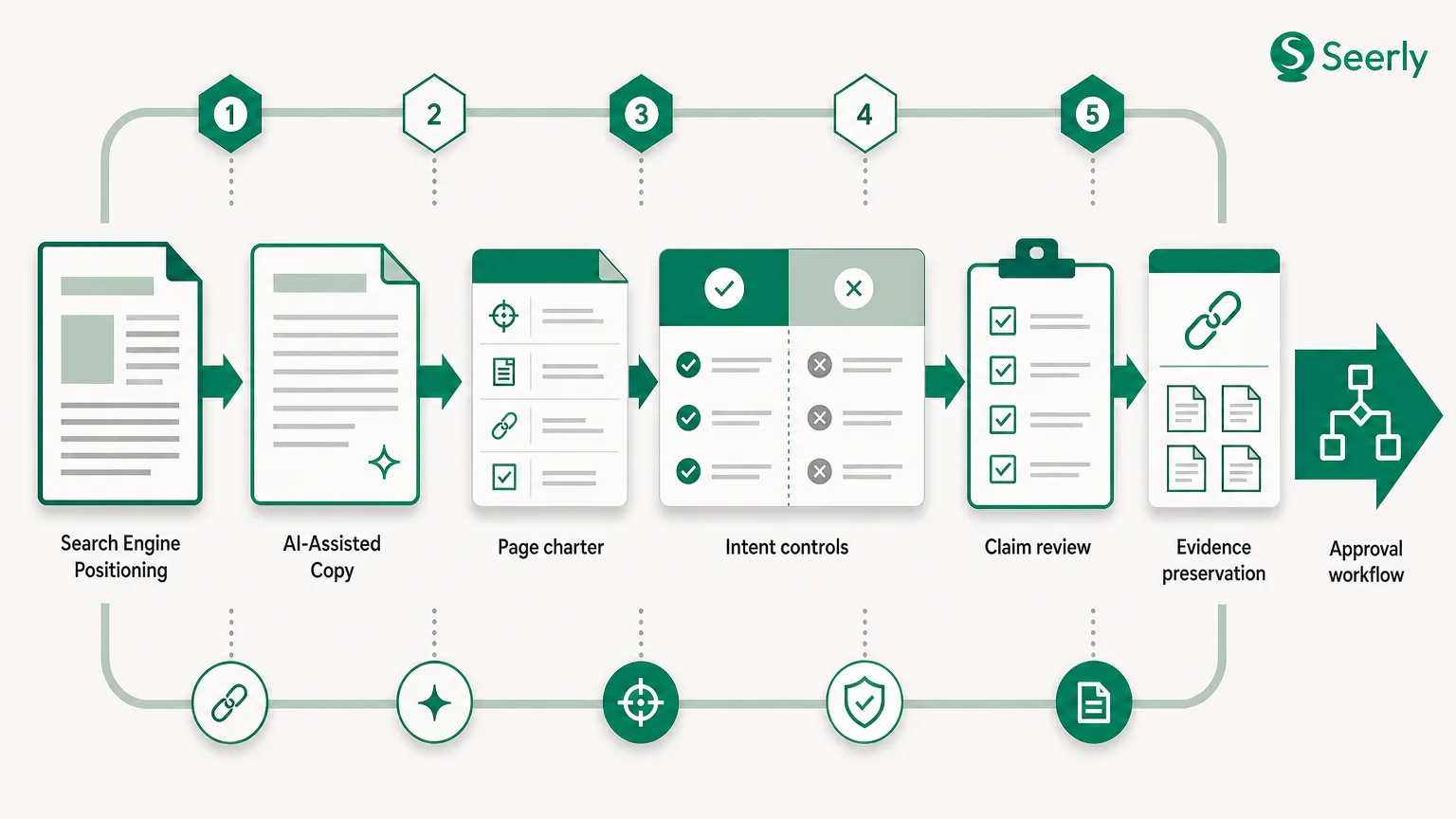
Content changes: Log the page, edit date, and hypothesis. State which observation the change addresses. Keep enough version history to reconstruct what happened.
-
Leadership-ready reporting: Explain the finding and the decision it supports. Include uncertainty and the next review date. A screenshot belongs in the evidence appendix, not in place of an argument.
Keep three measurement layers distinct. Activity metrics count work, such as pages edited or prompts tested; visibility metrics describe observed answers, including mentions or citation frequency within a stated sample. Business-outcome indicators concern qualified visits, conversions, revenue, or measured preference.
The connection between layers needs testing. Identifiable AI referrals can be followed through analytics and CRM records where tracking permits, but they capture only observable journeys. Buyer surveys or preference research can add context, though exposure and later brand searches don’t establish incremental impact on their own.
How can an agency or in-house team establish a credible baseline?
Start with a question that affects a purchase decision, such as whether a service meets a buyer’s security requirements. A vague prompt like “best software” might produce plenty of names without explaining what the team should change. The baseline should help settle decisions, not fill a chart.
Treat the following 30 days as a setup period. It’s enough time to establish a method and a first review, not a promise that revenue effects will appear. For agencies, agree on the evidence rules with the client before collection starts.
-
Days 1-4: Select priority prompts. Gather questions from customer interviews, site search, or sales discussions. Choose a manageable panel that covers discovery and evaluation, then document the business reason for each prompt. Avoid suggesting that this panel represents every possible buyer query.
-
Days 5-9: Capture initial answers. Run the panel across selected surfaces and save complete responses with their cited sources. Repeat observations under documented conditions, recording dates and access methods. Keep screenshots as supporting evidence, but retain searchable text for review.
-
Days 10-13: Set evidence standards. Agree on what counts as a mention, recommendation, factual error, and supporting citation. Have another reviewer check a sample so disagreements surface early. Document how the team handles ambiguous answers instead of forcing them into tidy categories.
-
Days 14-18: Document competitor context. Review competitors within the same collected answers. Examine which sources support their inclusion and whether the comparison addresses the buyer’s task. Record observations separately from hypotheses about why those answers appeared.
-
Days 19-23: Assign owners. Give content changes an owner and route factual disputes to the right product expert. Assign analytics responsibility for referral and conversion checks. For an agency engagement, name the client approver who can authorize corrections.
-
Days 24-30: Set the review cadence. Produce a baseline report that states coverage and limitations. Agree on the next collection date and one decision the next review should address. Leave room to conclude that the evidence is insufficient.
An anonymized decision-record example
The following is hypothetical, not a customer case study or a reported result. A B2B software team has scattered notes suggesting that some AI answers describe a security feature as available only on an enterprise plan. Its current product page says the feature is available more broadly, while an older help article retains the restriction.
Instead of announcing a visibility problem, the team creates a decision record. The record turns an ambiguous observation into a bounded investigation. No improvement is assumed.
| Record field | Illustrative entry |
|---|---|
| Buying task | Check security-feature availability before shortlisting |
| Evidence to retain | Complete answers, prompt wording, collection conditions, and cited URLs |
| Hypothesis | Conflicting public documentation may contribute to inaccurate descriptions |
| Proposed action | Verify the product fact, then correct contradictory documentation |
| Owner | Content lead, with product approval |
| Review condition | Repeat the same prompt panel after publication and compare factual accuracy |
| Business check | Review relevant referrals and qualification data without claiming causality |
If later answers become more accurate, the team has evidence of a change within the monitored sample. It still hasn’t proved that the edit caused more sales. That boundary is useful, even when it makes the presentation less dramatic.
What should leaders fund at the next maturity stage?
A team with unclear prompts doesn’t need a larger reporting contract yet. It needs a better account of the questions its buyers ask. Funding the next missing capability usually makes more sense than buying the largest available feature set.
Use the matrix below to connect a gap to a specific investment. Ask the budget owner what evidence would justify continuing that expense. If nobody can answer, pause before adding more tooling.
| Current gap | Most appropriate next investment | Evidence expected at review | |---|---| | Unclear prompts | Customer research and prompt-panel design | Questions mapped to documented buying tasks | | No source evidence | Answer capture and citation archiving | Reconstructable records with source context | | Inconsistent content claims | Product-fact review and content governance | Approved claims and corrected contradictions | | Limited reporting | Analyst capacity and reporting design | Decisions linked to findings and uncertainty | | No cross-provider comparison | Broader coverage with consistent collection rules | Separate, comparable results by surface | | Visibility without business context | Analytics and CRM measurement support | Observable referral outcomes with attribution limits |
At the content stage, Seerly’s practical guide to content changes for AI search can support the editing discussion. But monitoring software doesn’t replace product approval, and a content guide doesn’t replace measurement. Match the resource to the gap.
The thing is, more data can become a whole lot of noise when nobody owns the decision. I prefer a narrow program with a clear review rule over a sprawling dashboard that inspires no action. What would you stop doing if the next review showed no useful progress?
Frequently asked questions
Does publishing AI-oriented content count as adoption?
It counts as activity and may place a team at the isolated-experiments stage. Accountable adoption also needs repeatable evidence and an owner who acts on it. Publishing volume alone cannot establish maturity.
Must a mature program prove direct AI-search revenue?
No, but it must distinguish measured outcomes from inferred influence. Track attributable visits and downstream outcomes where possible, then state what the measurement misses. Strong governance includes admitting when the evidence cannot support a revenue claim.
Should GEO replace an established SEO program?
Not on the strength of an adoption statistic. Review shared content work and channel-specific evidence before reallocating resources. Preserve productive search activity while testing what AI-search work contributes.
Can a small team reach the highest stage?
Yes, within a clearly bounded scope. A modest prompt panel with reliable records can support sound decisions without an elaborate department. The limit is decision quality, not dashboard size.
Set one milestone before adding more initiatives
Score your generative engine optimization adoption against the five stages, using evidence your team can reproduce. Identify the first missing capability, then set one review milestone before approving another AI-search initiative. Make the milestone a decision about what to continue, change, or stop.
An adoption claim should survive the question, “What do we know now that changes our next investment?” If the answer is only that you’ve published more content, keep building the measurement program. Learn more about Seerly’s approach to measurable AI-search visibility.